
UPSC Mapping
- Prelims: Agriculture & Governance
- Mains: GS Paper 3 (Agriculture) & GS Paper 2 (Governance)
| Established | Key Objective |
|---|---|
| 1984 | Promote horticulture production & marketing |
Article
What is Horticulture Subsidy Scheme?
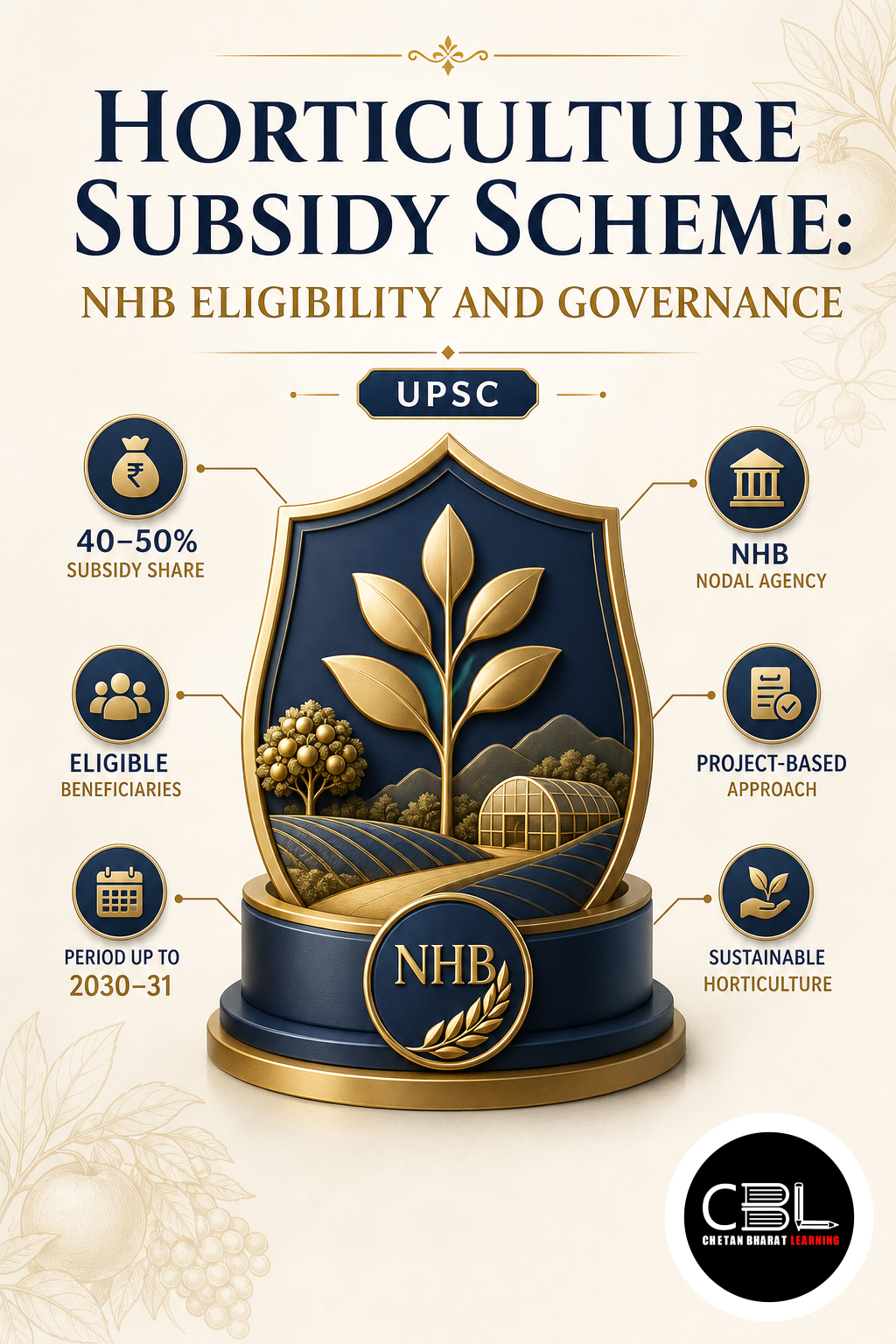
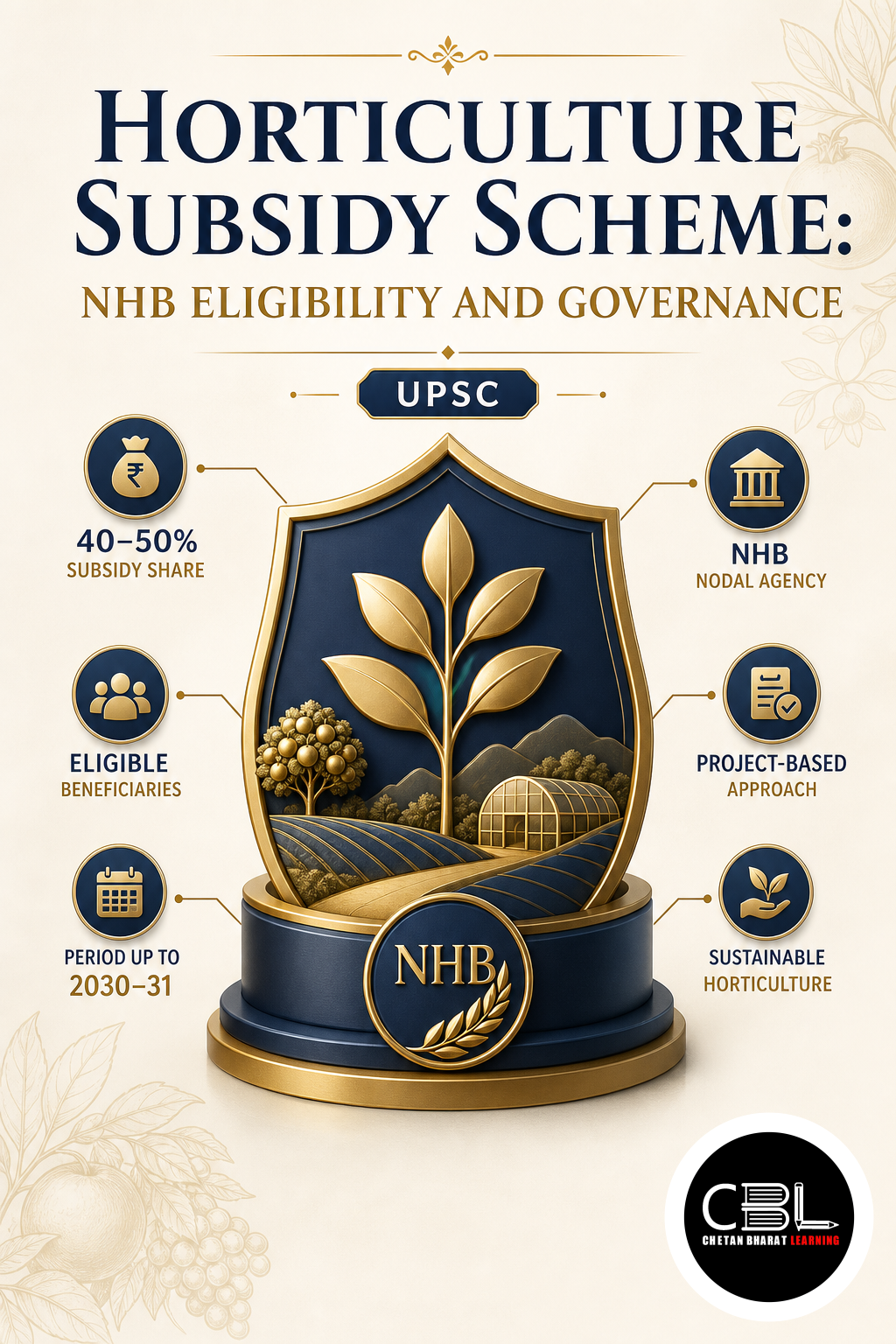
Horticulture Subsidy Scheme refers to the financial assistance provided by the National Horticulture Board to promote horticulture crops, including fruits, vegetables, flowers, and spices. The NHB provides subsidies for production, storage, processing, and marketing. The new eligibility restrictions aim to ensure that subsidies reach genuine beneficiaries and prevent misuse by politically connected persons.
Agricultural subsidies are justified by high initial investment, market risks, positive externalities, and the need for structural transformation. Subsidies help correct market failures and support developmental objectives. However, they must be targeted, transparent, and time-bound to be effective.
Why is Horticulture Subsidy Scheme in News?
Horticulture Subsidy Scheme is in the news because the NHB has introduced new eligibility restrictions to prevent politically connected individuals from benefiting. This is part of a broader effort to improve the targeting of public money and prevent conflict of interest.
The scheme is under the Ministry of Agriculture & Farmers Welfare and covers production, storage, processing, and marketing of horticulture crops.
Key Features of Horticulture Subsidy Scheme
- NHB Role: The National Horticulture Board implements the scheme.
- Eligibility Restrictions: New rules prevent politically connected persons from benefiting.
- Coverage: Production, storage, processing, and marketing of horticulture crops.
- Rationale: Corrects market failures and supports structural transformation.
- Governance: Emphasises targeting, transparency, and accountability.
Challenges in Horticulture Subsidy Scheme
- Targeting: Ensuring subsidies reach genuine beneficiaries is difficult.
- Conflict of Interest: Politically connected individuals may exploit the scheme.
- Leakages: Subsidies may be diverted or misused.
- Impact Measurement: Evaluating the effectiveness of subsidies is complex.
- Fiscal Burden: Subsidies can strain the government’s budget.
Way Forward for Horticulture Subsidy Scheme
To improve Horticulture Subsidy Scheme, the government should strengthen verification mechanisms, use digital monitoring (DBT, geo-tagging), and prevent conflict of interest through clear exclusion rules. Outcome-based subsidies and periodic reviews can ensure effectiveness. The focus should shift from ‘more subsidy’ to ‘better-designed subsidy’—targeted, transparent, and capable of creating durable productive capacity.
Combining subsidies with market reforms can enhance their impact. For international best practices, refer to the FAO.
Prelims Practice Corner
Q1. Which body administers the horticulture subsidy scheme?
- (a) Ministry of Agriculture
- (b) National Horticulture Board
- (c) NABARD
- (d) FCI
Answer: (b) The NHB administers the scheme.
Q2. When was the National Horticulture Board established?
- (a) 1970
- (b) 1984
- (c) 1995
- (d) 2001
Answer: (b) The NHB was established in 1984.
Q3. What is the rationale for agricultural subsidies?
- (a) To increase imports
- (b) To correct market failures and support structural transformation
- (c) To reduce production
- (d) To increase food prices
Answer: (b) Subsidies correct market failures and support development.
Q4. What is a key challenge in subsidy schemes?
- (a) High utilisation
- (b) Targeting and preventing misuse
- (c) Low demand
- (d) Surplus production
Answer: (b) Targeting genuine beneficiaries and preventing misuse are key challenges.
Q5. What is the focus of the new eligibility restrictions?
- (a) Increase subsidies
- (b) Prevent politically connected persons from benefiting
- (c) Expand coverage to all crops
- (d) Reduce spending
Answer: (b) The restrictions aim to prevent politically connected individuals from benefiting.
Mains Practice Questions
Q1. Discuss the challenges in targeting agricultural subsidies in India and suggest measures to improve their effectiveness. (250 words, 15 marks)
Answer Structure:
- Intro: Introduce the horticulture subsidy scheme and its objectives.
- Body: Discuss the rationale for subsidies, targeting challenges, and conflict-of-interest risks. Suggest measures: digital monitoring, outcome-based subsidies, and periodic reviews.
- Conclusion: Emphasise the need for better-designed subsidies that create durable productive capacity.
Q2. What is the role of the National Horticulture Board in promoting horticulture in India? (150 words, 10 marks)
Answer Structure:
- Intro: Define the NHB.
- Body: Explain its role in production, storage, processing, and marketing of horticulture crops, and its subsidy schemes.
- Conclusion: Conclude that the NHB is crucial for horticulture development.
FAQs on Horticulture Subsidy Scheme
- What is the National Horticulture Board?
- It is an agency under the Ministry of Agriculture promoting horticulture development.
- Why are subsidies given for horticulture?
- To correct market failures, support high initial investment, and promote structural transformation.
- What are the new eligibility restrictions?
- They aim to prevent politically connected persons from benefiting from the scheme.
Related Current Affairs
Preparing for UPSC, PCS or HCS?
Talk to a mentor at Chetan Bharat Learning, Chandigarh. Free guidance on choosing the right exam and building a study plan.
Chat on WhatsAppCall 97793 53345UPSC / IAS / PCS coaching in Chandigarh · Trusted by aspirants across Punjab & Haryana
Leave a Reply
You must be logged in to post a comment.