
UPSC Mapping
| Prelims | Environment & Health |
|---|---|
| Mains | GS Paper 3 (Environment & Public Health) |
Article
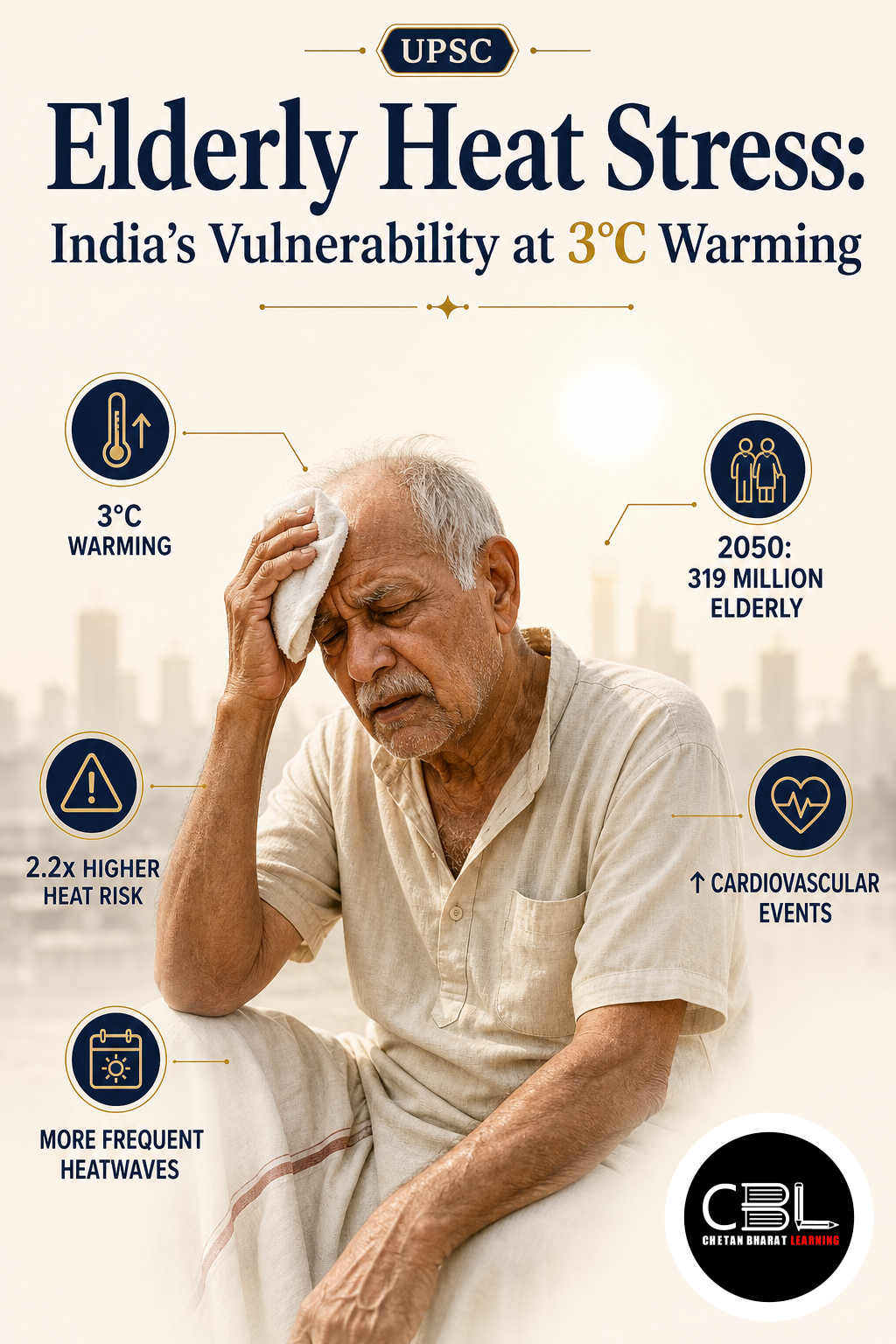
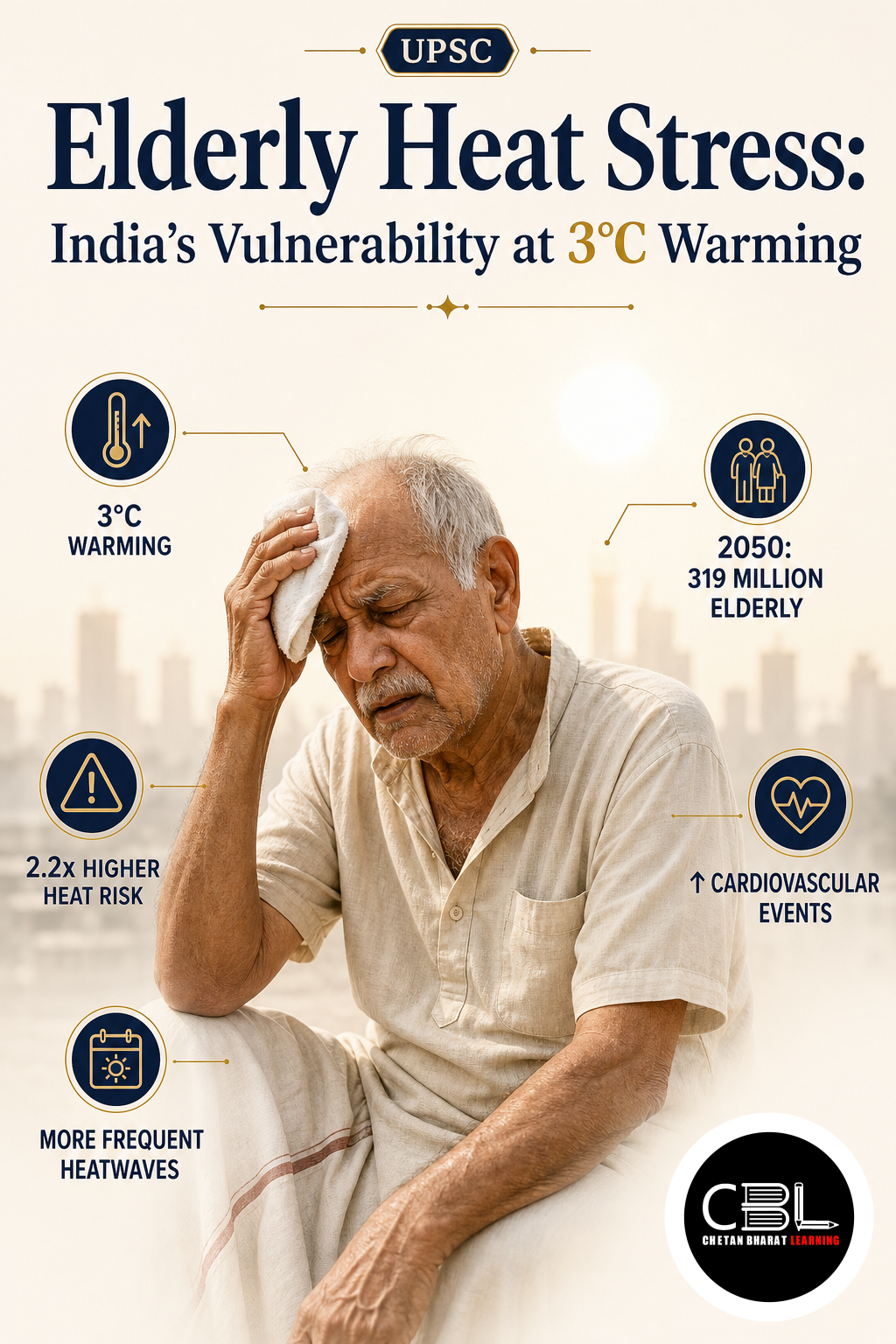
Elderly Heat Stress in India is a growing concern, with a new Lancet Planetary Health study estimating that at 3°C of global warming, more than 80% of India’s older adults could experience at least 180 hours of intolerable heat a year. In Delhi and the Indo-Gangetic Plain, this could rise to over 2,000 hours.
Quick Facts
| Elderly Affected (3°C) | 80%+ |
|---|---|
| Delhi (1.5°C) | ~1,000 hours/year |
| Delhi (3°C) | 2,000+ hours/year |
What is Elderly Heat Stress?
Elderly Heat Stress refers to the physiological strain on older adults caused by exposure to extreme heat and humidity. The Lancet Planetary Health study estimates that at 3°C of global warming, more than 80% of India’s older adults could face at least 180 hours of intolerable heat annually. In Delhi and the Indo-Gangetic Plain, older adults may experience close to or over 1,000 hours at 1.5°C (expected around 2030), rising to over 2,000 hours at 3°C.
Older people face serious health risks from heat at lower temperatures than younger adults because they sweat less, their blood vessels respond more slowly, and their hearts work harder in the heat. The study found that previous estimates may have underestimated the number of people at risk by at least two‐fold.
Why is Elderly Heat Stress in News?
Elderly Heat Stress is in the news following the publication of the Lancet Planetary Health study, which highlights India’s extreme vulnerability. The study warns that South Asia is among the most vulnerable regions, combining large population exposure and high poverty rates, which limit the capacity to adapt.
The study’s findings are a grave public health warning, calling for urgent action to protect older adults through heat action plans, accessible cooling, and healthcare support. For more details, refer to this PIB release.
Key Features of Elderly Heat Stress
- High Vulnerability: Over 80% of India’s elderly affected at 3°C warming.
- Concentrated Exposure: Heat stress is not spread evenly; it is concentrated between May and September.
- Physiological Factors: Older adults are less able to regulate body temperature.
- Combined Hazards: Heat and humidity together are more dangerous than dry heat.
- Adaptation Limits: Poverty limits access to cooling and healthcare.
Challenges in Elderly Heat Stress
- Underestimation: Previous studies may have underestimated the risk by using data from younger adults.
- Infrastructure: Lack of accessible cooling, power outages, and inadequate healthcare.
- Poverty: Low-income elderly cannot afford air conditioning or fans.
- Awareness: Many elderly and caregivers lack awareness of heat risks.
- Policy Gaps: Heat action plans often do not specifically target the elderly. For more on public health, visit the health section.
Way Forward
To address Elderly Heat Stress, India must develop and implement targeted heat action plans that include the elderly as a priority group. Expanding access to affordable cooling (fans, coolers, ACs) and ensuring reliable power supply are critical. Healthcare systems should be equipped to handle heat‐related illnesses.
Community awareness programmes and early warning systems can help elderly and caregivers take preventive measures. Urban planning—green spaces, cool roofs, and shade—can reduce the urban heat island effect. For international best practices, refer to the WHO.
Prelims Practice Corner
-
What percentage of India’s elderly could face intolerable heat at 3°C warming?
(a) 50% (b) 60% (c) 70% (d) 80%
Answer: (d) Over 80% of older adults could face intolerable heat.
-
In which region could elderly face over 2,000 hours of heat at 3°C?
(a) Western Ghats (b) Indo-Gangetic Plain (c) Coastal Tamil Nadu (d) Himalayan foothills
Answer: (b) The Indo-Gangetic Plain, including Delhi, faces extreme heat.
-
Why are older adults more vulnerable to heat?
(a) They spend more time outdoors (b) Reduced sweating and slower blood vessel response (c) They consume more water (d) They have lower body fat
Answer: (b) Older adults have reduced sweating and slower cardiovascular response.
-
What is wet-bulb heat?
(a) Heat measured in wet conditions (b) A measure combining heat and humidity (c) Heat in rainy seasons (d) Heat in water bodies
Answer: (b) Wet-bulb heat combines temperature and humidity.
-
Which journal published the study on elderly heat stress?
(a) Nature (b) The Lancet Planetary Health (c) Science (d) BMJ
Answer: (b) The study was published in The Lancet Planetary Health.
Mains Practice Questions
-
Discuss the public health implications of the Lancet study on elderly heat stress in India and suggest policy measures to mitigate the risks. (250 words, 15 marks)
Answer Structure:
- Intro: Introduce the study and its key findings.
- Body: Discuss the vulnerability of the elderly, the role of climate change, and the health system challenges. Suggest measures: targeted heat action plans, cooling access, healthcare preparedness, and urban planning.
- Conclusion: Emphasise the need for urgent adaptation and mitigation.
-
What is the concept of ‘wet-bulb temperature’ and why is it important for understanding heat stress? (150 words, 10 marks)
Answer Structure:
- Intro: Define wet-bulb temperature.
- Body: Explain that it combines heat and humidity, reflecting the body’s ability to cool through sweating. High wet-bulb temperatures are dangerous because sweat cannot evaporate.
- Conclusion: Conclude that wet-bulb temperature is a critical metric for heat stress assessment.
FAQs on Elderly Heat Stress
- What is elderly heat stress?
- It is the physiological strain on older adults caused by exposure to extreme heat and humidity.
- Why are older adults more vulnerable?
- They have reduced sweating capacity, slower blood vessel response, and often have pre-existing health conditions.
- What can be done to protect the elderly?
- Targeted heat action plans, access to cooling, healthcare preparedness, and community awareness.
Related Current Affairs
Preparing for UPSC, PCS or HCS?
Talk to a mentor at Chetan Bharat Learning, Chandigarh. Free guidance on choosing the right exam and building a study plan.
Chat on WhatsAppCall 97793 53345UPSC / IAS / PCS coaching in Chandigarh · Trusted by aspirants across Punjab & Haryana
Leave a Reply
You must be logged in to post a comment.