
UPSC Mapping
| Exam | Topic |
|---|---|
| Prelims | Economy & Taxation |
| Mains | GS Paper 3 (Economic Development & Taxation) |
Article
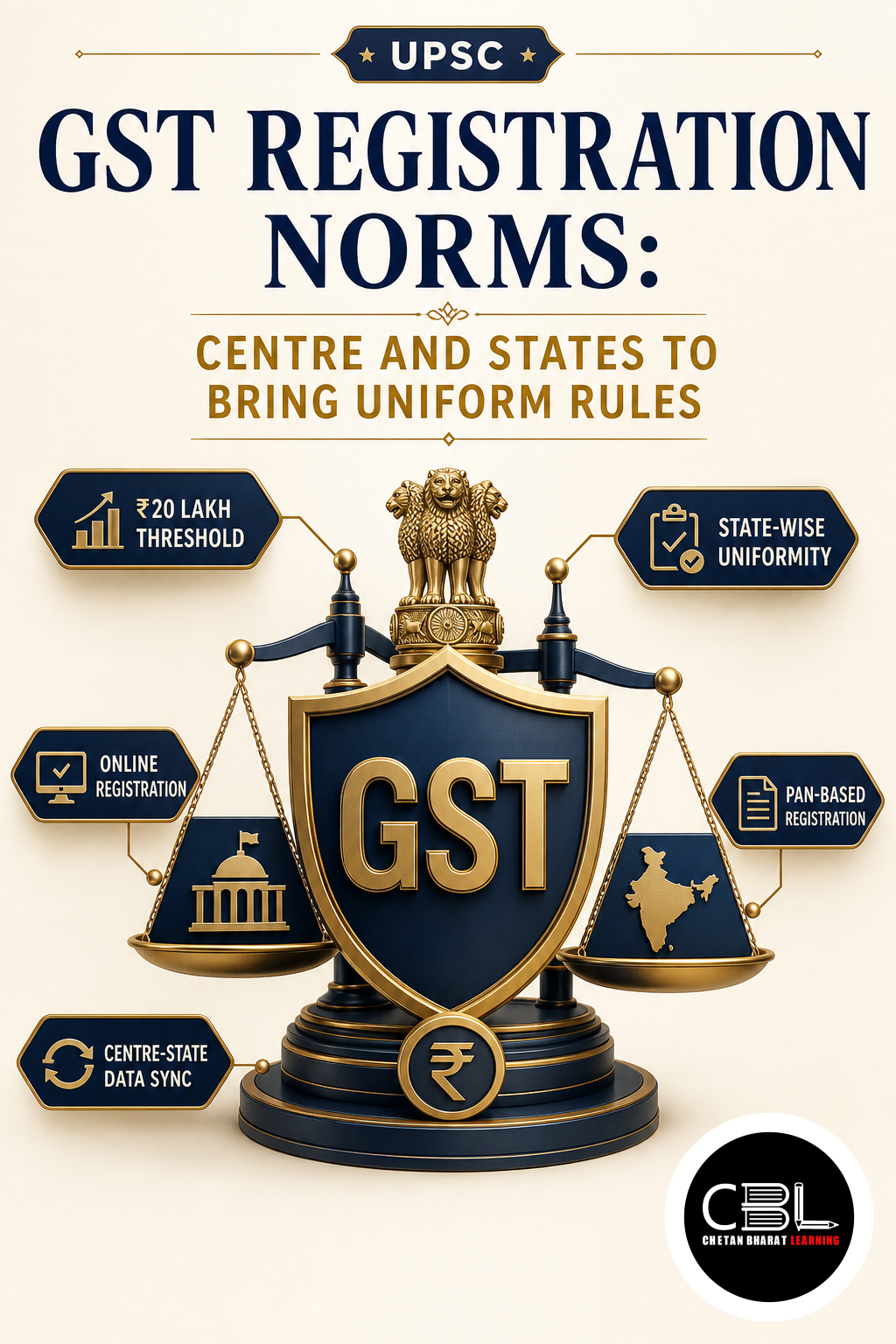
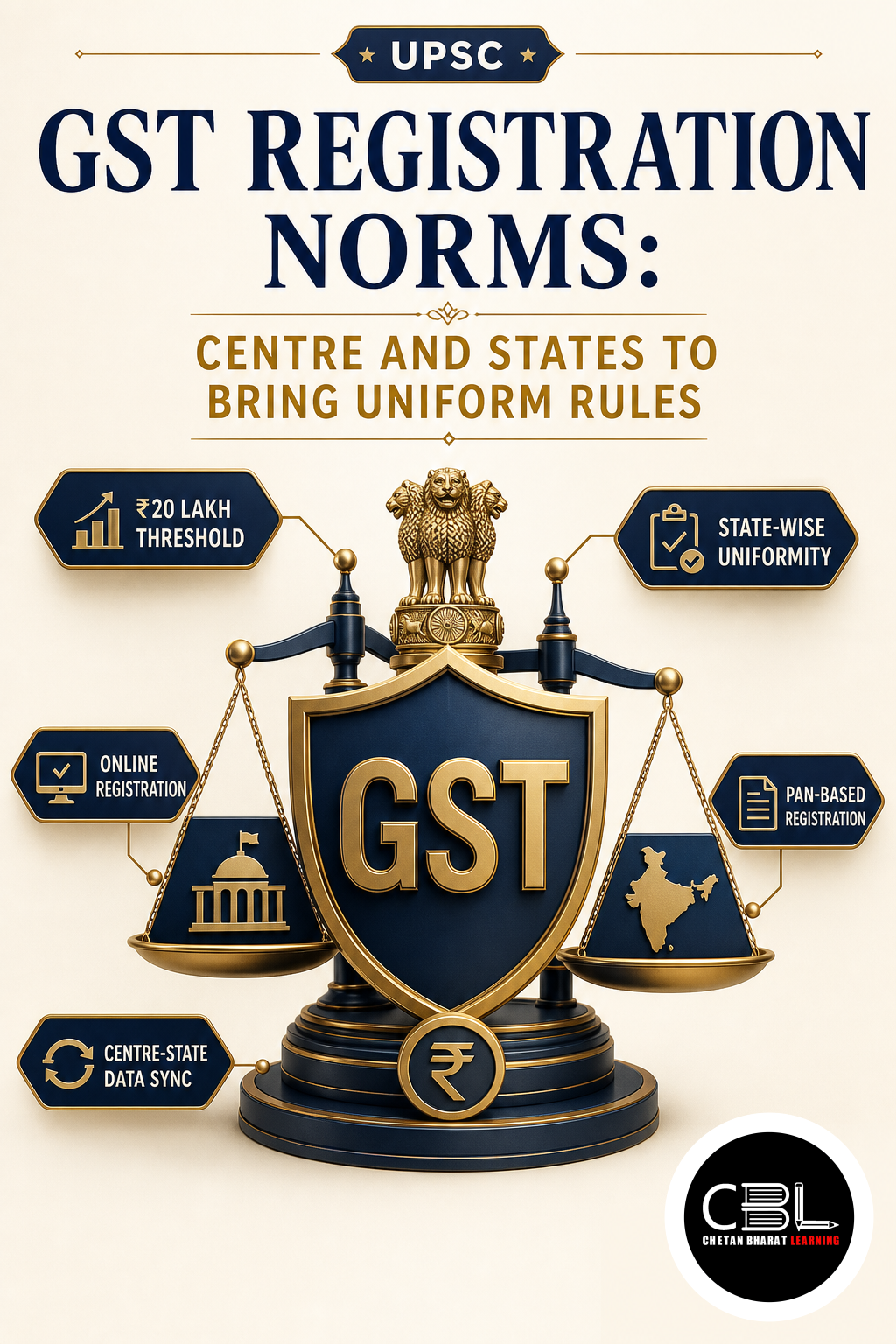
GST Registration Norms are being standardised by the Centre and state tax officers to bring uniformity in documents required for faster processing of GST registration applications for businesses that pass on tax credit of over Rs 2.5 lakh a month. The proposal will be placed before the GST Council after agreement among all states. For more such economic updates, explore the economy archive.
| Threshold | Key Body |
|---|---|
| ₹2.5 lakh/month ITC | GST Council |
What are GST Registration Norms?
GST Registration Norms are the rules and procedures for businesses to register under the Goods and Services Tax (GST) regime. Currently, there is a ‘non-uniformity’ in the procedure followed by the central GST formation and various state formations in granting registration. The proposed guidelines aim to standardise the documents required for businesses that pass on tax credit of over Rs 2.5 lakh per month.
Tax officers are also discussing automation in the process of cancellation of GST registration and streamlining the grounds on which a GST officer can cancel registration. The proposal will be placed before the GST Council, chaired by the Union Finance Minister and comprising ministers from all states and UTs.
Why are GST Registration Norms in News?
GST Registration Norms are in the news because the Centre and states are working together to eliminate the ‘non-uniformity’ in registration procedures. This is part of the government’s efforts to streamline GST administration and reduce compliance burdens for businesses. The move is expected to accelerate the registration process for large businesses that generate significant input tax credit (ITC).
The automation of registration cancellation and standardisation of grounds for cancellation are also being discussed. For more details, refer to this PIB release.
Key Features of GST Registration Norms
- Uniformity: Standardising documents required for registration across Centre and states.
- Threshold: Focus on businesses passing ITC of over Rs 2.5 lakh per month.
- Automation: Discussing automation in the cancellation process.
- Grounds for Cancellation: Streamlining reasons for cancelling registration.
- GST Council: The proposal will be placed before the Council for approval.
Challenges in GST Registration Norms
- State Variation: Different states have different procedures and interpretations.
- Compliance Burden: Small businesses may find the process cumbersome.
- Technology Adoption: Automation requires robust IT infrastructure and training.
- Fraud Prevention: Ensuring that uniform norms do not create loopholes for tax evasion.
- Timely Implementation: Coordinating across 36 states and UTs takes time. For more on tax reforms, visit the economy section.
Way Forward for GST Registration Norms
To successfully implement GST Registration Norms, the government should conduct stakeholder consultations to ensure the new guidelines are practical. Providing a clear transition period and training for tax officials is essential. The use of technology can streamline the process and reduce human discretion.
Regular reviews of the norms can help identify and rectify any issues. The GST Council should ensure that the norms are transparent and business-friendly. For international best practices, refer to the OECD.
Prelims Practice Corner
- Q1. Who chairs the GST Council?
(a) Prime Minister (b) Finance Minister (c) RBI Governor (d) Law Minister
Answer: (b) The Union Finance Minister chairs the GST Council. - Q2. For which businesses are uniform registration norms being developed?
(a) All businesses (b) Businesses with ITC over ₹2.5 lakh/month (c) Only small businesses (d) Only exporters
Answer: (b) The norms target businesses passing ITC of over ₹2.5 lakh per month. - Q3. What is the main goal of standardising GST registration?
(a) Increase tax rates (b) Reduce compliance burden and bring uniformity (c) Exempt large businesses (d) Simplify export procedures
Answer: (b) The goal is to reduce the compliance burden and bring uniformity. - Q4. What is the role of the GST Council?
(a) Implement GST (b) Recommend tax rates and rules (c) Collect taxes (d) Audit taxpayers
Answer: (b) The GST Council recommends tax rates and rules. - Q5. What is Input Tax Credit (ITC)?
(a) Tax paid on sales (b) Tax paid on purchases that can be claimed back (c) Tax refund (d) Tax exemption
Answer: (b) ITC is the tax paid on purchases that can be claimed back.
Mains Practice Questions
- Q1. Discuss the role of the GST Council in harmonising tax procedures across states, with reference to the proposed uniform registration norms. (250 words, 15 marks)
Answer Structure:
- Intro: Introduce the GST Council and the proposal for uniform registration norms.
- Body: Discuss the current non-uniformity, the proposed guidelines, and the role of the GST Council in achieving consensus. Analyse the benefits for businesses and the challenges in implementation.
- Conclusion: Emphasise the need for a collaborative approach.
- Q2. What is the GST Council and what are its key functions? (150 words, 10 marks)
Answer Structure:
- Intro: Define the GST Council.
- Body: Explain its composition (FM + state ministers), its role in recommending tax rates, rules, and procedures, and its decision-making by consensus.
- Conclusion: Conclude that the Council is the key decision-making body for GST.
FAQs on GST Registration Norms
What is the GST Council?
It is the constitutional body that recommends GST tax rates, rules, and procedures.
Why are uniform registration norms needed?
To eliminate the current ‘non-uniformity’ in procedures across states and reduce compliance burdens.
What is the threshold for the new norms?
The norms apply to businesses that pass on input tax credit of over ₹2.5 lakh per month.
Related Current Affairs
Preparing for UPSC, PCS or HCS?
Talk to a mentor at Chetan Bharat Learning, Chandigarh. Free guidance on choosing the right exam and building a study plan.
Chat on WhatsAppCall 97793 53345UPSC / IAS / PCS coaching in Chandigarh · Trusted by aspirants across Punjab & Haryana
Leave a Reply
You must be logged in to post a comment.