

UPSC Mapping
| Prelims | Mains |
|---|---|
| Environment & Biodiversity | GS Paper 3 (Environment & Ecology) |
Article
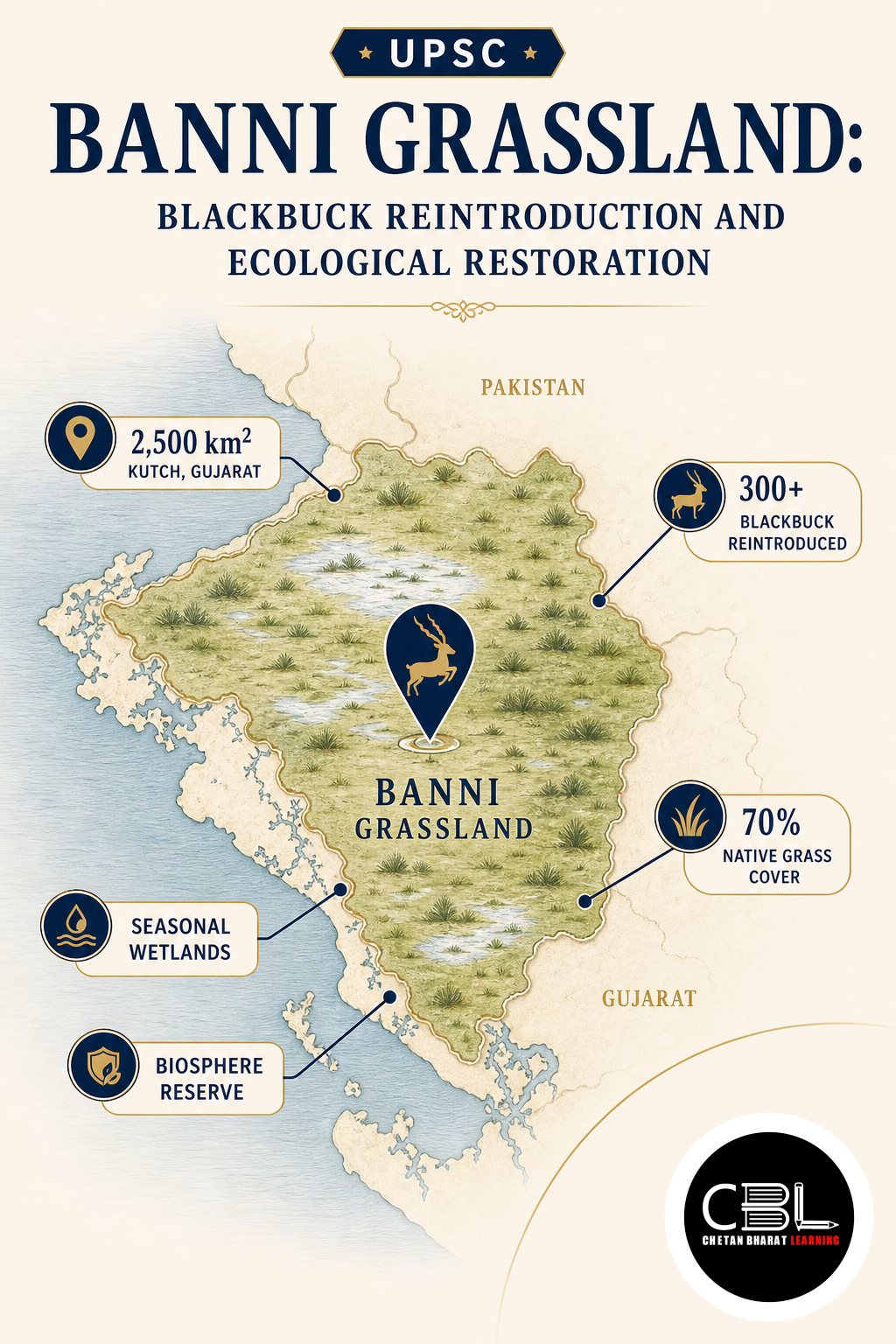
Banni Grassland in Gujarat’s Kutch region has seen the release of 20 blackbucks to rebuild the native herbivore community and strengthen ecological processes. The Banni Grassland is one of Asia’s largest natural grassland ecosystems, traditionally inhabited by pastoral communities such as the Maldhari, Halaypotra, Hingora, Hingorja, and Mutwa. For more such environment updates, explore the environment archive.
The grassland faces ecological threats from Prosopis juliflora, an invasive species that has significantly altered parts of the ecosystem. The recent release of 20 blackbucks aims to rebuild the native herbivore community and strengthen ecological processes, contributing to the restoration of the grassland’s ecological balance.
Quick Facts
| Location | Kutch, Gujarat |
|---|---|
| Key Species | Banni buffalo, Kharai camel, Kankrej cattle |
| Threat | Prosopis juliflora (invasive) |
What is Banni Grassland?
Banni Grassland is one of Asia’s largest natural grassland ecosystems, located in the Kutch region of Gujarat. It is traditionally inhabited by pastoral communities such as the Maldhari, Halaypotra, Hingora, Hingorja, and Mutwa, whose livelihoods depend largely on livestock rearing. The region is known for unique livestock breeds including Banni buffaloes (nocturnal grazers), Kharai camel, and Kankrej cattle.
The grassland faces threats from the invasive tree Prosopis juliflora, which has altered native grass communities. The blackbuck reintroduction aims to restore natural grazing regimes and enhance biodiversity in the ecosystem.
Why is Banni Grassland in News?
Gujarat has released 20 blackbucks into Banni Grassland as part of a conservation effort to rebuild the native herbivore community and restore ecological balance. The invasive Prosopis juliflora has displaced native grasses and impacted pastoral livelihoods. The reintroduction of blackbucks is expected to improve grazing patterns and ecosystem health. (PIB release)
Key Features of Banni Grassland
- Location: Kutch region of Gujarat
- Ecosystem: One of Asia’s largest natural grasslands
- Pastoral Communities: Maldhari, Halaypotra, Hingora, Hingorja, Mutwa
- Unique Livestock: Banni buffalo, Kharai camel, Kankrej cattle
- Ecological Threat: Invasive Prosopis juliflora
Challenges in Banni Grassland
- Invasive Species: Prosopis juliflora alters ecosystem dynamics
- Livelihood Pressures: Climate change and land-use shifts affect pastoralists
- Habitat Degradation: Overgrazing and encroachment
- Conservation Balance: Aligning restoration with community needs
- Water Scarcity: Arid conditions limit resources
Way Forward for Banni Grassland
An integrated approach is needed: control invasive species mechanically and biologically, promote sustainable grazing, and involve pastoral communities in decision-making. Monitoring the blackbuck population and restoring native grasses will enhance ecosystem resilience. Improving water availability and alternative livelihoods for pastoralists will reduce pressure on grassland resources. (IUCN)
Prelims Practice Corner
Q1. Where is Banni Grassland located?
(a) Rajasthan (b) Gujarat (c) Maharashtra (d) Madhya Pradesh
Answer: (b) Banni Grassland is in Gujarat’s Kutch region.
Q2. Which invasive species threatens Banni Grassland?
(a) Parthenium (b) Prosopis juliflora (c) Lantana camara (d) Water hyacinth
Answer: (b) Prosopis juliflora is the invasive species.
Q3. Which animal was reintroduced into Banni Grassland?
(a) Cheetah (b) Blackbuck (c) Lion (d) Wild ass
Answer: (b) Twenty blackbucks were released.
Q4. Which pastoral community inhabits Banni Grassland?
(a) Bhil (b) Maldhari (c) Gond (d) Santhal
Answer: (b) The Maldhari community is traditionally associated with Banni.
Q5. What is the purpose of blackbuck reintroduction?
(a) Tourism (b) Rebuilding native herbivore community (c) Hunting (d) Research
Answer: (b) The reintroduction aims to restore ecological processes.
Mains Practice Questions
-
Q1. Discuss the ecological significance of grasslands like Banni and the challenges they face from invasive species and human activities. (250 words, 15 marks)
Intro: Introduce Banni Grassland and its significance.
Body: Discuss the ecological role of grasslands, the threat from Prosopis juliflora, and the impact on pastoral communities. Evaluate the blackbuck reintroduction and suggest restoration measures.
Conclusion: Emphasise the need for an integrated conservation approach.
-
Q2. What is the role of pastoral communities in maintaining grassland ecosystems? (150 words, 10 marks)
Intro: Highlight the traditional role of pastoralists.
Body: Explain how communities like the Maldhari co-evolved with grasslands, maintaining biodiversity through sustainable grazing. Their traditional knowledge is valuable for conservation.
Conclusion: Conclude that pastoral communities are integral to grassland conservation.
FAQs on Banni Grassland
What is Banni Grassland?
It is one of Asia’s largest natural grassland ecosystems, located in Gujarat’s Kutch region.
What are the unique livestock breeds of Banni?
Banni buffalo, Kharai camel, and Kankrej cattle.
What is the main ecological threat?
The invasive species Prosopis juliflora.
Related Current Affairs
Preparing for UPSC, PCS or HCS?
Talk to a mentor at Chetan Bharat Learning, Chandigarh. Free guidance on choosing the right exam and building a study plan.
Chat on WhatsAppCall 97793 53345UPSC / IAS / PCS coaching in Chandigarh · Trusted by aspirants across Punjab & Haryana
Leave a Reply
You must be logged in to post a comment.