
UPSC Mapping
| Prelims | Polity & Education |
|---|---|
| Mains | GS Paper 2 (Polity & Education) |
| Policy Implementation | From 2026-27 |
|---|---|
| Key Debate | English as ‘non-native’ vs ‘indigenous’ |
Article
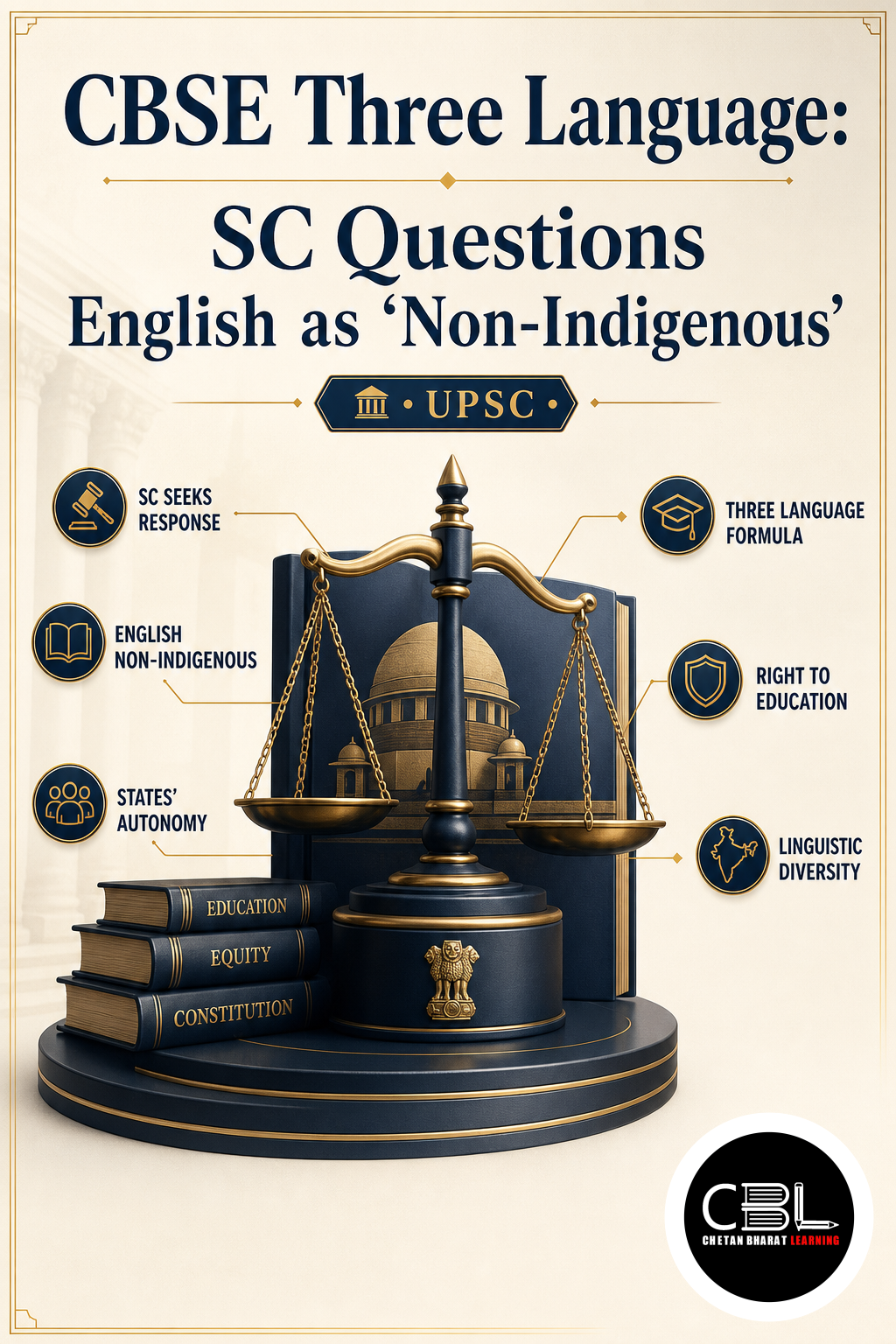
CBSE Three Language policy has come under Supreme Court scrutiny, with the bench questioning whether English can be treated as a ‘non-indigenous’ language given its deep roots in Indian society. The Court is examining the constitutionality of the CBSE’s decision to implement the three-language formula under the National Education Policy (NEP) from 2026-27.
What is the CBSE Three Language Policy?
The CBSE Three Language policy, introduced under the National Education Policy (NEP) 2020, requires students in Class 9 to study three languages, with at least two being ‘Bharatiya Bhashas’ (Indian languages). A ‘non-native’ language—such as English, French, or German—can be taken as the third language only if the other two are Indian languages.
Why is CBSE Three Language in News?
The Supreme Court is examining whether English can be classified as ‘non-indigenous’, given its deep roots and official status under the Constitution. Petitioners argue that infrastructure and teacher shortages make the policy difficult to implement, and the Court has suggested a reprieve for current Class 6 students.
Key Features of CBSE Three Language
- Three Languages: Students must study three languages in school.
- Bharatiya Bhashas: At least two must be Indian languages (Hindi, Sanskrit, Tamil, Telugu, etc.).
- Third Language: A ‘non-native’ language can be the third if the other two are Indian languages.
- Constitutional Question: Whether English can be classified as ‘non-indigenous’.
- Implementation Challenges: Infrastructure, teacher availability, and student demand.
Challenges in CBSE Three Language
- Infrastructure: Lack of trained teachers and resources for 23 language options.
- Teacher Availability: Many Sanskrit teachers lack required qualifications.
- Student Burden: Additional language studies may increase academic pressure.
- Constitutional Classification: Debate over English’s status as ‘indigenous’ or ‘foreign’.
- Unequal Capacities: CBSE and State Board schools differ in implementation capabilities.
Way Forward for CBSE Three Language
Government must provide a clear transition timeline and adequate infrastructure support, train teachers, and develop curricula. A phased implementation can ease the burden. The Supreme Court’s ruling on English’s status will set a crucial precedent.
Prelims Practice Corner
- Q1. What is the key requirement of the CBSE Three Language policy? (a) Only two languages (b) Three languages with at least two Bharatiya Bhashas (c) Only English and Hindi (d) Any three languages
Answer: (b) At least two must be Indian languages. - Q2. Which language is at the centre of the constitutional debate? (a) Hindi (b) Sanskrit (c) English (d) Tamil
Answer: (c) English’s classification as ‘non-indigenous’ is being questioned. - Q3. Under which Article does the Constitution deal with official languages? (a) Article 343 (b) Article 344 (c) Article 345 (d) All of the above
Answer: (d) Articles 343–351 deal with official language. - Q4. How many languages are in the Eighth Schedule? (a) 18 (b) 22 (c) 24 (d) 26
Answer: (b) There are 22 constitutionally recognised languages. - Q5. Which court is hearing the challenge to the three-language policy? (a) Delhi High Court (b) Supreme Court (c) Madras High Court (d) Allahabad High Court
Answer: (b) The Supreme Court is hearing the petitions.
Mains Practice Questions
- Q1. Discuss the constitutional and practical challenges in implementing the three-language policy in India, with reference to the CBSE framework and NEP 2020. (250 words, 15 marks)
Answer Structure: Intro: Policy overview and SC scrutiny. Body: Constitutional framework, classification of English, infrastructure and phased implementation. Conclusion: Need for coherence and feasibility. - Q2. What is the distinction between ‘official language’ and ‘national language’ in India? (150 words, 10 marks)
Answer Structure: Intro: No national language in India. Body: Hindi and English as Union official languages (Article 343), state official languages. Conclusion: Reflects linguistic diversity.
FAQs on CBSE Three Language
- What is the three-language policy? It requires students to study three languages, with at least two being Indian languages, as per NEP 2020.
- Why is the classification of English controversial? The SC is examining whether English, despite being an official language, can be treated as ‘non-indigenous’.
- What are the implementation challenges? Lack of trained teachers, inadequate infrastructure, and unequal capacities across schools.
Related Current Affairs
Preparing for UPSC, PCS or HCS?
Talk to a mentor at Chetan Bharat Learning, Chandigarh. Free guidance on choosing the right exam and building a study plan.
Chat on WhatsAppCall 97793 53345UPSC / IAS / PCS coaching in Chandigarh · Trusted by aspirants across Punjab & Haryana
Leave a Reply
You must be logged in to post a comment.