
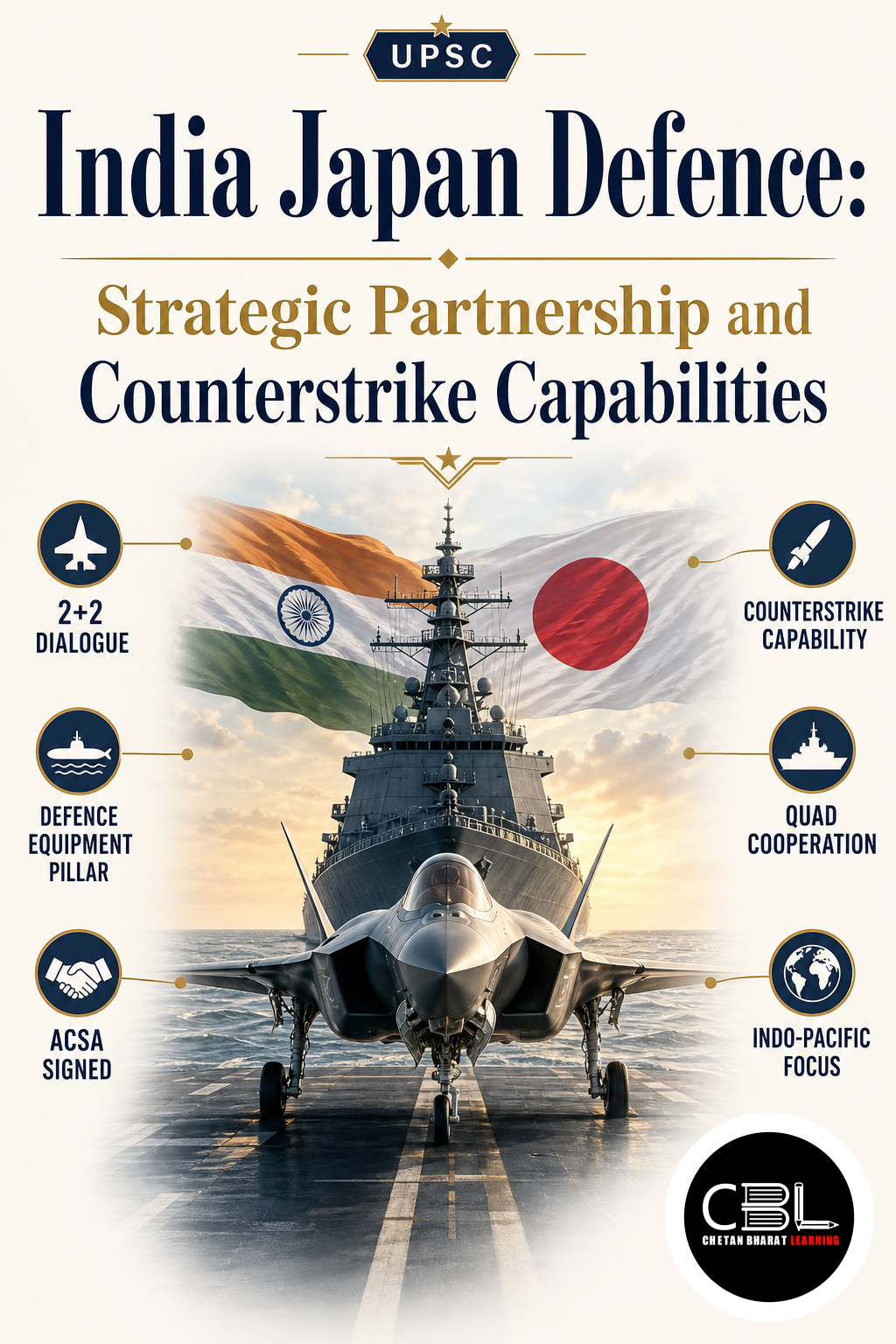

India Japan Defence partnership is at a pivotal moment as Japan’s defence policy undergoes a historic transformation, moving from post-war restraint to a proactive security posture. Japan’s Defence Minister Shinjiro Koizumi’s visit to India highlights the need to upgrade the bilateral defence relationship amid a changing Asia. For more such international relations updates, explore the international relations archive.
What is India Japan Defence Partnership?
India Japan Defence partnership is a strategic relationship aimed at deepening security cooperation in the Indo-Pacific. Japan is transforming its defence posture, moving from a restrained, US-dependent model to a more proactive military power with long-range strike capabilities, strengthened air and missile defence, and expanded cyber and space capabilities.
Japan’s defence spending is rising to around 2% of GDP, with a revitalised defence industrial base, eased arms export restrictions, and a new Official Security Assistance programme. The partnership with India includes a 2+2 dialogue, a logistics agreement, regular tri-service exercises, and a first bilateral defence co-development project on the UNICORN naval communications antenna.
Why is India Japan Defence in News?
India Japan Defence is in the news because Japan’s Defence Minister Koizumi’s visit to India after consultations in Canberra signals new directions in Indo-Pacific security cooperation. Japan’s 2022 National Security Strategy explicitly identifies China, North Korea, and Russia as security challenges—a historic departure from its traditional posture.
The visit is expected to push bilateral defence cooperation beyond “incremental” towards “operational and technological weight.” However, defence industrial cooperation has been painfully slow, and experts argue that India must match Japan’s commitment and urgency. For more details, refer to this PIB release.
Key Features of India Japan Defence
India Japan Defence has several distinctive features:
- Strategic Convergence: Both countries confront China’s military rise and share concerns about American policy volatility.
- Japan’s Transformation: Acquiring long-range counterstrike capabilities, including Tomahawk missiles, and strengthening cyber, space, and unmanned systems.
- Defence Industrial Cooperation: First co-development project (UNICORN antenna), but cooperation has been slow.
- Institutional Architecture: 2+2 dialogue, logistics agreement, and regular tri-service exercises.
- Indo-Pacific Vision: Shared commitment to a free and open Indo-Pacific.
Challenges in India Japan Defence
India Japan Defence faces several challenges:
- Slow Defence Industrial Cooperation: Joint research, development, and co-production have been limited.
- Operational Coordination: Armed forces need to move beyond exercises to greater operational coordination in anti-submarine warfare, maritime surveillance, and air defence.
- Technology Transfer: Japan’s easing of arms export restrictions must translate into tangible technology sharing with India.
- China Factor: Balancing cooperation with Japan while managing relations with China is a diplomatic challenge.
- Strategic Autonomy: India must ensure its partnership with Japan does not compromise its strategic autonomy. For more on defence cooperation, visit the international relations section.
Way Forward for India Japan Defence
To strengthen India Japan Defence, both countries must set more ambitious goals for operational coordination and defence industrial cooperation. Joint development of critical technologies—missiles, unmanned systems, cyber defence—can build strategic resilience.
India should match Japan’s commitment by streamlining defence procurement and facilitating technology transfer. Expanding maritime domain awareness and joint surveillance in the Indian Ocean and the Western Pacific is essential. The partnership should be anchored in a shared vision of a stable, secure, and prosperous Indo-Pacific. For international best practices, refer to the CSIS.
FAQs on India Japan Defence
Why is Japan changing its defence posture?
Driven by China’s military rise, North Korean missile threats, and uncertainty about US commitments.
What is the 2+2 dialogue between India and Japan?
It is a ministerial-level dialogue between foreign and defence ministers of both countries.
What is Japan’s Article 9?
It is the constitutional clause where Japan renounces war and the threat or use of force as a means of settling international disputes.
Related Current Affairs
Preparing for UPSC, PCS or HCS?
Talk to a mentor at Chetan Bharat Learning, Chandigarh. Free guidance on choosing the right exam and building a study plan.
Chat on WhatsAppCall 97793 53345UPSC / IAS / PCS coaching in Chandigarh · Trusted by aspirants across Punjab & Haryana
Leave a Reply
You must be logged in to post a comment.