

UPSC Mapping
Prelims
History & Freedom Struggle
Mains
GS Paper 1 (Modern History)
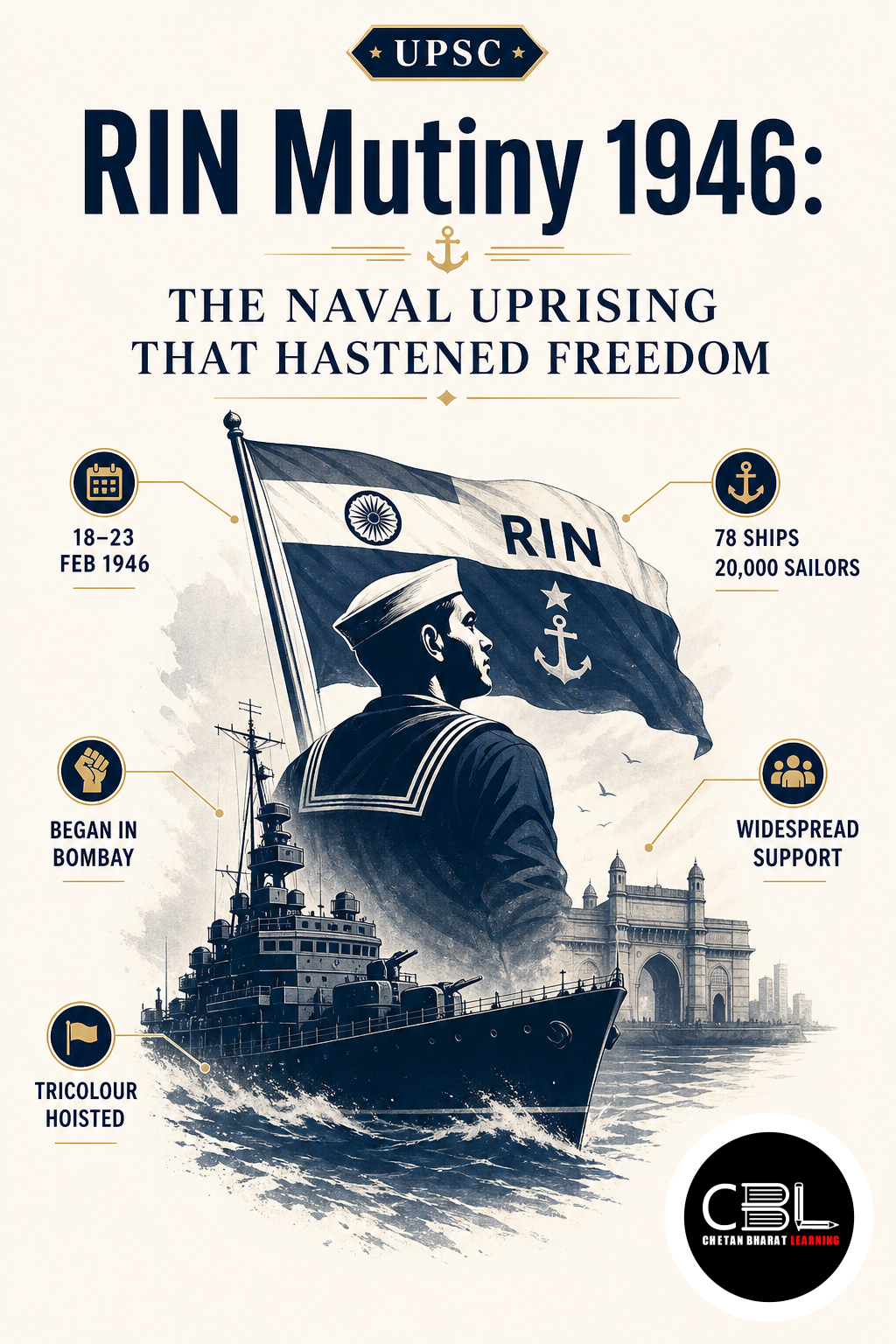
| Start Date | 18 February 1946 |
|---|---|
| Sailors Involved | 20,000+ |
| Civilian Casualties | 400–700 |
What was the RIN Mutiny 1946?
The RIN Mutiny 1946 was a revolt by Indian sailors (ratings) of the Royal Indian Navy against British rule, beginning at HMIS Talwar in Bombay. The mutiny cascaded rapidly, spreading to Karachi, Calcutta, Madras, and Visakhapatnam. The mutineers organised themselves under the Naval Central Strike Committee (NCSC), led by M.S. Khan and Madan Singh, and called themselves the ‘Indian National Navy’ and ‘Azad Hindis.’
The British responded with disproportionate force, leading to police firing on 22 February 1946, killing an estimated 400–700 people (mostly civilians) and injuring 1,500–2,000. The mutiny exposed the collapse of British authority over India’s armed forces, shattering the myth of unquestioning loyalty.
Why is RIN Mutiny 1946 in News?
The RIN Mutiny 1946 is in the news as India celebrated its 80th Independence Day, prompting a re-evaluation of the mutiny’s role in hastening Britain’s exit. Many historians regard the mutiny as pivotal in convincing the British that Indian armed forces could no longer be relied upon to enforce colonial rule.
Justice Phani Bhusan Chakravartti later recorded that Prime Minister Clement Attlee attributed Britain’s departure to the INA trials and the RIN mutiny. Despite its significance, the mutiny received limited post-independence recognition—partly because it lacked a unifying leader like Netaji, and partly because independent India’s Navy was uncomfortable memorialising a mutiny.
Key Features of RIN Mutiny 1946
- Widespread Participation: Over 20,000 sailors across 78 ships and 20 shore establishments.
- Demands: Disciplinary action against Commander King, better conditions, pay parity, and political demands like withdrawal from Indonesia and free trials for INA detainees.
- Civilian Solidarity: Nearly three lakh mill workers, dockyard staff, and students joined protests; citizens supplied food to the strikers.
- British Response: Police firing killed 400–700 civilians, injuring 1,500–2,000.
- National Leadership: Sardar Patel and Jinnah persuaded mutineers to surrender; the Communist Party fully supported the uprising.
Challenges in RIN Mutiny 1946
- Lack of Unified Leadership: Unlike the INA under Netaji, the mutiny lacked a single charismatic leader.
- Post-Mutiny Suppression: The British prosecuted many mutineers despite assurances of fair treatment.
- Limited Recognition: Independent India’s Navy was uncomfortable memorialising a mutiny, leading to its historical overshadowing.
- Communal Fears: Congress and Muslim League feared that prolonged violence could trigger communal conflict and derail Cabinet Mission talks.
- Strategic Timing: The mutiny occurred just as British were negotiating the transfer of power, complicating the political calculus.
Way Forward for RIN Mutiny 1946
To restore the RIN Mutiny 1946 to its rightful place in India’s freedom struggle, academic and public discourse should highlight its role in hastening Britain’s exit. Incorporating the mutiny into school and college curricula can educate younger generations about the naval uprising’s significance.
Memorials and commemorative events can honour the sailors who participated. Research into the mutiny’s archival records can provide a more nuanced understanding of its impact on the British decision to quit India.
Prelims Practice Corner
-
When did the RIN Mutiny 1946 begin?
- (a) 15 August 1946
- (b) 18 February 1946
- (c) 18 February 1945
- (d) 22 February 1946
Answer: (b) The mutiny began on 18 February 1946.
-
How many sailors were involved in the RIN Mutiny 1946?
- (a) 5,000
- (b) 10,000
- (c) 20,000
- (d) 30,000
Answer: (c) Over 20,000 sailors participated.
-
Where did the RIN Mutiny 1946 begin?
- (a) Karachi
- (b) Calcutta
- (c) HMIS Talwar, Bombay
- (d) Madras
Answer: (c) It began at HMIS Talwar in Bombay.
-
Who led the Naval Central Strike Committee?
- (a) Netaji Subhas Chandra Bose
- (b) M.S. Khan and Madan Singh
- (c) Sardar Patel
- (d) Jinnah
Answer: (b) M.S. Khan was President and Madan Singh Vice-President.
-
How many civilians were killed in police firing during the mutiny?
- (a) 100–200
- (b) 400–700
- (c) 1,000–1,500
- (d) 2,000–3,000
Answer: (b) An estimated 400–700 civilians were killed.
Mains Practice Questions
-
Q1. Critically examine the significance of the RIN Mutiny of 1946 in the broader context of India’s freedom struggle and Britain’s decision to quit India. (250 words, 15 marks)
Answer Structure:
- Intro: Introduce the RIN Mutiny 1946 and its timing.
- Body: Discuss causes: racial discrimination, poor conditions, INA trials. Analyse its spread and civilian solidarity. Evaluate its impact on British decision-making and its under-recognition in post-independence India.
- Conclusion: Emphasise the mutiny’s role in hastening Britain’s exit and the need for greater historical recognition.
-
Q2. What were the causes and consequences of the RIN Mutiny of 1946? (150 words, 10 marks)
Answer Structure:
- Intro: Frame the mutiny as a reaction to colonial injustice.
- Body: Discuss causes: wartime expansion and contraction, racism, poor conditions, INA trials. Consequences: British realisation of military unreliability, acceleration of Cabinet Mission talks, and historical under-recognition.
- Conclusion: Conclude that the mutiny was a decisive catalyst for freedom.
FAQs on RIN Mutiny 1946
- What was the RIN Mutiny of 1946?
- It was a naval uprising by Indian ratings against British rule, beginning at HMIS Talwar in Bombay, involving over 20,000 sailors.
- Why did the RIN mutiny occur?
- Racial discrimination, poor conditions, food quality, job insecurity, and nationalist sentiment fuelled by the INA trials.
- Why is the RIN mutiny historically significant?
- It convinced the British that Indian armed forces could no longer be relied upon to enforce colonial rule, hastening their exit.
Related Current Affairs
Preparing for UPSC, PCS or HCS?
Talk to a mentor at Chetan Bharat Learning, Chandigarh. Free guidance on choosing the right exam and building a study plan.
Chat on WhatsAppCall 97793 53345UPSC / IAS / PCS coaching in Chandigarh · Trusted by aspirants across Punjab & Haryana
Leave a Reply
You must be logged in to post a comment.