

UPSC Mapping
| Prelims | Art & Culture |
|---|---|
| Mains | GS Paper 1 (Indian Heritage & Culture) |
Article
What is Cultural Heritage AI?
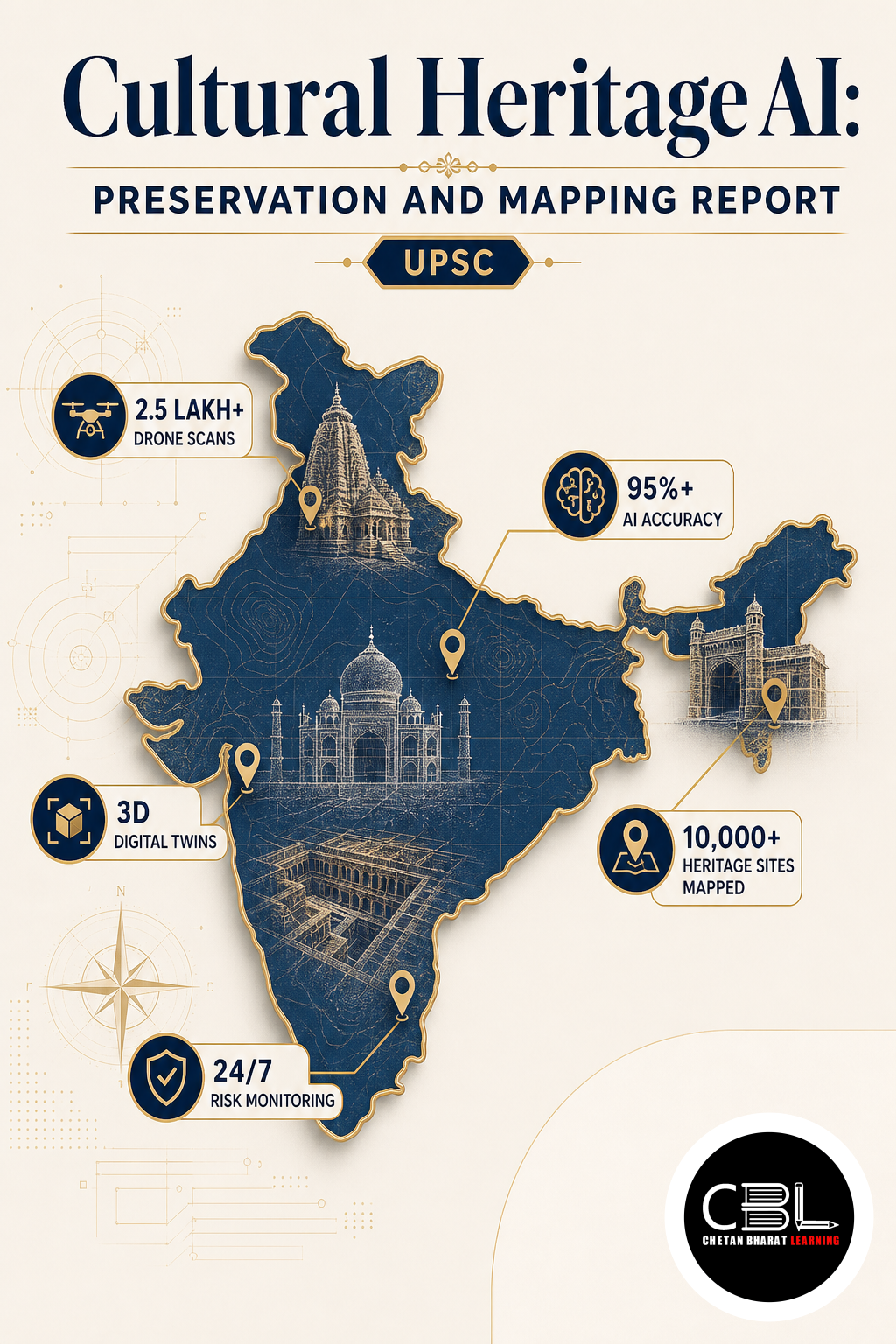
Cultural Heritage AI refers to the application of artificial intelligence and digital technologies to preserve, document, and disseminate India’s vast cultural heritage, including manuscripts, artefacts, and traditional knowledge. The committee’s report identifies critical gaps in current preservation efforts and proposes a technology-driven roadmap.
India is home to an estimated 5 million manuscripts, but many remain uncatalogued and at risk. The report recommends a complete-capture standard using multispectral recovery and carbon dating at Indian accelerator laboratories, moving beyond standard scanning that misses material properties.
Why is Cultural Heritage AI in News?
Cultural Heritage AI is in the news because the Parliamentary Standing Committee presented its 393rd report with concrete recommendations to leverage AI for heritage preservation. The report addresses concerns such as scholar deficit, custody trust, and tamper resistance, proposing innovative solutions like the Akshar Mitra citizen-science platform and federated learning for restricted collections.
The committee also recommends overlaying cultural GIS layers onto the PM Gati Shakti Master Plan and onboarding artisans onto ONDC to improve market access.
Key Features of Cultural Heritage AI Report
- Multispectral Capture: Adopt complete-capture standards using multispectral recovery and carbon dating to recover fire-fused or overwritten folios.
- Akshar Mitra Platform: Launch a citizen-science platform with contributor credit and university partnerships to address the scholar deficit.
- Federated Learning: Deploy federated learning so restricted collections train AI models without transferring images outside custody.
- Open-Access Index: Build an open-access index of figures, places, and works supporting a time-layered cultural atlas.
- Tamper-Proof Credentials: Enforce the International Image Interoperability Framework (IIIF) and embed tamper-proof credentials in every rendering.
Challenges in Cultural Heritage AI
- Standard Scanning Limitations: Traditional scanning misses material properties and cannot recover fire-fused or overwritten folios.
- Scholar Shortage: A shortage of paleography scholars bottlenecks high-volume textual curation.
- Trust Issues: Private custodians withhold texts due to weak trust in data ownership and security.
- Tampering Risks: Digital assets face unauthorised modification, tampering, and piracy on platforms.
- Market Integration: Heritage mapping runs isolated from infrastructure planning, leaving artisans off digital markets.
Way Forward for Cultural Heritage AI
To realise the vision of Cultural Heritage AI, India must invest in high-resolution digitisation infrastructure and train a new generation of digital humanists. Establishing district salvage annexes with cultural first-aid training and a deep archive on century-lasting media will protect against disasters.
Integrating heritage mapping with infrastructure planning through PM Gati Shakti and ONDC can boost artisan livelihoods. A collaborative approach involving government, academia, private custodians, and technology partners is essential.
Prelims Practice Corner
Q1. Which Parliamentary Standing Committee presented the 393rd report on cultural heritage?
- a) Committee on Education
- b) Committee on Transport, Tourism and Culture
- c) Committee on Finance
- d) Committee on Home Affairs
Answer: (b) The Department-related Parliamentary Standing Committee on Transport, Tourism and Culture presented the report.
Q2. What is the Akshar Mitra platform?
- a) A digital library
- b) A citizen-science platform for manuscript curation
- c) An AI model for translation
- d) A government portal for artisans
Answer: (b) The report recommends launching Akshar Mitra as a citizen-science platform with contributor credit.
Q3. What is federated learning in the context of cultural heritage?
- a) Centralised training of AI models
- b) Training AI models without transferring images outside custody
- c) Sharing data across institutions
- d) Public access to all manuscripts
Answer: (b) Federated learning allows restricted collections to train AI models without transferring images outside custody.
Q4. Which framework is recommended for tamper-proof credentials?
- a) PDF
- b) IIIF
- c) HTML
- d) JPEG
Answer: (b) The International Image Interoperability Framework (IIIF) is recommended.
Q5. What is the purpose of overlaying cultural GIS layers on PM Gati Shakti?
- a) To restrict tourism
- b) To integrate heritage mapping with infrastructure planning
- c) To digitise maps
- d) To promote real estate
Answer: (b) The report recommends overlaying cultural GIS layers onto the PM Gati Shakti Master Plan for integrated planning.
Mains Practice Questions
Q1. Discuss the role of AI and digital technologies in preserving India’s cultural heritage, with reference to the recommendations of the Parliamentary Standing Committee. (250 words, 15 marks)
Answer Structure
Intro: Introduce the committee’s report and its focus on AI for heritage.
Body: Discuss key recommendations: multispectral capture, Akshar Mitra, federated learning, IIIF. Analyse challenges: scholar deficit, trust, tampering. Suggest a way forward.
Conclusion: Emphasise the need for a collaborative, technology-driven approach.
Q2. What are the major challenges in preserving India’s manuscript heritage, and how can AI address them? (150 words, 10 marks)
Answer Structure
Intro: Highlight the scale of India’s manuscript wealth and its vulnerability.
Body: Discuss challenges: physical decay, scholar shortage, custody issues. Explain how AI solutions like multispectral imaging, citizen science, and federated learning can mitigate these.
Conclusion: Conclude that AI is a powerful enabler but requires institutional support.
FAQs on Cultural Heritage AI
What is the 393rd Parliamentary Committee report about?
It is about preserving, mapping, and sustaining India’s cultural heritage using AI and digital technologies, with recommendations on digitisation, citizen science, and tamper-proof credentials.
What is the Akshar Mitra platform?
It is a proposed citizen-science platform to involve volunteers in manuscript curation, addressing the shortage of paleography scholars.
How does federated learning help heritage preservation?
It allows AI models to be trained on restricted collections without moving the images out of custody, addressing trust and security concerns.
Related Current Affairs
Preparing for UPSC, PCS or HCS?
Talk to a mentor at Chetan Bharat Learning, Chandigarh. Free guidance on choosing the right exam and building a study plan.
Chat on WhatsAppCall 97793 53345UPSC / IAS / PCS coaching in Chandigarh · Trusted by aspirants across Punjab & Haryana
Leave a Reply
You must be logged in to post a comment.