

UPSC Mapping
| Prelims | Economy – Digital Payments and CBDC |
|---|---|
| Mains | GS Paper III – Indian Economy and Digital Infrastructure |
Quick Facts
| Current Development | BRICS payment-system discussions |
|---|---|
| Key Institution | Reserve Bank of India |
| Indian Payment System | UPI |
| Digital Currency | Digital Rupee (e₹) |
What is UPI internationalisation?
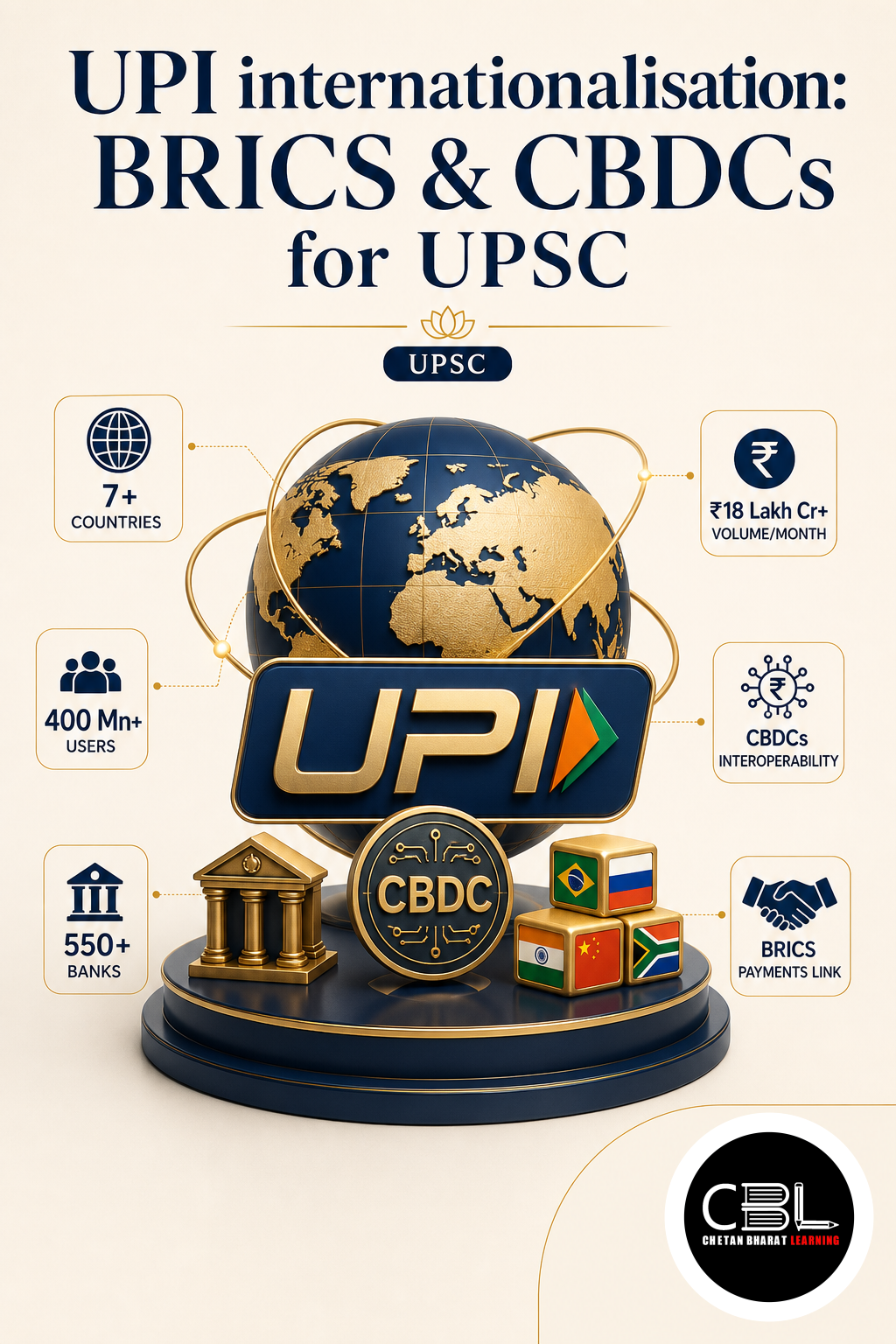
UPI internationalisation refers to expanding the use, acceptance and interoperability of India’s Unified Payments Interface beyond domestic transactions. It can involve linking UPI with foreign fast payment systems, enabling UPI-based merchant payments abroad, supporting cross-border remittances and developing compatible payment infrastructure with partner jurisdictions.
The concept should not be confused with making UPI a single global payment network. Instead, it involves interoperability, where different domestic systems communicate through agreed technical, regulatory and settlement arrangements. RBI has already pursued bilateral linkages and has participated in Project Nexus, a multilateral initiative designed to interlink domestic fast payment systems for instant cross-border retail payments.
UPI itself is a means of payment, while the Digital Rupee is a digital form of sovereign currency issued by the RBI. The distinction matters for UPSC because international payment interoperability can involve both payment-system connectivity and the possible future use of CBDCs as settlement instruments. RBI’s Digital Rupee FAQs explicitly distinguish e₹ from UPI while noting that e₹ applications can scan UPI QR codes.
Why is UPI internationalisation in News?
UPI internationalisation gained fresh significance after RBI Governor Sanjay Malhotra said BRICS members are discussing options for connecting fast payment systems and CBDCs. He described cross-border payments as an area where there is scope to reduce costs, while stressing that the possible linkages remain at the discussion stage. The RBI had earlier recommended that a proposal concerning CBDC connectivity be considered in the BRICS 2026 agenda.
The issue is important because cross-border transactions can involve multiple intermediaries, foreign-exchange conversion, compliance requirements and settlement arrangements. A more interoperable architecture could reduce friction while improving speed, cost and transparency. India’s experience with UPI gives it a significant policy and technological reference point as it seeks wider international use of its digital payment infrastructure.
Key Features
- Fast payment interoperability: Domestic fast payment systems can be connected so users can make cross-border retail payments with fewer intermediaries.
- CBDC connectivity: BRICS discussions include the possibility of linking central bank digital currencies, although the proposal remains under discussion and is not an operational BRICS network.
- Lower transaction friction: Better interoperability can address costs and delays associated with correspondent banking, foreign-exchange conversion and multiple settlement layers.
- UPI as digital public infrastructure: India’s domestic experience provides a scalable reference for international payment cooperation, while NPCI International Payments Limited works with foreign entities to expand NPCI payment platforms abroad.
- CBDC-UPI interoperability: RBI has enabled Digital Rupee users to scan UPI QR codes, showing how sovereign digital currency can coexist with an existing payment interface.
Challenges
- Cybersecurity: Greater connectivity can widen the attack surface and requires resilient authentication, fraud monitoring and incident-response mechanisms.
- Regulatory differences: Countries may apply different KYC, AML/CFT, consumer-protection and data-governance requirements, complicating seamless interoperability.
- Monetary sovereignty: Wider use of digital payment systems and CBDCs requires central banks to manage implications for capital flows, liquidity and financial stability.
- Settlement and liquidity: Cross-border transactions require reliable arrangements for foreign-exchange conversion, settlement finality and sufficient liquidity across participating systems.
- Trust and governance: International payment networks need common standards, clear institutional responsibilities and confidence that transaction data and financial infrastructure remain secure.
Way Forward
India should pursue interoperability-first cooperation rather than seeking a single payment architecture for all countries. Bilateral UPI linkages, multilateral platforms such as Project Nexus and carefully designed CBDC experiments can operate as complementary pathways. The approach should prioritise common technical standards, settlement efficiency, cybersecurity and consumer protection.
UPI internationalisation can also support the wider internationalisation of the rupee if payment connectivity is matched by deeper financial markets, predictable regulation and adequate liquidity. RBI has already highlighted cross-border payments and digital infrastructure as areas where interoperability can support wider international use of the Indian currency.
Prelims Practice Corner
Q1. With reference to UPI, consider the following statements:
- It is a payment interface.
- It is itself a central bank digital currency.
- It can be linked with foreign fast payment systems.
Options: (a) 1 and 2 only (b) 1 and 3 only (c) 2 and 3 only (d) 1, 2 and 3
Answer: (b) UPI is a payment system/interface and can be interconnected with other fast payment systems; it is not a CBDC.
Q2. The Digital Rupee issued by the RBI is best described as:
- (a) A private cryptocurrency
- (b) A digital form of sovereign currency
- (c) A foreign exchange reserve asset
- (d) A payment application
Answer: (b) The Digital Rupee or e₹ is India’s CBDC and represents a digital form of the rupee issued by the RBI.
Q3. Project Nexus is associated with:
- (a) Linking domestic fast payment systems for cross-border retail payments
- (b) Regulating cryptocurrency exchanges
- (c) Financing BRICS infrastructure
- (d) Managing India’s foreign-exchange reserves
Answer: (a) Project Nexus seeks to interlink domestic fast payment systems to facilitate instant cross-border retail payments.
Q4. Which institution is responsible for issuing India’s Central Bank Digital Currency?
- (a) SEBI
- (b) NPCI
- (c) Reserve Bank of India
- (d) Ministry of Electronics and Information Technology
Answer: (c) The Reserve Bank of India issues the Digital Rupee as India’s central bank digital currency.
Q5. Which of the following is a major challenge in international payment-system interoperability?
- (a) Identical regulatory frameworks across countries
- (b) Elimination of foreign-exchange risks
- (c) Differences in KYC, AML/CFT and data rules
- (d) Absence of any cybersecurity concerns
Answer: (c) Different legal, regulatory and data-governance frameworks can complicate cross-border interoperability.
Mains Practice Questions
Q1. Examine the significance of linking fast payment systems and CBDCs among BRICS members for India’s digital economy. (10 marks)
- Intro: Define payment-system interoperability and place the BRICS discussion in the context of India’s digital public infrastructure.
- Body: Cover lower transaction costs, faster remittances, UPI’s international experience, CBDC interoperability, rupee internationalisation, cybersecurity and regulatory challenges.
- Conclusion: Emphasise standards-based, secure and inclusive interoperability with safeguards for monetary and financial stability.
Q2. Discuss how India’s digital payment infrastructure can contribute to the internationalisation of the rupee while preserving financial stability. (15 marks)
- Intro: Introduce rupee internationalisation as wider use of the Indian currency in cross-border trade, investment and payments.
- Body: Discuss UPI linkages, CBDC experimentation, local-currency settlement, lower remittance costs, trade facilitation, deeper financial markets, liquidity, convertibility, cybersecurity and regulatory coordination.
- Conclusion: Recommend gradual internationalisation supported by credible institutions, resilient payment infrastructure and macroeconomic stability.
FAQs on UPI internationalisation
What does UPI internationalisation mean?
It means expanding the international use and interoperability of India’s UPI-based payment infrastructure. This can include linking UPI with foreign fast payment systems and enabling cross-border payments.
How is UPI different from the Digital Rupee?
UPI is a payment system or means of payment, whereas the Digital Rupee is India’s central bank digital currency issued by the RBI. RBI has enabled e₹ applications to use UPI QR codes for payments.
Why is BRICS discussing payment-system linkages?
BRICS members see scope for improving cross-border payment efficiency and reducing costs. Current discussions include possible linkages between fast payment systems and CBDCs, but no final integrated system has been announced.
Related Current Affairs
Preparing for UPSC, PCS or HCS?
Talk to a mentor at Chetan Bharat Learning, Chandigarh. Free guidance on choosing the right exam and building a study plan.
Chat on WhatsAppCall 97793 53345UPSC / IAS / PCS coaching in Chandigarh · Trusted by aspirants across Punjab & Haryana
Leave a Reply
You must be logged in to post a comment.