
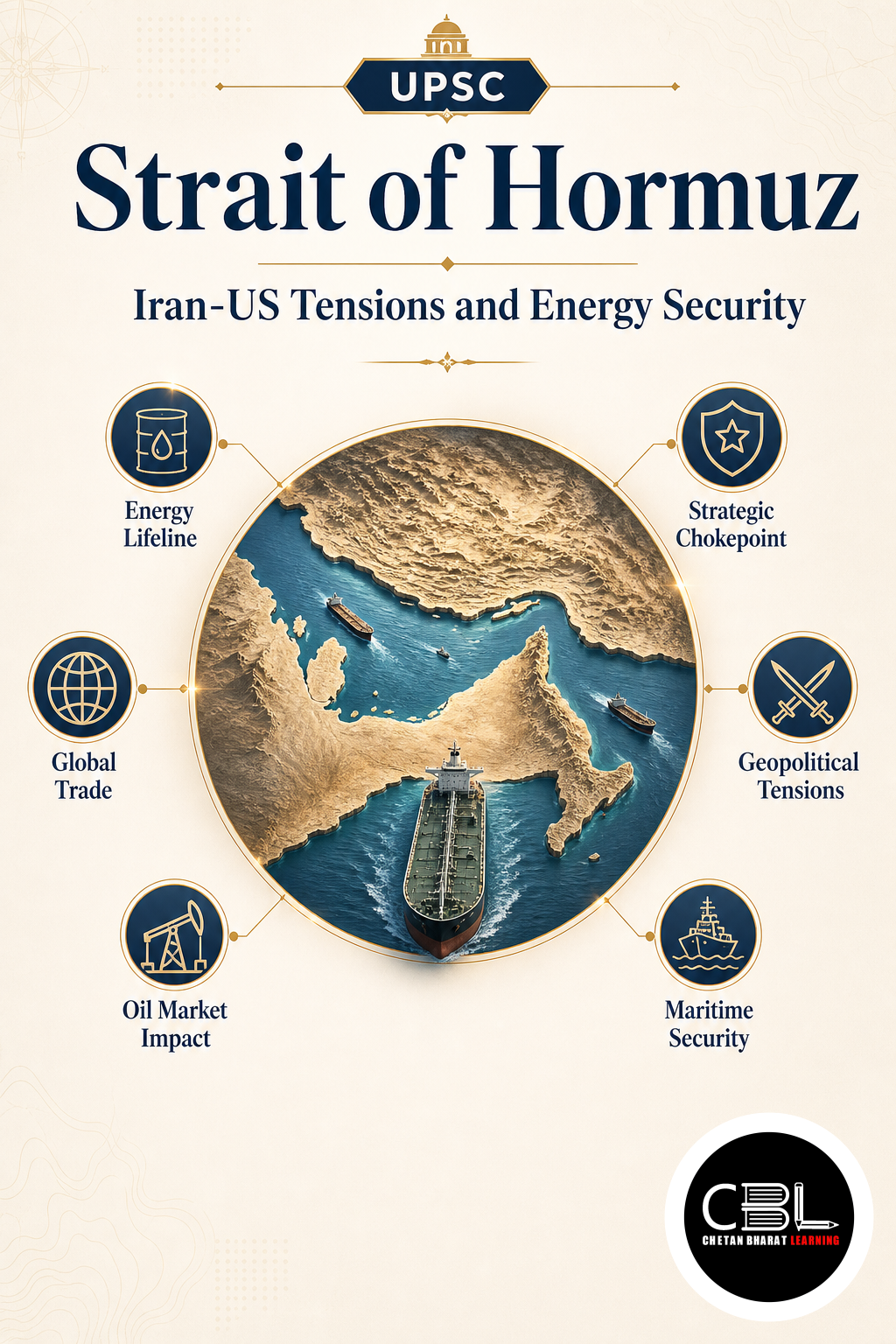

UPSC Mapping
Prelims
- Strait of Hormuz
- UNCLOS
- Maritime Chokepoints
Mains
- GS Paper II – International Relations
- GS Paper III – Energy Security
Quick Facts
| Location | Persian Gulf to Gulf of Oman and Arabian Sea |
|---|---|
| Strategic Role | Major oil and LNG shipping corridor |
| Key Law | UNCLOS |
What is Strait of Hormuz?
The Strait of Hormuz is a narrow maritime passage connecting the Persian Gulf with the Gulf of Oman and, beyond it, the Arabian Sea. It is one of the world’s important maritime chokepoints because substantial energy trade moves through this corridor.
A maritime chokepoint is a narrow passage through which a disproportionately important volume of trade, energy, or shipping traffic moves. Because alternative routes can be more difficult or costly, disruption at such locations can have consequences beyond the immediate region.
The Strait’s geography gives it significance for both exporting states and importing economies. Gulf oil-producing countries depend on maritime routes to reach international markets, while energy-importing countries remain interested in the safety and continuity of these sea lanes.
Why is Strait of Hormuz in News?
According to the passage, Iran has resumed nuclear negotiations with the United States while also discussing alternative shipping arrangements with Oman. The report connects these developments with concerns over maritime access, regional stability, and the security of energy flows.
This issue illustrates how diplomacy and maritime security can intersect in West Asia. Negotiations between states may have implications for the wider strategic environment in which commercial vessels, energy shipments, and international trade operate.
Discussions on shipping arrangements should be understood alongside the broader geopolitical situation. For UPSC, the development therefore needs to be studied through both International Relations and energy-security perspectives.
Key Features
The strategic importance of the Strait can be understood through five interconnected dimensions:
- Global energy corridor: The Strait carries a significant share of international oil and LNG trade, making its stability important for energy markets.
- Strategic geography: It connects the Persian Gulf with the Gulf of Oman and the wider maritime routes of the Arabian Sea.
- Gulf exporters: Major oil-producing states in the Gulf depend heavily on maritime access for reaching external markets.
- Maritime law: The report discusses UNCLOS, transit passage, and freedom of navigation in relation to maritime movement.
- India’s interests: The route matters to India because crude oil, LPG, and LNG imports depend on secure maritime connectivity.
Challenges
The passage highlights several challenges associated with the Strait and the wider regional environment:
- Geopolitical tensions: Regional conflicts and diplomatic confrontations can increase uncertainty around maritime traffic.
- Energy security: Disruptions affecting a major energy corridor can create wider concerns for oil and gas supplies.
- Navigation and sovereignty: Maritime security involves balancing coastal-state interests with navigation rights under international law.
- Economic consequences: Shipping disruptions can affect trade flows and contribute to pressure on energy prices and inflation.
- Strategic uncertainty: Bilateral diplomatic negotiations cannot by themselves eliminate wider maritime and regional risks.
Way Forward
The report suggests that reducing vulnerability requires a combination of diversified shipping routes, sustained diplomacy, and respect for international maritime law. Alternative corridors can provide resilience, but they should complement rather than simply replace secure navigation through established sea lanes.
India’s approach should also connect maritime security with energy security. This means linking the Strait with diversification of energy sources, secure sea lines of communication, diplomatic engagement in West Asia, and the resilience of India’s external trade.
At the regional level, continued diplomatic engagement can help reduce escalation risks and protect commercial navigation. At the international level, adherence to maritime law and cooperation among states can support predictable movement of commercial vessels.
Prelims Practice Corner
Q1. The Strait of Hormuz connects which of the following?
(a) Red Sea and Mediterranean Sea (b) Persian Gulf and Gulf of Oman (c) Arabian Sea and Bay of Bengal (d) Black Sea and Mediterranean Sea
Answer: (b) Persian Gulf and Gulf of Oman — the Strait provides the maritime connection between the Persian Gulf and the Gulf of Oman.
Q2. A maritime chokepoint is best described as:
(a) A deep-sea mining zone (b) A narrow passage critical to major trade or energy flows (c) A coastal industrial zone (d) An exclusive fishing zone
Answer: (b) A narrow passage critical to major trade or energy flows — disruption at such locations can have wider economic consequences.
Q3. Which international legal framework is mentioned in the report in relation to maritime navigation?
(a) WTO Agreement (b) UNCLOS (c) Kyoto Protocol (d) Ramsar Convention
Answer: (b) UNCLOS — the report refers to the United Nations Convention on the Law of the Sea in discussing navigation and maritime rights.
Q4. According to the report, which country is discussing alternative shipping arrangements with Iran?
(a) Oman (b) Qatar (c) Kuwait (d) Bahrain
Answer: (a) Oman — the report specifically refers to discussions between Iran and Oman.
Q5. Why is the Strait particularly relevant to India’s energy interests?
(a) It is India’s only shipping route (b) It is relevant to crude oil, LPG and LNG imports (c) It connects India directly with Europe (d) It is India’s territorial water
Answer: (b) It is relevant to crude oil, LPG and LNG imports — the report highlights these energy interests.
Mains Practice Questions
Q1. Explain the strategic significance of the Strait of Hormuz for global energy security and India’s national interests. (10 Marks)
Answer Structure
Intro: Introduce the Strait as a critical maritime chokepoint connecting the Persian Gulf with wider international sea routes.
Body: Cover strategic geography, oil and LNG flows, India’s crude and gas interests, maritime security, UNCLOS, and geopolitical risks.
Conclusion: Stable sea lanes are essential for predictable energy supplies and wider regional economic security.
Q2. Discuss how geopolitical tensions in West Asia can influence international maritime trade and energy markets. (15 Marks)
Answer Structure
Intro: Explain the relationship between regional instability and strategically important maritime corridors.
Body: Discuss maritime chokepoints, shipping disruptions, energy security, trade costs, international maritime law, diplomacy, and implications for India.
Conclusion: Diplomatic engagement, maritime cooperation, and respect for international law can strengthen regional stability.
FAQs on Strait of Hormuz
Why is the Strait of Hormuz important?
The report identifies it as a major maritime chokepoint for international oil and LNG transportation. Its security therefore has implications for energy supplies, trade, and regional stability.
Why is Oman mentioned in the report?
According to the report, Iran is discussing alternative shipping arrangements with Oman while broader negotiations with the United States have resumed. This connects maritime access with regional security.
What is a maritime chokepoint?
It is a narrow maritime passage through which an important volume of trade or energy transport moves. Disruption at such a passage can have effects beyond the immediate region.
How is the Strait relevant to India?
The report highlights its relevance to India’s crude oil, LPG, and LNG imports. Secure maritime connectivity therefore supports India’s energy security and external economic interests.
What is UNCLOS?
UNCLOS is the United Nations Convention on the Law of the Sea, an international legal framework governing various aspects of maritime rights and navigation.
Why does the Strait matter for energy markets?
Because it is a major route for energy shipments, disruptions can create concerns about supply continuity and wider market stability.
How can countries reduce vulnerability to chokepoint disruptions?
The report points towards diversified shipping routes, sustained diplomacy, and adherence to international maritime law. Broader energy diversification can also improve resilience.
Which UPSC papers cover the Strait of Hormuz?
The topic is relevant mainly to GS Paper II through International Relations and GS Paper III through energy security and economic implications.
Related Current Affairs
Preparing for UPSC, PCS or HCS?
Talk to a mentor at Chetan Bharat Learning, Chandigarh. Free guidance on choosing the right exam and building a study plan.
Chat on WhatsAppCall 97793 53345UPSC / IAS / PCS coaching in Chandigarh · Trusted by aspirants across Punjab & Haryana
Leave a Reply
You must be logged in to post a comment.