

UPSC Mapping
| Exam | Topics |
|---|---|
| Prelims | Ramsar Convention, Wetlands, Biodiversity |
| Mains | GS Paper III – Environment, Biodiversity and Conservation |
Quick Facts
| State | Arunachal Pradesh |
|---|---|
| Ramsar Status | India’s 101st Site |
| Protected Area | Kamlang Tiger Reserve |
| Lake Type | Freshwater Lake |
What is Glaw Lake?
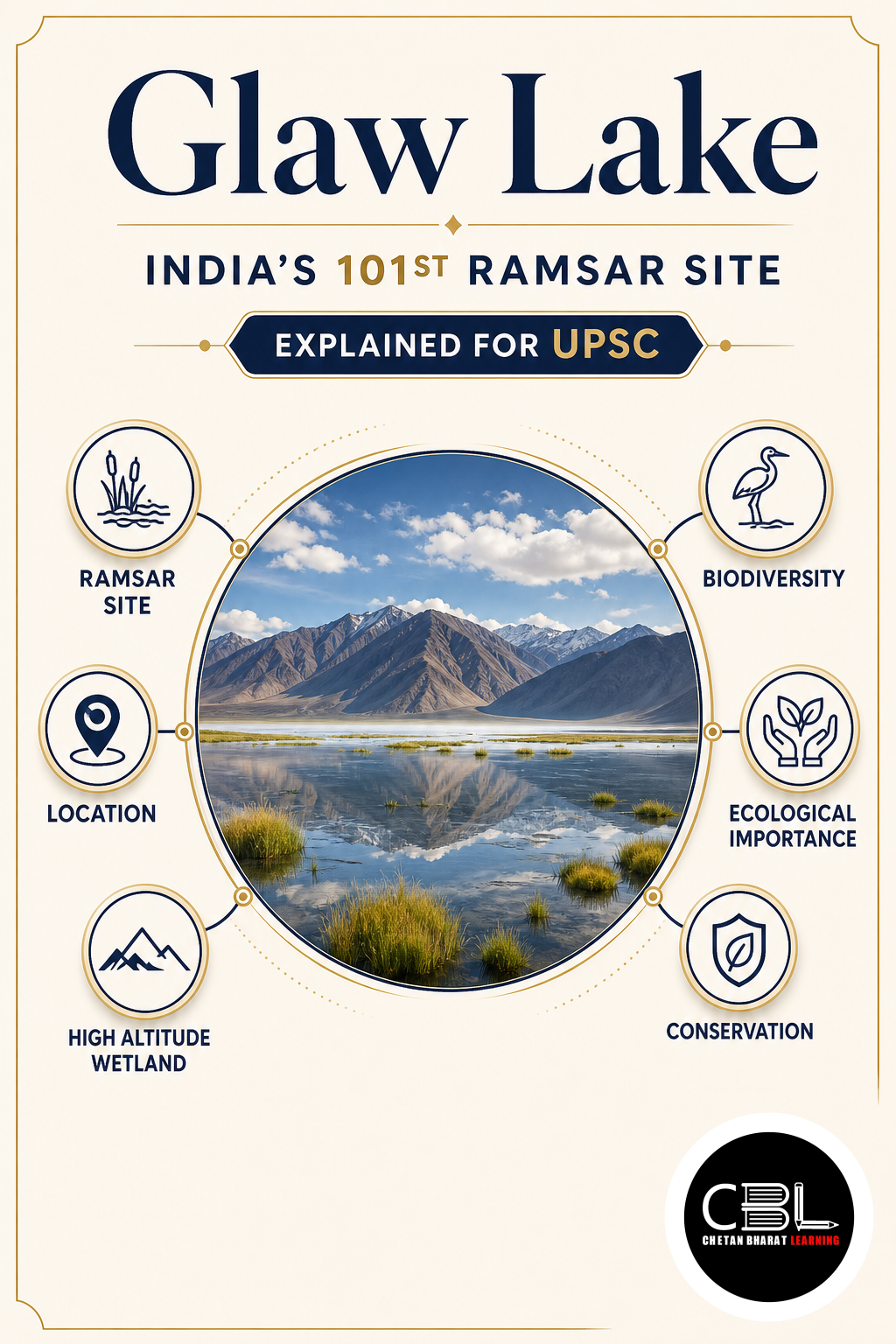
Glaw Lake is a pristine freshwater lake located within the Kamlang Tiger Reserve and Wildlife Sanctuary in the Eastern Himalayas of Arunachal Pradesh. The lake is fed by perennial mountain streams and serves as a major source of the Kamlang River.
Its designation as India’s 101st Ramsar Site recognizes its outstanding ecological significance, rich biodiversity and contribution to wetland conservation.
Why is Glaw Lake in News?
Glaw Lake has been designated as India’s 101st Ramsar Site under the Ramsar Convention. It is also the first wetland in Arunachal Pradesh to receive Ramsar recognition.
More information regarding wetlands is available through the Ministry of Environment, Forest and Climate Change (https://moef.gov.in).
Key Features
- Location: Situated within the Kamlang Tiger Reserve and Wildlife Sanctuary in the Eastern Himalayas.
- Freshwater ecosystem: The lake is fed by perennial mountain streams and forms an important source of the Kamlang River.
- Rich floral diversity: The lake and its catchment support over 150 tree species and 49 orchid species.
- Exceptional wildlife: The basin supports all four big cat species—Bengal Tiger, Indian Leopard, Clouded Leopard and Snow Leopard.
- Threatened species: The wetland provides habitat for the Critically Endangered White-bellied Heron, highlighting its global conservation importance.
Significance of Ramsar Designation
- Biodiversity conservation: Encourages protection of fragile freshwater ecosystems and associated flora and fauna.
- International recognition: Brings global attention to the ecological importance of Arunachal Pradesh’s wetlands.
- Sustainable management: Promotes scientific conservation and wise use of wetland resources.
- Water security: Conserving headwater wetlands helps sustain river systems and ecosystem services.
- UPSC relevance: Ramsar Sites remain one of the most frequently asked environment topics in the Civil Services Examination.
Way Forward
The Ramsar designation offers an opportunity to strengthen long-term conservation through scientific management, community participation and biodiversity monitoring. Sustainable tourism and habitat protection can further enhance the ecological resilience of the wetland.
For UPSC, candidates should remember the location of Glaw Lake, its Ramsar status, association with Kamlang Tiger Reserve, the Kamlang River, its floral diversity, the four big cat species and the White-bellied Heron. Additional information is available through the Ramsar Convention Secretariat (https://ramsar.org).
Prelims Practice Corner
Q1. Glaw Lake is located in:
- (a) Sikkim
- (b) Arunachal Pradesh
- (c) Assam
- (d) Meghalaya
Answer: (b)
Q2. Glaw Lake is situated within:
- (a) Namdapha National Park
- (b) Dibang Wildlife Sanctuary
- (c) Kamlang Tiger Reserve
- (d) Kaziranga National Park
Answer: (c)
Q3. Glaw Lake has been designated as:
- (a) India’s 95th Ramsar Site
- (b) India’s 101st Ramsar Site
- (c) UNESCO World Heritage Site
- (d) Biosphere Reserve
Answer: (b)
Q4. Which river originates from or is primarily fed by Glaw Lake?
- (a) Subansiri
- (b) Kamlang River
- (c) Lohit River
- (d) Siang River
Answer: (b)
Q5. Which of the following species is found in the Glaw Lake basin?
- (a) Great Indian Bustard
- (b) White-bellied Heron
- (c) Nilgiri Tahr
- (d) Blackbuck
Answer: (b)
Mains Practice Questions
Q1. Discuss the ecological significance of wetlands in biodiversity conservation with reference to Glaw Lake. (10 Marks)
Answer Structure:
- Intro: Define wetlands and Ramsar Sites.
- Body: Explain biodiversity, hydrological functions, ecosystem services and Glaw Lake’s ecological importance.
- Conclusion: Highlight sustainable conservation and community participation.
Q2. Examine the role of the Ramsar Convention in promoting wetland conservation in India. (15 Marks)
Answer Structure:
- Intro: Briefly introduce the Ramsar Convention.
- Body: Discuss principles of wise use, biodiversity conservation, ecosystem services and India’s Ramsar initiatives.
- Conclusion: Emphasise integrated wetland management for sustainable development.
FAQs on Glaw Lake
Why is Glaw Lake important?
Glaw Lake is India’s 101st Ramsar Site and Arunachal Pradesh’s first Ramsar wetland. It supports exceptional biodiversity and serves as an important freshwater ecosystem in the Eastern Himalayas.
Where is Glaw Lake located?
Glaw Lake is located within the Kamlang Tiger Reserve and Wildlife Sanctuary in Arunachal Pradesh and is fed by perennial mountain streams.
Which notable wildlife species are found around Glaw Lake?
The basin supports Bengal Tiger, Indian Leopard, Clouded Leopard, Snow Leopard and the Critically Endangered White-bellied Heron, besides rich floral diversity including over 150 tree species and 49 orchid species.
Related Current Affairs
Preparing for UPSC, PCS or HCS?
Talk to a mentor at Chetan Bharat Learning, Chandigarh. Free guidance on choosing the right exam and building a study plan.
Chat on WhatsAppCall 97793 53345UPSC / IAS / PCS coaching in Chandigarh · Trusted by aspirants across Punjab & Haryana
Leave a Reply
You must be logged in to post a comment.