

UPSC Relevance
GS Paper III: Indian Economy, External Sector, Manufacturing, Trade Policy.
Prelims: Minimum Import Price, Anti-Dumping Duty, DGTR, Dumping.
Article
Why in News
According to the passage, the Government has imposed a Minimum Import Price (MIP) of US$ 850 per metric tonne on imports of PVC Suspension Resin (S-PVC). The measure is temporary and aims to protect domestic industry from abnormally cheap imports while encouraging domestic production.
What is PVC Suspension Resin?
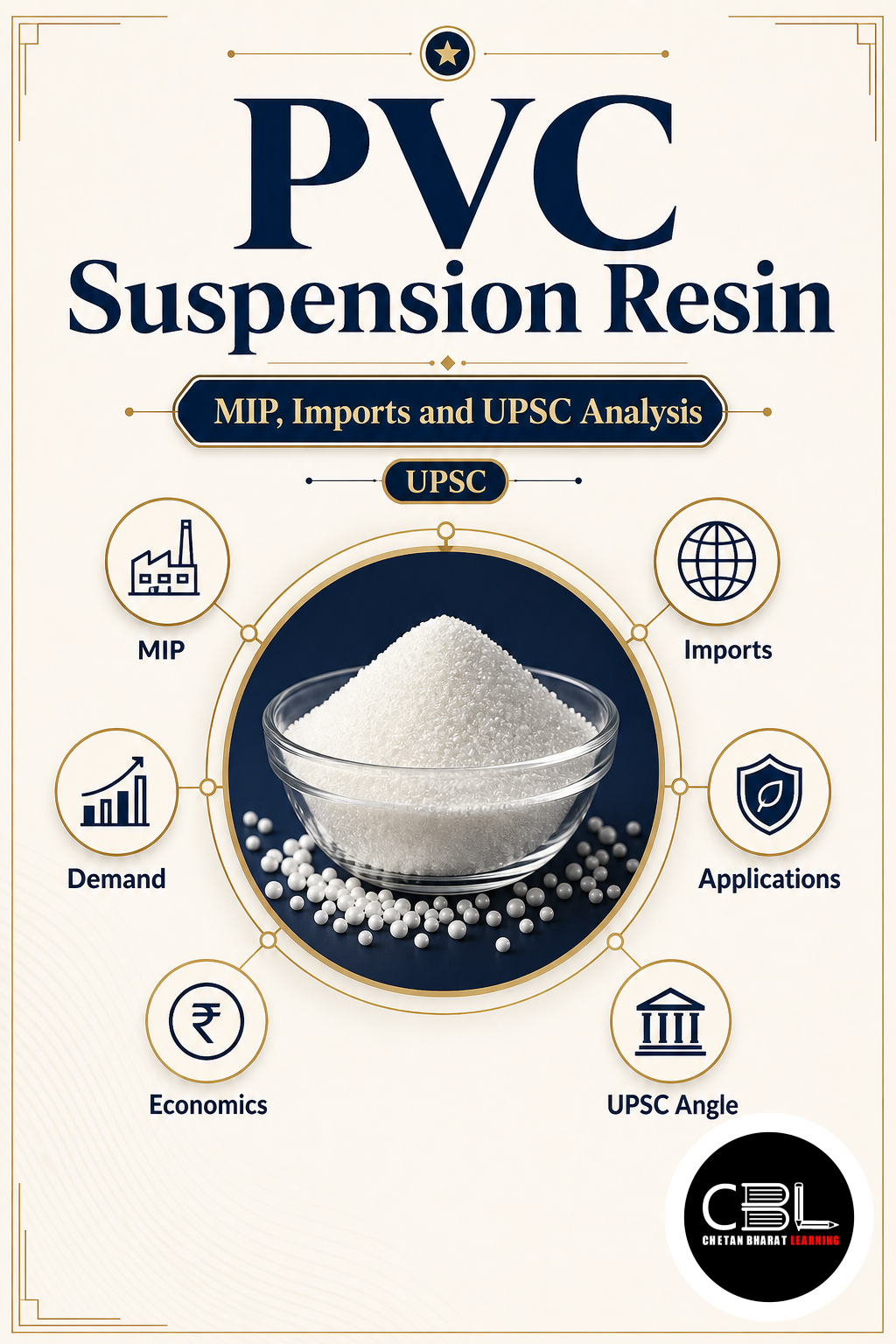
PVC (Polyvinyl Chloride) is one of the world’s most widely used plastics because of its durability, light weight and versatility. PVC Suspension Resin (S-PVC) is the most common form of PVC manufactured through the suspension polymerisation process. It serves as an intermediate industrial raw material for producing pipes, fittings, profiles and numerous industrial products.
Properties and Uses
- Key properties: Lightweight, strong, corrosion resistant, durable and easy to mould.
- Construction: Pipes, fittings, doors and windows.
- Electrical sector: Cable insulation and conduits.
- Healthcare: Medical equipment.
- Packaging and consumer goods: Widely used in manufacturing.
Why Does India Import PVC?
India’s demand for PVC is significantly higher than domestic production. Annual demand is approximately ₹16.15 lakh tonnes compared with domestic production of around ₹4.19 lakh tonnes, creating a substantial import requirement.
What is a Minimum Import Price (MIP)?
The Minimum Import Price (MIP) is a government-prescribed floor price below which imports are not permitted. It does not prohibit imports but prevents entry of goods at abnormally low prices.
Why Did the Government Impose MIP?
- Prevent cheap imports that could affect domestic producers.
- Protect domestic industry from losses arising from unfair pricing.
- Encourage local manufacturing and increase industrial capacity.
- Reduce import dependence over the long term.
What is Dumping?
Dumping occurs when a foreign company exports goods at a price lower than their normal value or even below the selling price in its domestic market. Such pricing can capture market share, weaken domestic competitors and later allow prices to increase.
What is Anti-Dumping Duty?
When dumping causes injury to domestic industry, the government may impose an Anti-Dumping Duty (ADD). Unlike MIP, which fixes a minimum import price, ADD is an additional customs duty designed to neutralise the effect of dumping.
MIP vs Anti-Dumping Duty
| Aspect | Minimum Import Price | Anti-Dumping Duty |
|---|---|---|
| Nature | Floor price | Extra customs duty |
| Objective | Prevent very cheap imports | Neutralise injury from dumping |
| Duration | Usually temporary | Based on investigation |
Role of DGTR
The Directorate General of Trade Remedies (DGTR), under the Ministry of Commerce and Industry, is responsible for investigating dumping, subsidies and recommending trade remedy measures such as anti-dumping, countervailing and safeguard duties.
Government Clarification
The MIP is a temporary measure for one year. Certain categories such as Special Economic Zones (SEZs), Export-Oriented Units (EOUs) and Advance Authorisation holders are exempt. The broader objective is to reduce import dependence while improving domestic manufacturing capacity.
Prelims Practice
- What is the purpose of a Minimum Import Price (MIP)? Answer: To prevent imports below a prescribed floor price.
- Which body investigates dumping cases in India? Answer: Directorate General of Trade Remedies (DGTR).
- Dumping refers to: Answer: Exporting goods below their normal value or domestic market price.
- Anti-Dumping Duty is: Answer: An additional customs duty imposed to offset injury from dumping.
- PVC Suspension Resin is mainly used as: Answer: An industrial raw material for manufacturing PVC products.
Mains Practice
- Q1. Explain the role of Minimum Import Price and Anti-Dumping Duty in protecting domestic industries. (10 Marks)
- Q2. Examine the challenges of balancing consumer interests, industrial competitiveness and import dependence in India’s trade policy. (15 Marks)
FAQs
What is PVC Suspension Resin?
It is the most common form of PVC produced through suspension polymerisation and widely used in manufacturing.
Why was MIP imposed?
It aims to prevent abnormally cheap imports and support domestic manufacturers.
Why is this topic important for UPSC?
It covers trade policy, manufacturing, dumping, DGTR and India’s external sector, making it relevant for both Prelims and GS Paper III.
Related Current Affairs
Preparing for UPSC, PCS or HCS?
Talk to a mentor at Chetan Bharat Learning, Chandigarh. Free guidance on choosing the right exam and building a study plan.
Chat on WhatsAppCall 97793 53345UPSC / IAS / PCS coaching in Chandigarh · Trusted by aspirants across Punjab & Haryana
Leave a Reply
You must be logged in to post a comment.