
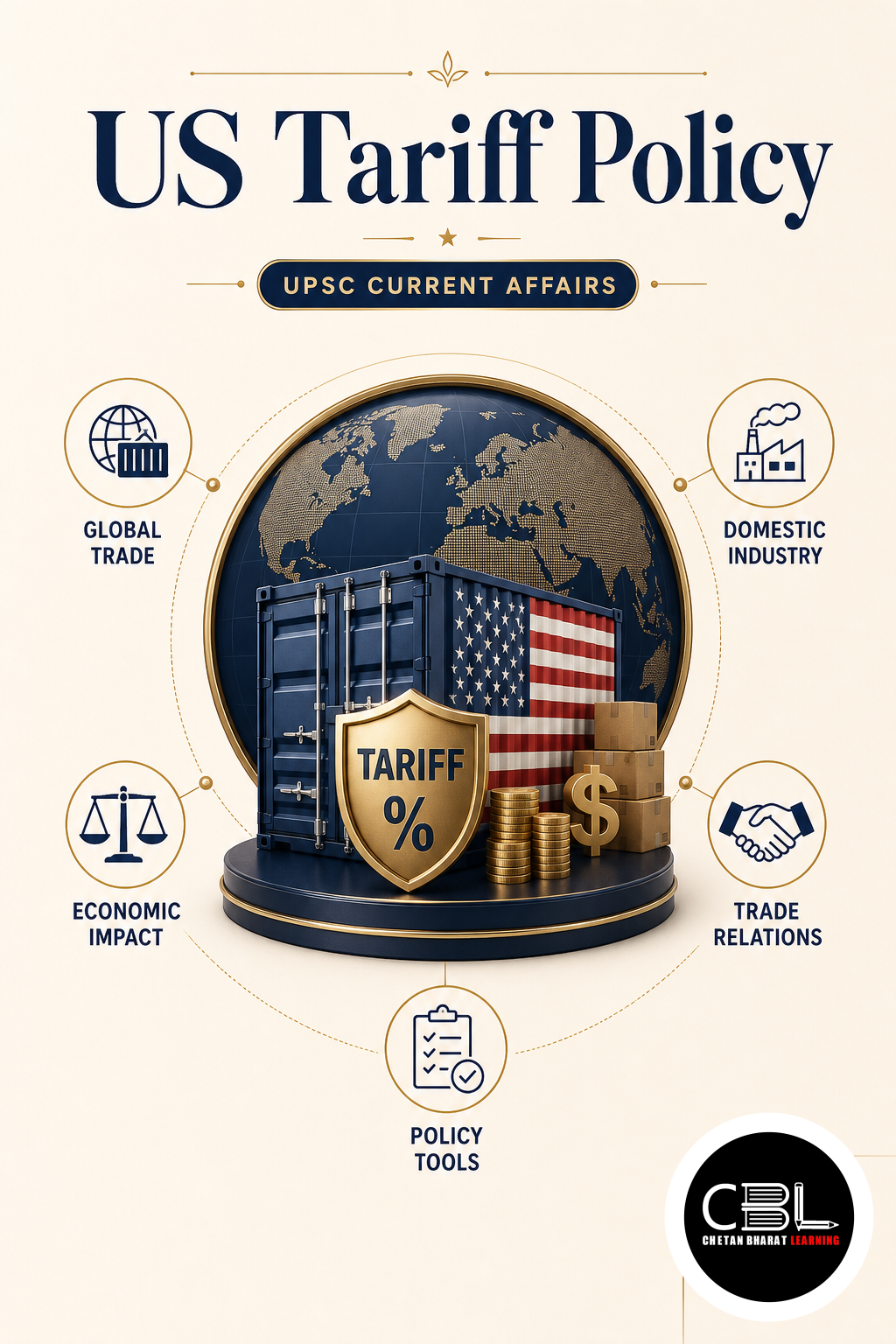

US Tariff Policy is in the news after the passage discussed the expansion of America’s tariff regime and argued that India should adopt a calibrated trade strategy while negotiating with the United States. UPSC aspirants should connect this issue with international trade, WTO rules and India’s economic diplomacy. For related topics, visit the daily current affairs archive.
What is US Tariff Policy?
US Tariff Policy refers to the use of import duties by the United States as part of its trade strategy. According to the uploaded infographic, a tariff is a tax imposed on imported goods, increasing their domestic price after import.
The uploaded material explains that tariffs may be imposed to protect domestic industries, generate government revenue, reduce trade deficits, address national security concerns or pursue strategic and political objectives.
Why is US Tariff Policy in News?
The passage discusses the expanding use of tariffs by the United States and argues that India should avoid hurried concessions while negotiating a bilateral trade agreement. It notes that tariffs are increasingly being used as a permanent and aggressive trade instrument.
The accompanying infographic describes this shift as a movement from free trade towards strategic protectionism, driven by manufacturing revival, supply chain security, countering China and protecting domestic employment. Official trade updates may be followed through the Ministry of Commerce and Industry.
Key Features
The uploaded infographic highlights the following concepts:
- International trade: Countries exchange goods and services because of differences in resources, technology, production costs and comparative advantage.
- Protectionism: Governments protect domestic industries using tariffs, quotas, subsidies, anti-dumping duties and local content requirements.
- Section 232: The uploaded source explains that this provision permits import restrictions on grounds of national security.
- Section 301: According to the infographic, it allows action against countries accused of unfair trade practices.
- Bilateral Trade Agreement (BTA): A trade agreement between two countries aimed at reducing tariffs, improving market access, increasing investment and boosting bilateral trade.
Challenges
The uploaded source identifies several challenges for India:
- Global protectionism: The changing international trade environment requires careful policy responses.
- Supply chain disruptions: Geopolitical developments affect trade and manufacturing.
- Maintaining policy flexibility: India should avoid one-sided or hurried concessions according to the passage.
- Balancing strategic relations: Trade negotiations increasingly intersect with geopolitical considerations.
- Export diversification: The infographic recommends expanding export destinations to reduce vulnerability to tariff shocks.
Related discussions are available through the economy current affairs archive.
Way Forward
The uploaded infographic recommends that India expand manufacturing, strengthen the Production Linked Incentive (PLI) programme, diversify supply chains, improve logistics and pursue export diversification while maintaining policy autonomy.
The source also emphasises reciprocity in trade negotiations, where both countries make mutual concessions rather than unilateral commitments. Readers should monitor future developments through the Directorate General of Foreign Trade (DGFT).
FAQs on US Tariff Policy
Why do countries impose tariffs?
According to the uploaded infographic, tariffs protect domestic industries, generate revenue, reduce trade deficits and address national security or strategic concerns.
What is MFN under the WTO?
The uploaded source explains that the Most Favoured Nation principle requires members to extend the same tariff treatment to all WTO members unless an exception applies.
What strategy does the uploaded source recommend for India?
It recommends a calibrated trade strategy, policy autonomy, export diversification and avoiding hurried one-sided concessions during negotiations.
Source note: This article is based exclusively on the passage editorial and infographic. No additional factual claims have been introduced beyond what is supported by the uploaded material. The structure follows the CBL SEO, editorial and UPSC publishing manuals.
Related Current Affairs
Preparing for UPSC, PCS or HCS?
Talk to a mentor at Chetan Bharat Learning, Chandigarh. Free guidance on choosing the right exam and building a study plan.
Chat on WhatsAppCall 97793 53345UPSC / IAS / PCS coaching in Chandigarh · Trusted by aspirants across Punjab & Haryana
Leave a Reply
You must be logged in to post a comment.