
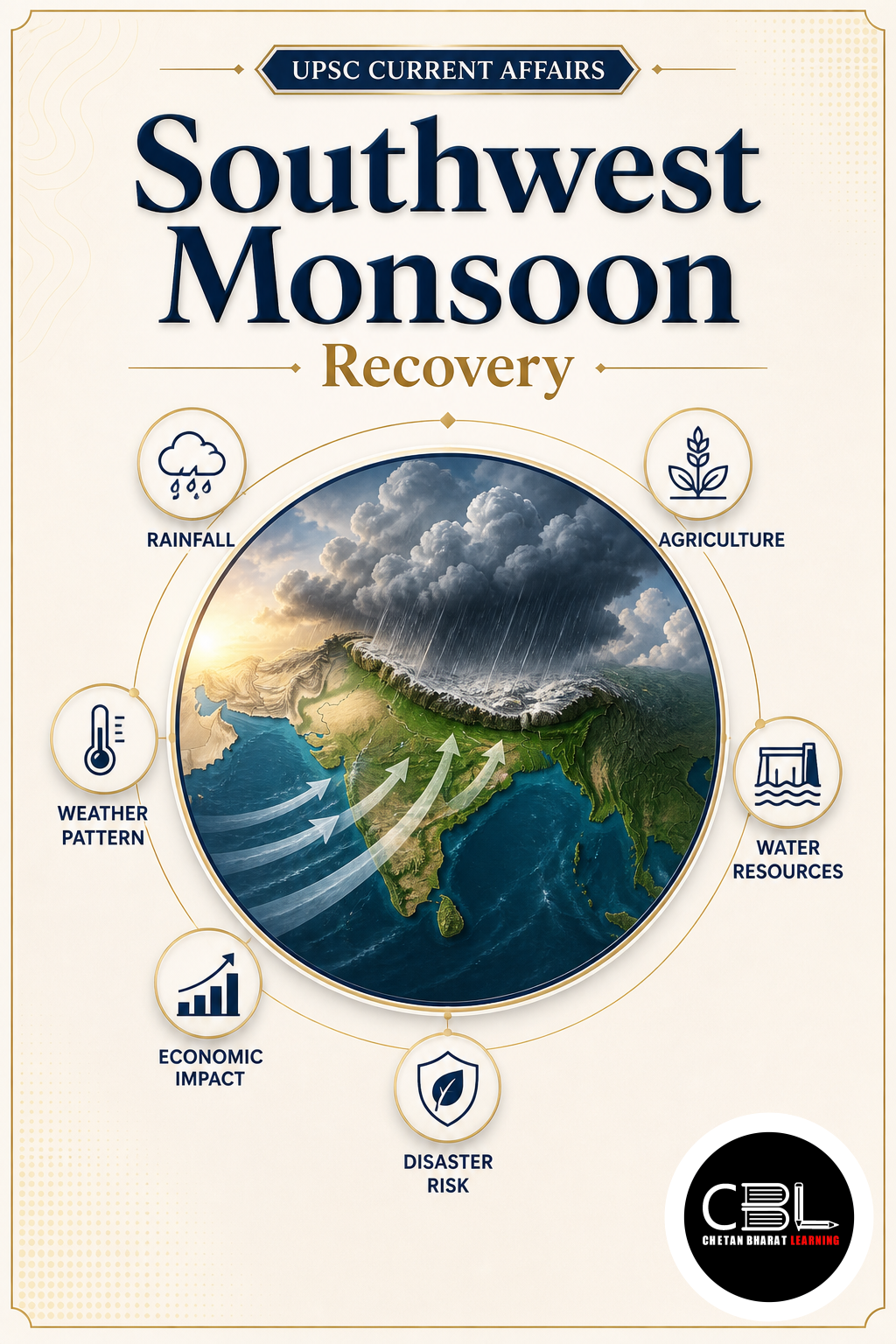

UPSC Mapping
- Prelims: Indian Monsoon, Low Pressure Systems, Monsoon Trough
- Mains: GS Paper I – Physical Geography and Indian Climate
Article
Southwest Monsoon brings nearly 75% of India’s annual rainfall between June and September, forming the backbone of Indian agriculture and water security. It results from differential heating of land and sea, moist winds from the oceans, low-pressure areas and condensation.
Quick Facts
| June Deficit | Around 40% (as reported) |
|---|---|
| Seasonal Deficit | Reduced to about 14% (as reported) |
What is Southwest Monsoon?
Southwest Monsoon is the seasonal reversal of winds bringing nearly 75% of India’s rainfall between June and September. It arises due to land-sea thermal contrasts, low-pressure areas over land, moisture-laden winds from oceans and condensation-induced rainfall.
Why is Southwest Monsoon in News?
After a deficient June, widespread July rainfall substantially reduced the seasonal deficit. Multiple low-pressure systems formed over the Bay of Bengal, moved inland with abundant moisture and produced rainfall across eastern, central, western and northwestern India. Official forecasts are available from the India Meteorological Department (IMD).
Key Features
- Low Pressure Systems: Main drivers of monsoon rainfall through depressions and areas of low pressure.
- Bay of Bengal: Major formation region due to warm sea surface temperatures and moisture.
- Monsoon Trough: Elongated low-pressure belt across northern India guiding monsoon systems.
- Arabian Sea and Bay of Bengal Branches: Their interaction distributes rainfall across India.
- Agricultural Significance: July rains support sowing, soil moisture, reservoir filling and groundwater recharge for Kharif crops.
Challenges
- Rainfall Variability: Spatial differences due to topography, wind patterns and system movements.
- Break Monsoon: Reduced rainfall when the monsoon trough shifts northwards.
- Floods and Droughts: Simultaneous excess and deficient rainfall in different regions.
- Agricultural Dependence: Crop performance closely tied to monsoon timing and intensity.
- June Deficiency: Fewer low-pressure systems and weaker moisture transport caused early-season deficit.
Way Forward
Timely formation of low-pressure systems and optimal monsoon trough positioning are crucial for widespread rainfall. Effective forecasting and water management can mitigate climate-related risks. Monitor updates via the India Meteorological Department.
Prelims Practice Corner
- Q1. According to the uploaded source, the Southwest Monsoon contributes approximately what share of India’s annual rainfall?
- Answer: (c) 75%
- Q2. Most monsoon rainfall originates from:
- Answer: (b) Low-pressure areas and depressions
- Q3. The Bay of Bengal is favourable for low-pressure formation because of:
- Answer: (b) Warm sea surface temperatures and abundant moisture
- Q4. The monsoon trough is:
- Answer: (b) An elongated belt of low pressure across northern India
- Q5. Which branch of the Southwest Monsoon primarily affects Kerala first?
- Answer: (b) Arabian Sea Branch
Mains Practice Questions
- Q1. Explain the role of low-pressure systems in determining the spatial and temporal distribution of the Southwest Monsoon in India. (15 Marks)
- Intro: Define low-pressure systems.
- Body: Formation, moisture transport, monsoon trough, rainfall distribution and agriculture.
- Conclusion: Highlight the importance of accurate forecasting.
- Q2. Discuss the significance of the Southwest Monsoon for India’s economy and food security. (10 Marks)
- Intro: Mention dependence on monsoon rainfall.
- Body: Agriculture, reservoirs, groundwater and climate variability.
- Conclusion: Emphasise sustainable water management.
FAQs on Southwest Monsoon
Why did rainfall improve during July?
Multiple low-pressure systems formed over the Bay of Bengal, moved inland and produced widespread rainfall.
Why is the Bay of Bengal important for the monsoon?
Warm sea surface temperatures, abundant moisture and favourable conditions for cyclonic circulation.
What is a break monsoon?
A break monsoon occurs when the monsoon trough shifts towards the Himalayan foothills, reducing rainfall over central and northwestern India.
Related Current Affairs
Preparing for UPSC, PCS or HCS?
Talk to a mentor at Chetan Bharat Learning, Chandigarh. Free guidance on choosing the right exam and building a study plan.
Chat on WhatsAppCall 97793 53345UPSC / IAS / PCS coaching in Chandigarh · Trusted by aspirants across Punjab & Haryana
Leave a Reply
You must be logged in to post a comment.