

UPSC Syllabus Mapping
GS Paper: GS-II & GS-III
Subject: International Relations and Science & Technology — Nuclear Energy, Non-Proliferation, West Asia and Global Strategic Issues
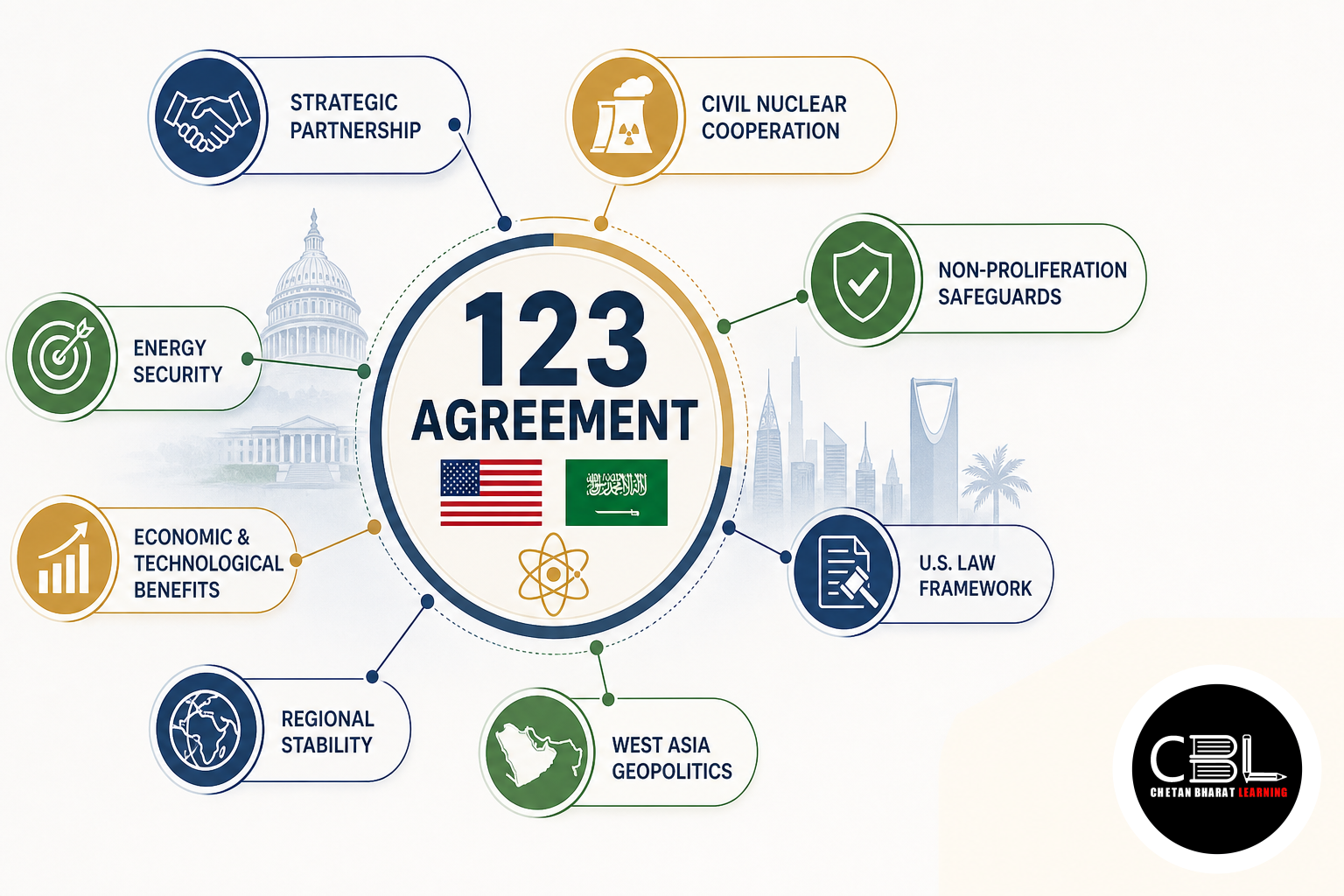
What is a 123 Agreement?
The term refers to agreements for peaceful nuclear cooperation concluded under Section 123 of the United States Atomic Energy Act of 1954. Such an agreement establishes the legal framework necessary before significant transfers of nuclear material, equipment or technology can take place between the United States and another country. It is therefore an enabling framework for civilian nuclear commerce rather than an agreement to transfer nuclear weapons.
These arrangements contain conditions intended to ensure that cooperation remains peaceful. The details differ among partner countries and can address safeguards, physical security, retransfers of nuclear material and sensitive activities connected with the fuel cycle. They are also subject to procedures involving the US Congress. India and the United States concluded a similar civil nuclear cooperation agreement under this framework following the India–US nuclear initiative, although the circumstances and associated international arrangements were distinct.
Why is the 123 Agreement in News?
US Energy Secretary Chris Wright and Saudi Energy Minister Prince Abdulaziz bin Salman signed a peaceful nuclear cooperation agreement in July 2026 together with an accompanying bilateral safeguards arrangement. The US Department of Energy described the arrangement as laying the legal foundation for a long-term nuclear partnership and providing greater access for American companies to Saudi Arabia’s developing civilian nuclear programme.
Saudi Arabia wants to diversify its domestic energy mix while preserving hydrocarbons for other economic uses and supporting electricity‐intensive requirements such as cooling and desalination. For Washington, cooperation offers commercial opportunities while maintaining American involvement in a strategic nuclear market where suppliers from other major powers could otherwise compete. The agreement’s objectives include nuclear safety, security and non‐proliferation.
Key Features of the US-Saudi Nuclear Pact
The agreement creates a framework through which US companies can participate in Saudi Arabia’s civilian nuclear sector. This potentially covers reactor technology, equipment, technical expertise and related nuclear cooperation subject to applicable US law and safeguards. It therefore carries both commercial and strategic significance.
- Peaceful nuclear cooperation: Enables transfer of civilian nuclear technology and expertise under agreed legal conditions.
- Bilateral safeguards arrangement: Addresses the peaceful use and control of nuclear material.
- Fuel‐cycle debate: Focus on whether and under what conditions Saudi Arabia could undertake domestic uranium enrichment.
- Additional Protocol issue: Reports indicate acceptance of the IAEA Additional Protocol is not yet a mandatory condition.
- Congressional role: Section 123 agreements require statutory review by the US Congress before entry into force.
- Strategic competition: American participation helps maintain US influence over Saudi nuclear development amid competing suppliers.
Uranium enrichment increases the proportion of uranium-235. Low-enriched uranium fuels civilian reactors, while higher enrichment levels have weapons relevance. Enrichment technology is therefore sensitive and dual-use; possessing it raises nuclear latency but does not alone equal weapons development.
Challenges Related to Nuclear Non-Proliferation
The central challenge is balancing legitimate access to peaceful nuclear energy with safeguards against diversion to military uses. Saudi Arabia is a party to the Nuclear Non-Proliferation Treaty as a non-nuclear-weapon state. The global non-proliferation system relies on International Atomic Energy Agency safeguards to verify that declared nuclear material is not diverted from peaceful activities.
The IAEA Additional Protocol strengthens verification by providing broader information and access designed to detect undeclared nuclear material and activities. Debate over its adoption concerns the depth of international verification rather than the existence of safeguards per se.
Regional security concerns in West Asia amplify these technical issues. Perceived fuel-cycle advances can intensify security dilemmas even for officially civilian programmes. For India, West Asian stability matters for energy, trade, connectivity and its large diaspora.
Way Forward for Responsible Nuclear Cooperation
Effective implementation requires transparent safeguards and clear rules for sensitive fuel-cycle activities. Strong verification fosters confidence that nuclear materials and facilities remain dedicated to peaceful purposes. Robust nuclear security, export controls, material accounting and independent regulatory institutions should complement safeguards.
Saudi Arabia’s nuclear ambitions must align with its energy transition goals. Nuclear power offers low-carbon baseload generation and supports desalination, but requires capital, regulation, skilled personnel, waste management and long-term safety. Building institutional capacity is as important as acquiring reactor technology.
The wider objective is to prevent peaceful nuclear cooperation from weakening non-proliferation norms. The IAEA remains central to global verification and cooperation. For India, the development should be viewed through West Asian stability, nuclear governance and strategic balance rather than solely as a bilateral commercial agreement.
Prelims Practice Corner
1. In international nuclear diplomacy, a US nuclear cooperation agreement commonly called a 123 agreement derives its name from:
- (a) Article 123 of the UN Charter
- (b) Section 123 of the US Atomic Energy Act
- (c) Article 123 of the NPT
- (d) Section 123 of the IAEA Statute
Answer: (b) Section 123 of the US Atomic Energy Act.
2. Consider the following statements about uranium enrichment:
1. It increases the proportion of uranium-235 in uranium.
2. Enriched uranium can have civilian applications.
3. Enrichment technology has proliferation significance.
Which are correct?
(a) 1 only (b) 1 and 2 only (c) 2 and 3 only (d) 1, 2 and 3
Answer: (d) 1, 2 and 3.
3. The Additional Protocol is associated with:
- (a) WTO inspections
- (b) Enhanced IAEA nuclear safeguards and verification
- (c) Biological weapons verification
- (d) International maritime boundaries
Answer: (b) Enhanced IAEA nuclear safeguards and verification.
4. Saudi Arabia is:
- (a) Outside the Nuclear Non-Proliferation Treaty
- (b) An NPT nuclear-weapon state
- (c) An NPT non-nuclear-weapon state
- (d) A permanent member of the UN Security Council
Answer: (c) An NPT non-nuclear-weapon state.
5. Which of the following is NOT one of the five nuclear-weapon states recognised under the NPT?
- (a) China
- (b) France
- (c) India
- (d) United States
Answer: (c) India. India possesses nuclear weapons but is not recognised under the NPT and is not a treaty party.
Mains Practice Questions
1. Civil nuclear cooperation requires balancing access to peaceful nuclear technology with non-proliferation imperatives. Discuss in the context of the emerging US-Saudi nuclear partnership. (10 marks)
Outline: Peaceful nuclear cooperation → Section 123 framework → Saudi energy diversification → safeguards → enrichment and dual-use technology → Additional Protocol debate → regional security → need for credible verification.
2. Developments in West Asia’s civilian nuclear sector have implications beyond energy security to regional strategic stability. Examine from India’s perspective. (15 marks)
Outline: West Asian nuclear programmes → energy diversification → sensitive fuel cycle → proliferation concerns → regional security dilemma → India’s energy and diaspora interests → strategic relations with Gulf states → support for peaceful uses under robust safeguards.
FAQs on 123 Agreement
Why are US nuclear cooperation pacts called 123 agreements?
The name comes from Section 123 of the United States Atomic Energy Act of 1954, which governs significant peaceful nuclear cooperation with other countries.
Does civilian uranium enrichment automatically mean nuclear weapons development?
No. Enriched uranium has legitimate civilian uses as reactor fuel. However, enrichment is sensitive dual-use technology because higher enrichment levels can also have weapons relevance.
Why is the IAEA Additional Protocol important?
It provides the IAEA with broader information and verification access, strengthening its ability to detect undeclared nuclear material and activities in participating states.
Related Current Affairs
Preparing for UPSC, PCS or HCS?
Talk to a mentor at Chetan Bharat Learning, Chandigarh. Free guidance on choosing the right exam and building a study plan.
Chat on WhatsAppCall 97793 53345UPSC / IAS / PCS coaching in Chandigarh · Trusted by aspirants across Punjab & Haryana
Leave a Reply
You must be logged in to post a comment.