
UPSC Syllabus Mapping
| GS Paper | GS-I and GS-III |
|---|---|
| Subject | Women Empowerment, Defence, Maritime Geography and Tri-service Integration |
What is Samudra Pradakshina?
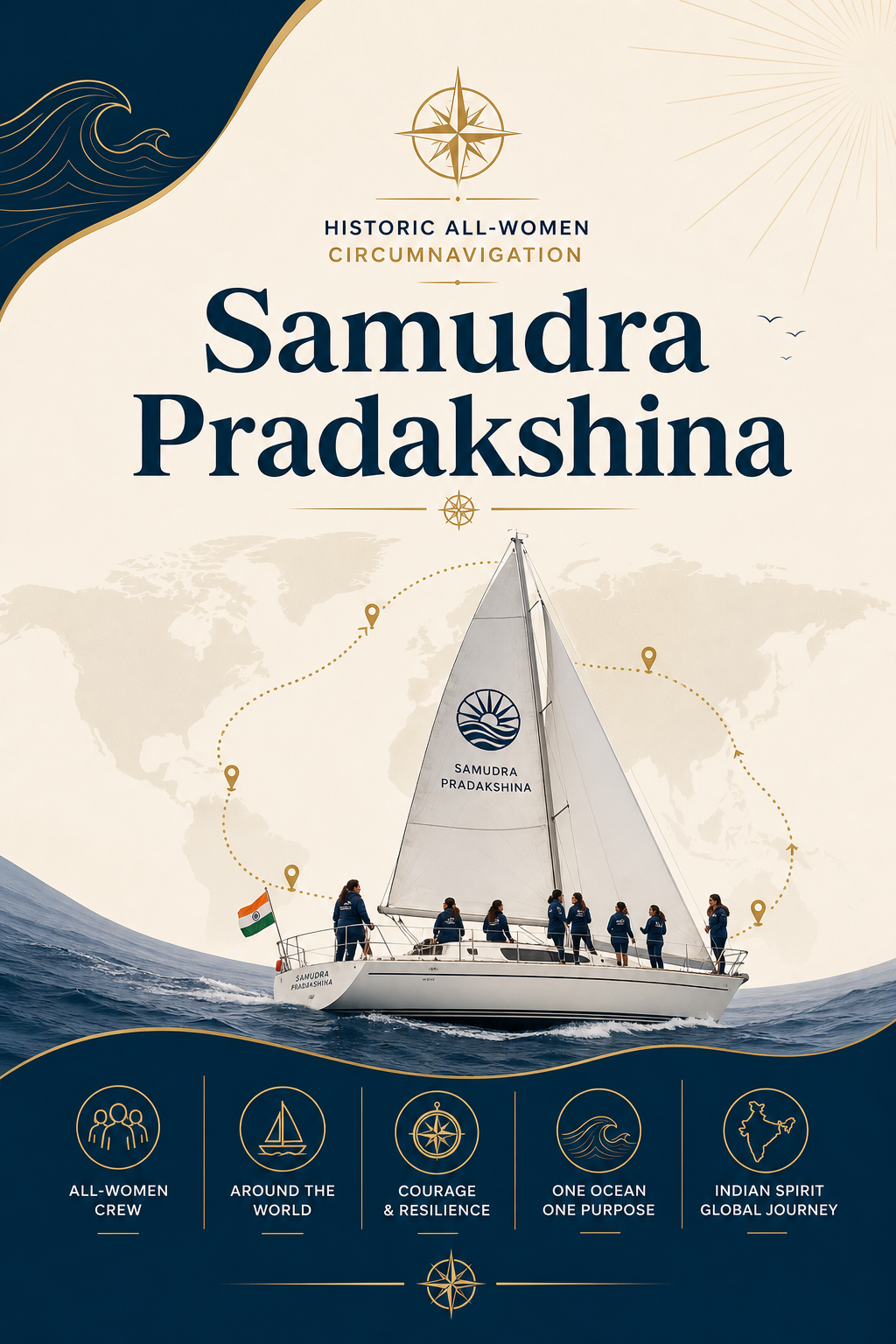
It was the first all-women sailing circumnavigation undertaken jointly by officers from all three branches of India’s Armed Forces. The expedition brought together personnel from the Indian Army, Indian Navy and Indian Air Force on a single maritime mission. Lieutenant Colonel Anuja Varudkar led the expedition, while Squadron Leader Shraddha P. Raju served as Deputy Expedition Leader.
The nine-member crew sailed aboard the Indian Army Sailing Vessel Triveni. The voyage began from Mumbai’s Gateway of India on 11 September 2025 and concluded in Mumbai on 22 July 2026. Circumnavigation by sail is substantially more than travelling around the world geographically. Internationally recognised sailing criteria require a route demonstrating genuine global passage, making navigation, weather assessment, seamanship and endurance integral to the achievement.
Why is Samudra Pradakshina in News?
The expedition entered current affairs after the Defence Minister formally flagged in the crew following successful completion of the 314-day voyage. During the journey, the team sailed nearly 25,500 nautical miles across four oceans. The expedition met internationally recognised circumnavigation requirements, including crossing all meridians of longitude, crossing the Equator twice and crossing the International Date Line.
The sailors also rounded three famous capes associated with long-distance ocean navigation: Cape Leeuwin in Australia, Cape Horn in South America and the Cape of Good Hope in Africa. Their passage through the difficult Drake Passage and rounding of Cape Horn earned the crew recognition as Cape Horners, a traditional distinction associated with sailors who have successfully navigated around Cape Horn. Official information on the achievement is available through the PIB Official Release.
Key Features of the Global Sailing Expedition
The voyage is notable for its combination of military cooperation and demanding maritime navigation. Sailing over long distances requires continuous management of weather, ocean currents, equipment, supplies and crew endurance. Unlike a powered naval deployment, an ocean-going sailing expedition depends heavily on understanding winds and sea conditions, making route planning and meteorological awareness especially important.
- Tri-service character: Women officers from the Army, Navy and Air Force participated together on one expedition.
- Vessel: The crew sailed aboard the Indian Army Sailing Vessel Triveni.
- Duration: The expedition lasted 314 days from September 2025 to July 2026.
- Distance: The voyage covered nearly 25,500 nautical miles across four oceans.
- Global navigation: The crew crossed all meridians of longitude, the Equator twice and the International Date Line.
- Great Capes: The route rounded Cape Leeuwin, Cape Horn and the Cape of Good Hope.
The voyage also required passage through the Drake Passage, the body of water between Cape Horn and Antarctica. It is known for challenging ocean and weather conditions because strong winds and currents circulate through the Southern Ocean with limited obstruction from major landmasses. Successfully navigating such waters requires substantial preparation. The mission was preceded by nearly two years of intensive training and supported by a round-the-clock shore-based network.
Challenges Related to Samudra Pradakshina
Ocean circumnavigation exposes sailors to rapidly changing weather, rough seas, fatigue and prolonged isolation. The crew must maintain the vessel while simultaneously handling navigation, watchkeeping and emergency preparedness. At high latitudes, strong winds and large waves can impose considerable physical and psychological demands. Equipment reliability becomes especially important when a vessel is far from ports or immediate external assistance.
Long voyages also test teamwork and decision-making. A small crew operates in confined conditions for extended periods, making communication, leadership and distribution of responsibilities critical. Military expeditions add another dimension because participants represent different services with their own professional backgrounds and operational cultures. Successful collaboration therefore demonstrates the practical value of joint training and interoperability beyond conventional combat exercises.
The achievement also has a gender dimension. Expanding women’s participation in demanding military and adventure activities requires opportunities, training pipelines and institutional support rather than symbolic inclusion alone. Demonstrated performance in high-endurance environments can broaden professional exposure and challenge assumptions concerning gender and operational capability. Aspirants can connect these themes with defence reforms and women’s empowerment through the UPSC current affairs library.
Way Forward for Maritime and Tri-Service Capacity
Experiential expeditions can complement formal military training by developing leadership, resilience, navigation and crisis-management skills. Future joint expeditions can deepen interaction among personnel from different services and strengthen a culture of cooperation. Lessons from planning, logistics, communications and shore support can also contribute to broader understanding of sustained operations in difficult maritime environments.
Women’s participation should continue to expand through merit-based opportunities, specialised training and appropriate institutional infrastructure. High-visibility achievements are most meaningful when accompanied by sustained pathways for professional development across the Armed Forces. Adventure and maritime programmes can provide valuable experience in leadership and teamwork while also creating role models for wider participation in defence and scientific exploration.
Samudra Pradakshina also offers useful geographical learning by connecting ocean navigation with the Equator, International Date Line, Southern Ocean and major capes. The Ministry of Defence provides official information on India’s defence institutions and initiatives. For UPSC, the expedition is therefore more than a factual achievement: it brings together maritime geography, jointness, leadership, endurance and women’s growing participation in India’s defence ecosystem.
Prelims Practice Corner
- Q1. Samudra Pradakshina was undertaken by women officers belonging to:
- (a) Indian Navy only
- (b) Army and Navy only
- (c) Army, Navy and Air Force
- (d) Navy and Coast Guard only
Answer: (c) It was a Tri-service expedition involving women officers from the Army, Navy and Air Force.
- Q2. Which vessel was used for the expedition?
- (a) INSV Tarini
- (b) IASV Triveni
- (c) INS Vikrant
- (d) INSV Mhadei
Answer: (b) The crew sailed aboard the Indian Army Sailing Vessel Triveni.
- Q3. Consider the following capes: 1. Cape Leeuwin 2. Cape Horn 3. Cape of Good Hope. Which were rounded during the expedition?
- (a) 1 only
- (b) 1 and 2 only
- (c) 2 and 3 only
- (d) 1, 2 and 3
Answer: (d) The crew rounded all three Great Capes.
- Q4. The Drake Passage lies between:
- (a) Africa and Madagascar
- (b) South America and Antarctica
- (c) Australia and New Zealand
- (d) Greenland and Iceland
Answer: (b) It lies between the southern tip of South America and Antarctica.
- Q5. Cape Leeuwin is located in:
- (a) Australia
- (b) South Africa
- (c) Chile
- (d) New Zealand
Answer: (a) Cape Leeuwin is situated in Western Australia.
Mains Practice Questions
- Q1. Adventure expeditions can contribute to leadership, jointness and operational resilience in the Armed Forces. Discuss. (10 marks)
Outline: Introduce military adventure training; discuss leadership, navigation, crisis management and teamwork; explain Tri-service cooperation; highlight endurance and decision-making; conclude with its complementary role in professional military development.
- Q2. Increasing women’s participation in challenging military activities requires both opportunity and institutional capacity. Examine. (15 marks)
Outline: Introduce changing roles of women in defence; discuss training, leadership and operational exposure; identify institutional and infrastructure requirements; highlight merit-based opportunities and career pathways; conclude with substantive gender inclusion.
FAQs on Global Sailing Expedition
What is Samudra Pradakshina?
It is the first-ever Tri-service all-women circumnavigation sailing expedition involving officers from the Indian Army, Indian Navy and Indian Air Force.
Who led the expedition and which vessel was used?
Lieutenant Colonel Anuja Varudkar led the expedition, and the nine-member crew sailed aboard the Indian Army Sailing Vessel Triveni.
What were the major geographical milestones?
The crew crossed all meridians of longitude, crossed the Equator twice and the International Date Line, and rounded Cape Leeuwin, Cape Horn and the Cape of Good Hope.
Leave a Reply
You must be logged in to post a comment.