
UPSC Syllabus Mapping
| GS Paper | GS-II |
|---|---|
| Subject | Governance, Education and Social Sector Policies |
What is Education Reforms?
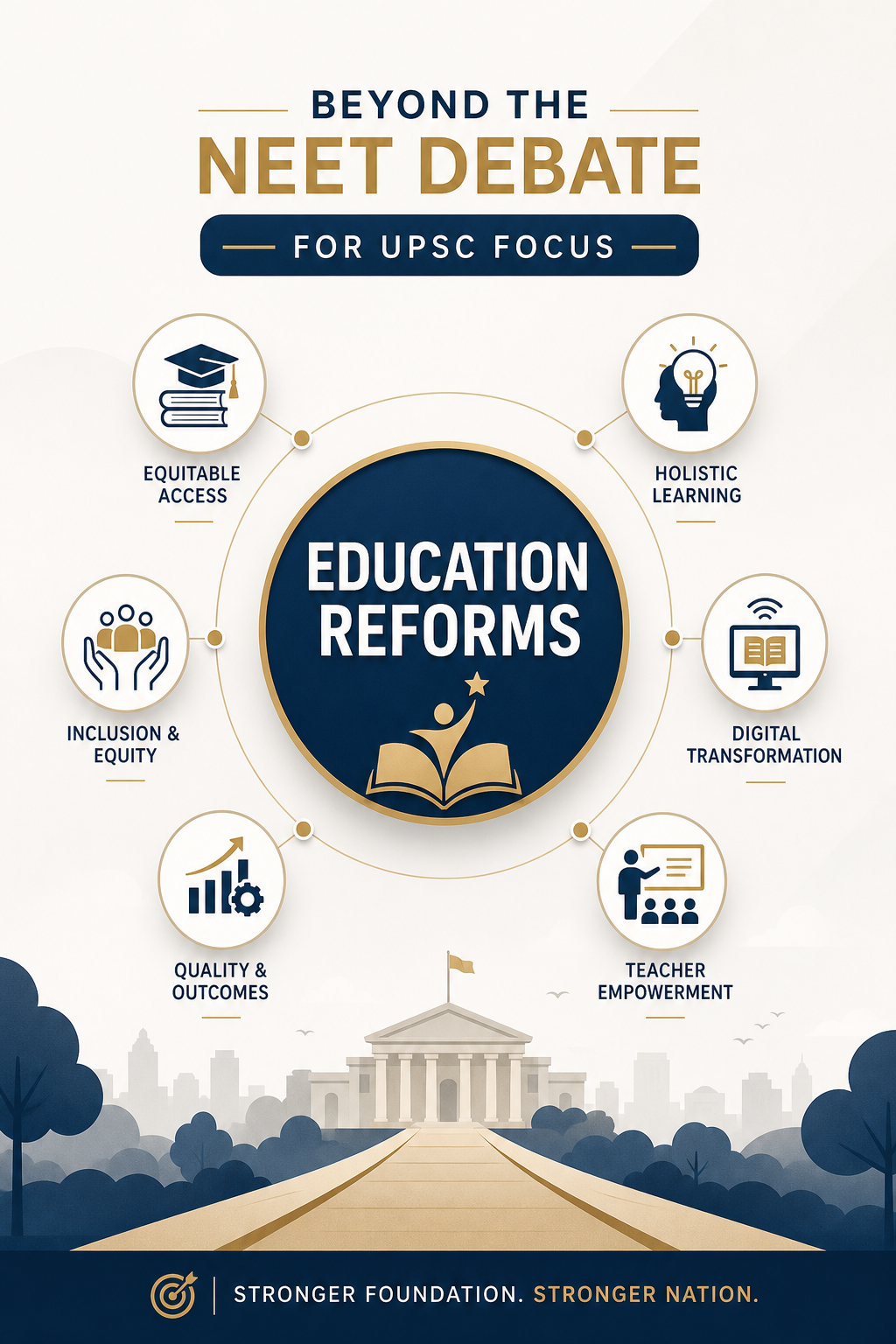
Education Reforms refer to systematic changes aimed at improving the quality, accessibility, inclusiveness and effectiveness of the education system. These reforms cover curriculum design, pedagogy, language of instruction, teacher training, assessment methods, governance and technology integration.
Recent discussions highlight three important pillars: strengthening Indian Knowledge Systems (IKS), promoting multilingual education and reforming examination systems to make learning more holistic, equitable and competency-based.
Why is Education Reforms in News?
Public debate should move beyond protests related to individual examinations and focus on comprehensive reforms that improve learning outcomes, institutional integrity and long-term educational quality. The discussion aligns with the objectives of the National Education Policy (NEP) 2020, which seeks transformational changes across the education sector.
The editorial emphasises that reforms in curriculum, multilingual learning and secure examination systems are essential for building a globally competitive education ecosystem. Official policy documents are available at Ministry of Education.
Key Features of Education Reforms
- Integration of Indian Knowledge Systems into higher education.
- Promotion of multilingual education in line with NEP 2020.
- Competency-based learning and flexible curriculum.
- Secure, transparent and technology-enabled examination systems.
- Greater emphasis on critical thinking, innovation and research.
- Improved teacher training and digital learning infrastructure.
- Balanced focus on employability, ethics and holistic development.
Challenges Related to Education Reforms
Implementation varies across states due to differences in administrative capacity, financial resources and institutional readiness. Language policy debates, unequal digital access, teacher shortages, examination malpractice and excessive dependence on coaching institutions continue to pose significant challenges.
Effective reforms require cooperation between the Union and State governments, educational institutions and regulatory bodies. For related governance topics, visit the UPSC current affairs library.
Way Forward for Education Reforms
India should strengthen implementation of NEP 2020 through better teacher capacity building, curriculum innovation, secure digital examination infrastructure, multilingual learning resources and stronger institutional accountability. Greater investment in research, technology and educational equity will improve long-term learning outcomes.
Further information on education policies can be accessed through PIB Official Release.
Prelims Practice Corner
- Which policy introduced the vision for multidisciplinary education and holistic learning in India?
- Indian Knowledge Systems primarily aim to?
- Which ministry is responsible for higher education policy in India?
- The Three-Language Formula is associated with which sector?
- Which GS Paper covers governance and social sector policies?
Answers
1. National Education Policy 2020
2. Integrating India’s intellectual traditions with modern education
3. Ministry of Education
4. Education
5. GS-II
Mains Practice Questions
Q1. Discuss the major reforms proposed under the National Education Policy 2020 to improve the quality of higher education in India.
Answer Outline: Curriculum reforms, multidisciplinary learning, multilingual education, Indian Knowledge Systems, governance reforms.
Q2. Evaluate the importance of examination reforms in improving transparency and educational outcomes.
Answer Outline: Technology, security, institutional accountability, fairness, competency-based assessment.
FAQs on Education Reforms
Why are Education Reforms important?
They improve learning quality, equity, employability and the overall effectiveness of the education system.
What role does NEP 2020 play in Education Reforms?
NEP 2020 provides a comprehensive framework for multidisciplinary education, flexibility, multilingual learning and institutional reforms.
Why is this topic important for UPSC?
It is relevant for GS-II governance, education policy, human resource development and social sector reforms.
Related Current Affairs
Preparing for UPSC, PCS or HCS?
Talk to a mentor at Chetan Bharat Learning, Chandigarh. Free guidance on choosing the right exam and building a study plan.
Chat on WhatsAppCall 97793 53345UPSC / IAS / PCS coaching in Chandigarh · Trusted by aspirants across Punjab & Haryana
Leave a Reply
You must be logged in to post a comment.