
UPSC Syllabus Mapping
- GS Paper: GS-I & GS-II
- Subject: Indian Society, Population, Governance and Social Development
- Syllabus Pointers: Prep with our comprehensive UPSC Current Affairs Hub analysis guidelines.
Article
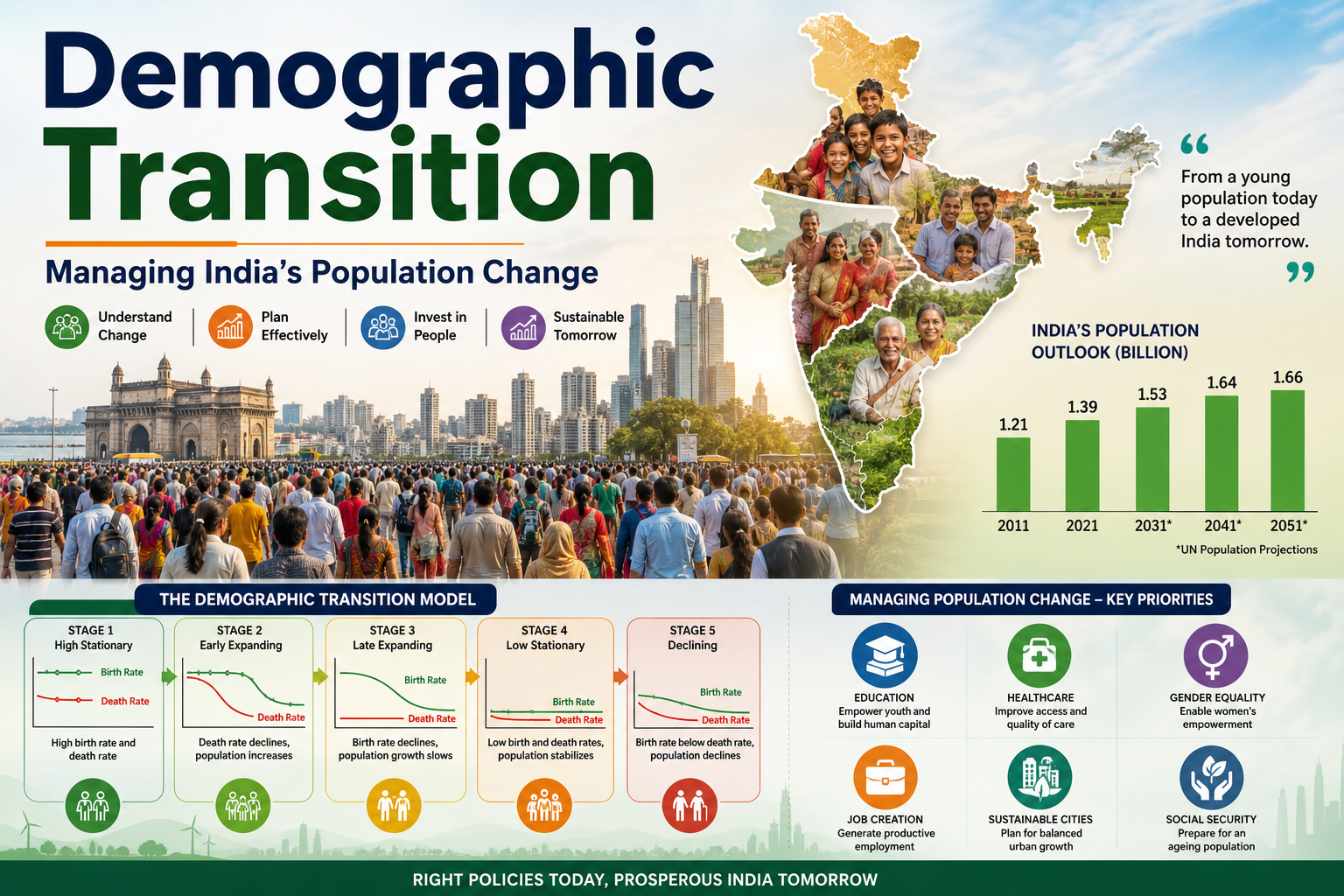
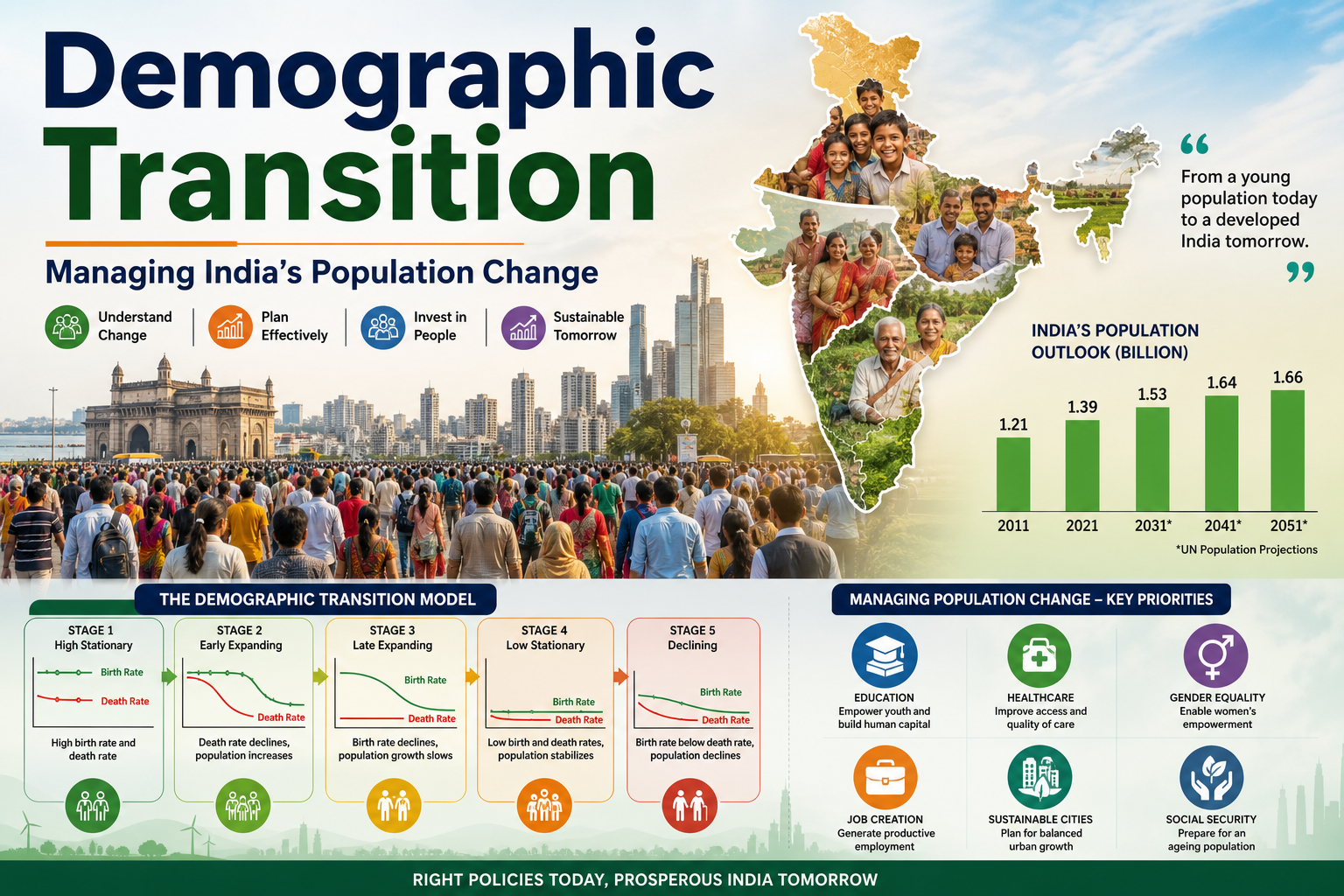
Recent discussions regarding Demographic Transition emphasise that India’s population debate should focus not on alarm over population growth or decline but on effectively managing structural demographic change. The policy challenge is to maximise the demographic dividend while preparing for ageing, regional disparities and changing workforce dynamics.
Key Dimensions of Demographic Transition
Demographic Transition is the long-term shift from high birth rates and high death rates to low birth rates and low death rates as a country develops economically and socially. The demographic transition model generally consists of five stages, ranging from high fertility and mortality to low fertility, population ageing and possible population decline.
India is presently in the later stages of demographic transition, although states are at different points. Southern and western states have experienced rapid fertility decline, while several northern states continue to have relatively higher fertility levels.
Total Fertility Rate (TFR)
Total Fertility Rate (TFR) is the average number of children a woman is expected to have during her lifetime. A replacement-level fertility of about 2.1 children per woman enables a population to remain broadly stable over the long term, assuming migration remains constant.
The debate has shifted from fears of population explosion during the 1960s and 1970s to concerns about ageing populations, declining fertility and future labour shortages in several countries.
Demographic Dividend and India’s Opportunity
Demographic Dividend refers to the economic growth potential arising from a relatively large working-age population. The dividend can be realised only when accompanied by quality education, skill development, employment generation and improved labour productivity.
Although India’s working-age population will gradually stabilise in the coming decades, higher female labour force participation, technological innovation, artificial intelligence and productivity improvements can help sustain long-term economic growth.
Emerging Policy Challenges
Federalism and Delimitation: Differential fertility trends across states have revived debates regarding parliamentary seat delimitation. Population-based reallocation may affect the political representation of states that adopted population stabilisation measures earlier, making a balanced approach essential.
Religion and Fertility: Fertility differences among religious communities have narrowed over time. Population policy should therefore be guided by reliable demographic evidence rather than rhetoric or stereotypes.
Women at the Centre: Lower fertility is closely associated with higher female education, urbanisation, delayed marriage, better healthcare, increased workforce participation and greater investment in children’s education and wellbeing. Population policy must safeguard reproductive rights and informed choice.
Why Evidence-Based Policy Matters
Population trends evolve gradually over decades. Policies based on demographic evidence are more likely to support sustainable development than responses driven by short-term fears of either rapid population growth or population decline.
For additional background on demographic transition, refer to global developmental tracking frameworks.
Way Forward
India should invest in education, healthcare, nutrition, skill development and employment generation to maximise its demographic dividend. Expanding women’s workforce participation, preparing for population ageing, strengthening healthcare systems and ensuring balanced federal reforms will help convert demographic change into long-term economic and social progress. Population policies should remain rights-based, evidence-driven and inclusive.
Prelims Package
Prelims Practice Corner
- Q1. The demographic dividend arises primarily because of:
- (a) High dependency ratio
- (b) Large proportion of working-age population
- (c) Declining life expectancy
- (d) Rapid population ageing
Answer: (b) Large proportion of working-age population
A demographic dividend is realised when a large working-age population is productively employed through investments in education, skills and jobs. - Q2. Replacement-level fertility is generally considered to be approximately:
- (a) 1.2
- (b) 1.8
- (c) 2.1
- (d) 3.0 children per woman
Answer: (c) Replacement-level fertility is about 2.1 children per woman under normal demographic conditions.
Mains Package
Mains Practice Question
“India’s demographic transition presents both opportunities and challenges. Discuss the significance of the demographic dividend and examine the policy measures required to manage population ageing, regional disparities and workforce transformation.” (150 Words, 10 Marks)
FAQs
What is demographic transition?
It is the long-term shift from high birth and death rates to low birth and death rates accompanying economic development, improved healthcare and social transformation.
Related Current Affairs
Preparing for UPSC, PCS or HCS?
Talk to a mentor at Chetan Bharat Learning, Chandigarh. Free guidance on choosing the right exam and building a study plan.
Chat on WhatsAppCall 97793 53345UPSC / IAS / PCS coaching in Chandigarh · Trusted by aspirants across Punjab & Haryana
Leave a Reply
You must be logged in to post a comment.