
Important for:
UPSC, Haryana HCS, Punjab PCS
Prelims: Energy security, crude oil imports, Strait of Hormuz
Mains: GS Paper 2 & GS Paper 3 — International Relations, Energy Security, Economy
Why in News?
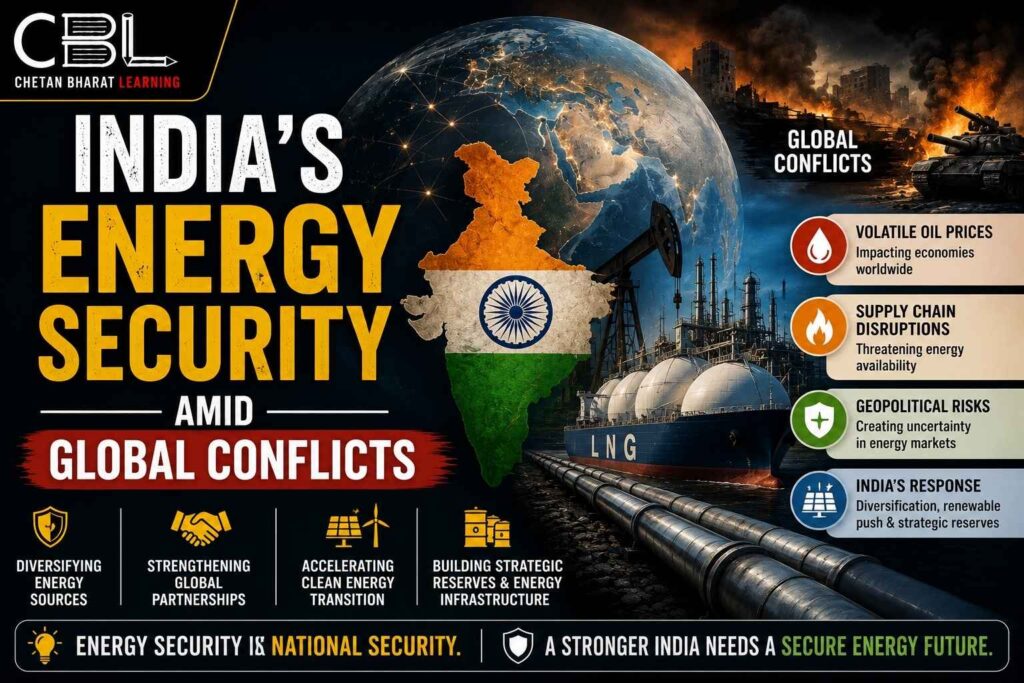
Global conflicts in West Asia have once again highlighted India’s dependence on imported crude oil and the risks posed by disruptions in major shipping routes like the Strait of Hormuz.
What is Energy Security?
➤ Energy security means:
✔ Reliable availability of energy
✔ Affordable prices
✔ Stable supply without disruption
India’s Energy Situation
India imports:
➤ More than 85% of its crude oil needs
This makes India vulnerable to:
- Global conflicts
- Supply disruptions
- Price shocks
Why is the Strait of Hormuz Important?
➤ Major global oil shipping route
✔ Connects Persian Gulf oil producers to global markets
➤ Large share of India’s imported oil passes through this route.
Major Challenges for India
1. Oil Price Volatility
Conflicts increase crude oil prices globally
2. Import Dependence
India relies heavily on external suppliers
3. Shipping Risks
War and instability can disrupt maritime trade routes
4. Inflation Pressure
Higher oil prices raise:
✔ Transport costs
✔ Food inflation
✔ Industrial costs
How India is Responding
1. Diversification of Suppliers
India imports oil from:
- Russia
- Iraq
- Saudi Arabia
- UAE
- USA
2. Strategic Petroleum Reserves (SPR)
Emergency oil storage for supply disruptions
3. Renewable Energy Push
Focus on:
✔ Solar energy
✔ Green hydrogen
✔ Electric vehicles
4. Domestic Energy Transition
Reducing long-term fossil fuel dependence
Why India Has Some Advantage
➤ India has diversified import partners compared to many countries.
➤ Flexible sourcing strategy helps manage shocks better.
Long-Term Energy Strategy
India aims to:
✔ Increase renewable energy capacity
✔ Reduce import dependency
✔ Build resilient energy infrastructure
Key Insight for UPSC
➤ True energy security comes from:
✔ Diversification
✔ Strategic reserves
✔ Renewable transition
—not just oil imports.
PRELIMS PRACTICE QUESTIONS
Q1. India imports approximately what percentage of its crude oil needs?
A. 20%
B. 40%
C. 60%
D. More than 85%
⇢ Answer: D
Q2. Strait of Hormuz is important because:
A. It is a freshwater lake
B. Major global oil trade passes through it
C. It produces coal
D. It connects Europe and Africa
⇢ Answer: B
Q3. Strategic Petroleum Reserve means:
A. Coal storage
B. Emergency crude oil storage
C. Water conservation
D. Solar battery reserve
⇢ Answer: B
Q4. Which of the following helps improve energy security?
A. Single supplier dependence
B. Renewable energy expansion
C. Import monopoly
D. Export restrictions
⇢ Answer: B
Q5. Green hydrogen is associated with:
A. Nuclear waste
B. Renewable energy transition
C. Coal mining
D. Oil refining
⇢ Answer: B
CBL Mains Practice Question
“India’s energy security challenges are increasingly linked to geopolitical conflicts and import dependence.”
Discuss India’s strategy to build a resilient energy ecosystem.
FAQs
1. What is energy security?
Reliable and affordable energy supply for a country.
2. Why is India vulnerable to oil shocks?
Because India imports most of its crude oil.
3. What is the Strait of Hormuz?
A major global oil shipping route.
4. What are Strategic Petroleum Reserves?
Emergency crude oil storage facilities.
5. Which GS papers cover this topic?
GS2 and GS3.
Leave a Reply
You must be logged in to post a comment.