
Important for:
UPSC, Haryana HCS, Punjab PCS
Prelims: Trade unions, labour codes, informal sector
Mains: GS Paper 2 — Labour Rights, Social Justice
GS Paper 3: Economy, Employment, Industrial Relations
Essay/Ethics: Workers’ rights vs economic reforms
Why in News?
A debate examines whether the decline of trade unions in India has negatively affected workers’ rights, wages, and working conditions in the context of economic reforms and labour market changes.
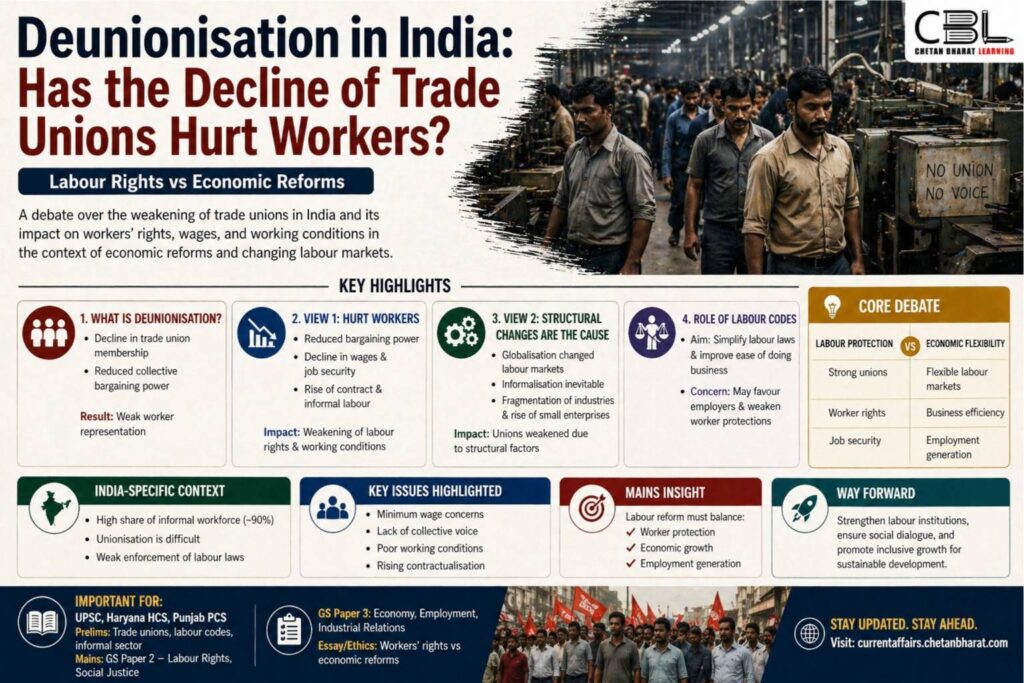
What is Deunionisation?
➤ Decline in:
- Trade union membership
- Collective bargaining power
➤ Leads to:
- Weak worker representation
View 1: Deunionisation Has Hurt Workers
➤ Key Arguments
- Reduced bargaining power
- Decline in wages and job security
- Growth of:
- Contract labour
- Informal employment
➤ Trade unions earlier:
- Secured labour rights
- Improved working conditions
Structural Changes
- Shift from:
→ Public sector → Private sector - Rise of:
→ Gig economy
→ Flexible labour markets
View 2: Structural Economic Changes Are the Real Cause
➤ Key Arguments
- Globalisation changed labour markets
- Informalisation inevitable in developing economies
➤ Trade unions weakened due to:
- Fragmentation of industries
- Rise of small-scale enterprises
➤ Additional Factors
- Political influence on unions reduced credibility
- Difficulty organising informal workers
Role of Labour Codes
- Aim:
→ Simplify labour laws
→ Improve ease of doing business
➤ Concern:
- May favour employers
- Could weaken worker protections
Core Debate (VERY IMPORTANT)
| Labour Protection | Economic Flexibility |
|---|---|
| Strong unions | Flexible labour markets |
| Worker rights | Business efficiency |
| Job security | Employment generation |
India-Specific Context
- High share of:
→ Informal workforce (~90%) - Challenges:
- Unionisation difficult
- Weak enforcement of labour laws
Key Issues Highlighted
- Minimum wage concerns
- Lack of collective voice
- Poor working conditions
- Rising contractualisation
➤ Mains Insight (VERY IMPORTANT)
→ Labour reform must balance:
✔ Worker protection
✔ Economic growth
✔ Employment generation
PRELIMS PRACTICE QUESTIONS
Q1. Trade unions are formed to:
A. Increase profits
B. Protect worker rights
C. Promote exports
D. Control inflation
✅ Answer: B
Q2. Informal sector refers to:
A. Government jobs
B. Jobs without formal contracts
C. IT sector
D. Banking sector
✅ Answer: B
Q3. Labour codes aim to:
A. Increase taxes
B. Simplify labour laws
C. Reduce exports
D. Increase imports
✅ Answer: B
Q4. Deunionisation leads to:
A. Strong bargaining power
B. Weak worker representation
C. Increased wages
D. More job security
✅ Answer: B
Q5. Which of the following is a challenge in labour markets?
- Informalisation
- Contract labour
- Over-regulation
A. 1 and 2 only
B. 2 and 3 only
C. 1 only
D. 1, 2 and 3
✅ Answer: A
Q6. Minimum wage is:
A. Maximum salary
B. Minimum legally allowed wage
C. Bonus
D. Tax
✅ Answer: B
CBL Mains Practice Question
“The decline of trade unions has weakened labour rights in India.”
Critically examine in the context of economic reforms. (250 words)
FAQs
1. What is deunionisation?
Decline in trade union strength and membership.
2. Why are unions important?
They protect worker rights and ensure fair wages.
3. What caused deunionisation?
Globalisation, informalisation, and structural changes.
4. Which GS paper covers this topic?
GS2 (Social Justice) and GS3 (Economy).
5. What is the solution?
Balanced labour reforms ensuring both growth and protection.
Related Current Affairs
Preparing for UPSC, PCS or HCS?
Talk to a mentor at Chetan Bharat Learning, Chandigarh. Free guidance on choosing the right exam and building a study plan.
Chat on WhatsAppCall 97793 53345UPSC / IAS / PCS coaching in Chandigarh · Trusted by aspirants across Punjab & Haryana
Leave a Reply
You must be logged in to post a comment.