
Important for:
UPSC, Haryana HCS, Punjab PCS
Prelims: Denotified Tribes (DNTs), Criminal Tribes Act, classification
Mains: GS Paper 2 — Social Justice, Welfare Schemes, Vulnerable Sections
Why in News?
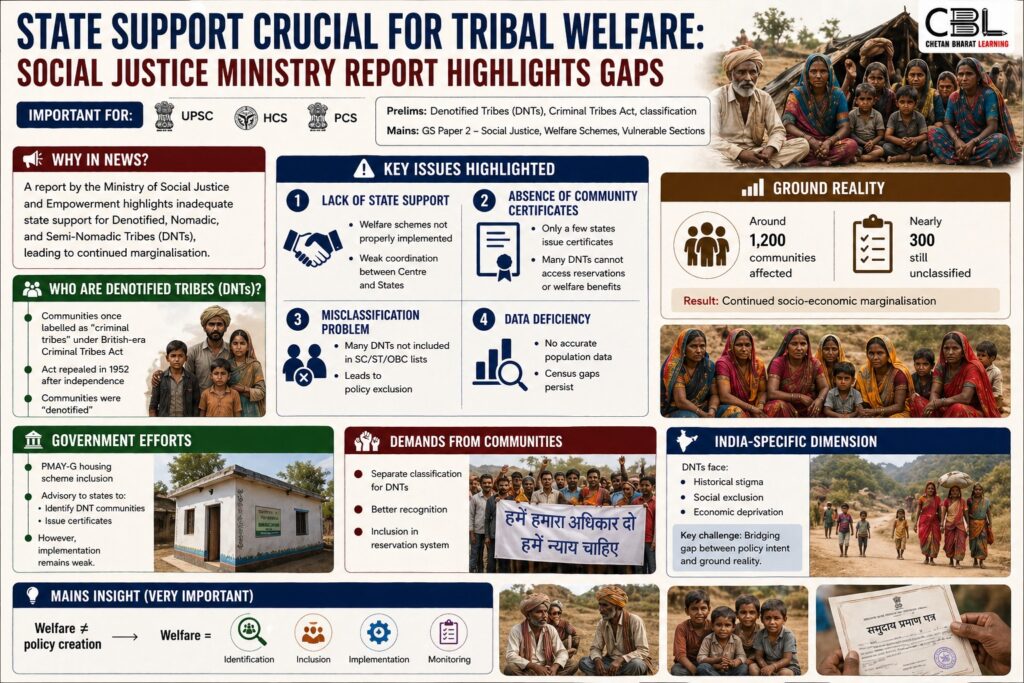
A report by the Ministry of Social Justice and Empowerment highlights that state governments have not adequately supported welfare measures for Denotified, Nomadic, and Semi-Nomadic Tribes (DNTs), leading to continued marginalisation.
Who are Denotified Tribes (DNTs)?
- Communities once labelled as “criminal tribes” under:
➤ British-era Criminal Tribes Act - After independence:
➤ Act repealed in 1952
➤ Communities were “denotified”
Key Issues Highlighted
1. Lack of State Support
- Welfare schemes not properly implemented
- Weak coordination between Centre and States
2. Absence of Community Certificates
- Only a few states issue certificates
- Many DNTs cannot:
➤ Access reservations
➤ Avail welfare benefits
3. Misclassification Problem
- Many DNTs:
- Not included in SC/ST/OBC lists
- Leads to:
➤ Policy exclusion
4. Data Deficiency
- No accurate population data
- Census gaps persist
Ground Reality
- Around 1,200 communities affected
- Nearly 300 still unclassified
➤ Result:
- Continued socio-economic marginalisation
Core Governance Issue
| Policy | Reality |
|---|---|
| Welfare schemes exist | Poor implementation |
| Targeted inclusion | Identification gaps |
| Legal recognition | Administrative delays |
Government Efforts
- PMAY-G housing scheme inclusion
- Advisory to states to:
- Identify DNT communities
- Issue certificates
☛ However:
- Implementation remains weak
Demands from Communities
- Separate classification for DNTs
- Better recognition
- Inclusion in reservation system
India-Specific Dimension
- DNTs face:
- Historical stigma
- Social exclusion
- Economic deprivation
☛ Key challenge:
- Bridging gap between policy intent and ground reality
Mains Insight
➤ Welfare ≠ policy creation
➤ Welfare =
✔ Identification
✔ Inclusion
✔ Implementation
✔ Monitoring
PRELIMS PRACTICE QUESTIONS
Q1. Denotified Tribes were associated with:
A. Industrial revolution
B. Criminal Tribes Act
C. Land reforms
D. Green Revolution
✅ Answer: B
Q2. Criminal Tribes Act was repealed in:
A. 1947
B. 1950
C. 1952
D. 1960
✅ Answer: C
Q3. DNTs are mainly:
A. Urban elites
B. Industrial workers
C. Marginalised communities
D. Agricultural landlords
✅ Answer: C
Q4. Main issue faced by DNTs is:
A. Overemployment
B. Lack of certificates
C. Excess taxation
D. Industrialisation
✅ Answer: B
Q5. Which ministry deals with DNT welfare?
A. Defence
B. Social Justice & Empowerment
C. Finance
D. Commerce
✅ Answer: B
Q6. Which of the following is a key challenge?
- Misclassification
- Lack of data
- Overrepresentation
A. 1 and 2 only
B. 2 and 3 only
C. 1 only
D. 1, 2 and 3
✅ Answer: A
CBL Mains Practice Question
“Despite multiple welfare schemes, Denotified and Nomadic Tribes continue to face marginalisation.”
Examine the reasons and suggest measures. (250 words)
FAQs
1. Who are Denotified Tribes?
Communities once labelled as criminals under colonial laws and later denotified.
2. What is the main issue?
Lack of identification and access to welfare benefits.
3. Why are certificates important?
They enable access to reservations and schemes.
4. Which GS paper covers this topic?
GS Paper 2 — Social Justice.
5. What is the solution?
Better identification, classification, and implementation.
Related Current Affairs
Preparing for UPSC, PCS or HCS?
Talk to a mentor at Chetan Bharat Learning, Chandigarh. Free guidance on choosing the right exam and building a study plan.
Chat on WhatsAppCall 97793 53345UPSC / IAS / PCS coaching in Chandigarh · Trusted by aspirants across Punjab & Haryana
Leave a Reply
You must be logged in to post a comment.