
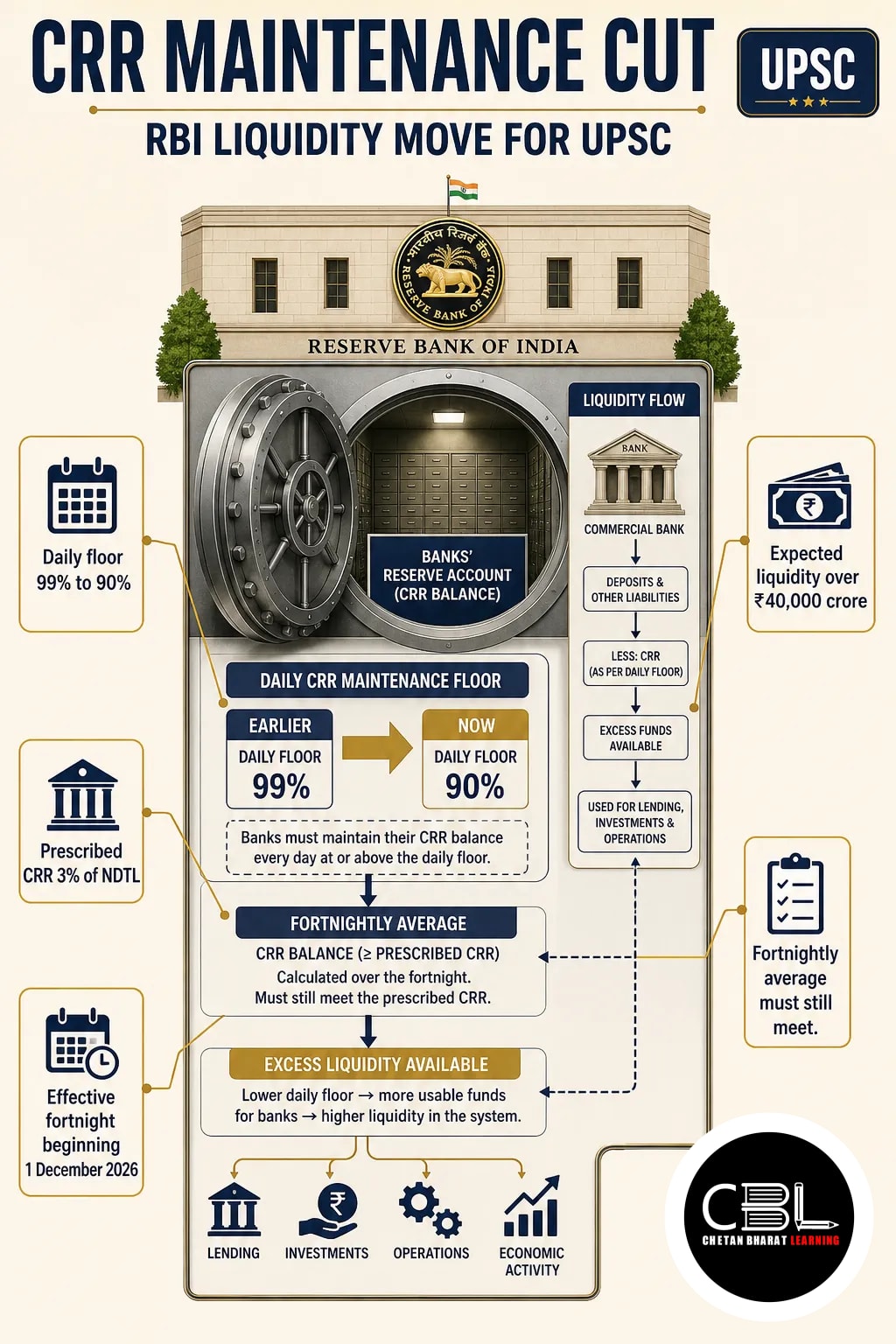

The CRR maintenance cut gives banks more daily liquidity flexibility after CBL’s earlier coverage of the Monetary Policy Committee decision. The move is important for economy current affairs because it changes the daily reserve floor, not the prescribed reserve ratio.
Quick answer: The Reserve Bank of India (RBI) has lowered daily cash reserve ratio (CRR) maintenance from 99% to 90% of the required amount. Effective from the fortnight beginning 1 December 2026, the CRR maintenance cut is expected to free over ₹40,000 crore while retaining the prescribed fortnightly average.
What is the cash reserve ratio?
The cash reserve ratio requires banks to keep a prescribed share of their liabilities as cash with the RBI. It is a tool for managing liquidity in the banking system.
For this decision, the prescribed CRR remains 3% of net demand and time liabilities (NDTL). NDTL broadly refers to a bank’s demand and time liabilities, adjusted for specified interbank balances.
What changed under the CRR maintenance cut?
The RBI reduced the minimum reserves scheduled banks must maintain each day, but not their required fortnightly average. The following facts distinguish the two requirements.
| Measure | Requirement or date |
|---|---|
| Daily minimum | 90% of the prescribed CRR requirement, down from 99% |
| Fortnightly average | Must still meet the RBI-prescribed CRR level |
| Prescribed CRR | 3% of NDTL |
| Effective date | Fortnight beginning 1 December 2026 |
The 90% figure is a share of the required reserve, not a share of NDTL. For example, if the relevant NDTL remains unchanged, 90% of a 3% requirement equals 2.7% of NDTL for the daily floor. However, banks must make up the difference to meet the fortnightly average.
Why did the RBI revise the daily floor?
The RBI cited its assessment of macroeconomic conditions and liquidity when announcing the revision. The CRR maintenance cut reverses a tightening announced on 9 October 2026.
That earlier decision raised the daily floor from 90% to 99%, effective from the fortnight beginning 16 October. At the time, substantial foreign currency non-resident bank deposits had contributed to abundant banking-system liquidity.
Why does this matter for bank liquidity?
The lower daily floor gives banks more room to manage cash balances and deploy credit on individual days. The expected availability of over ₹40,000 crore is a liquidity estimate, not a reduction in the prescribed CRR.
However, the unchanged fortnightly average limits how long banks can maintain reserves below the full requirement. For exam preparation, distinguish this operational flexibility from a cut in the reserve ratio itself.
Source: The Hindu Economy, 28 November 2026
- Monetary Policy Committee: RBI Policy Decision | UPSC Analysis (10 Aug 2026)
- Inflation and Economic Growth- June 2023 (23 Jun 2023)
Punjab PCS and Haryana HCS General Studies can test the RBI’s liquidity tools and banking terminology. In particular, distinguish the daily CRR floor from the fortnightly average.
Prelims Practice Corner
Mains Practice Questions
Frequently Asked Questions
What is the new daily CRR maintenance requirement?
It is 90% of the prescribed CRR requirement. However, scheduled banks must still meet the prescribed average over the fortnight.
Has the RBI reduced the prescribed CRR from 3%?
No, the prescribed CRR remains 3% of NDTL. Instead, the RBI has lowered the minimum share of that requirement maintained each day.
When does the revised daily CRR floor take effect?
It takes effect from the fortnight beginning 1 December 2026. The RBI expects the change to make over ₹40,000 crore available to the banking system.
Related Current Affairs
Preparing for UPSC, PCS or HCS?
Talk to a mentor at Chetan Bharat Learning, Chandigarh. Free guidance on choosing the right exam and building a study plan.
Chat on WhatsAppCall 97793 53345UPSC / IAS / PCS coaching in Chandigarh · Trusted by aspirants across Punjab & Haryana






Leave a Reply
You must be logged in to post a comment.