

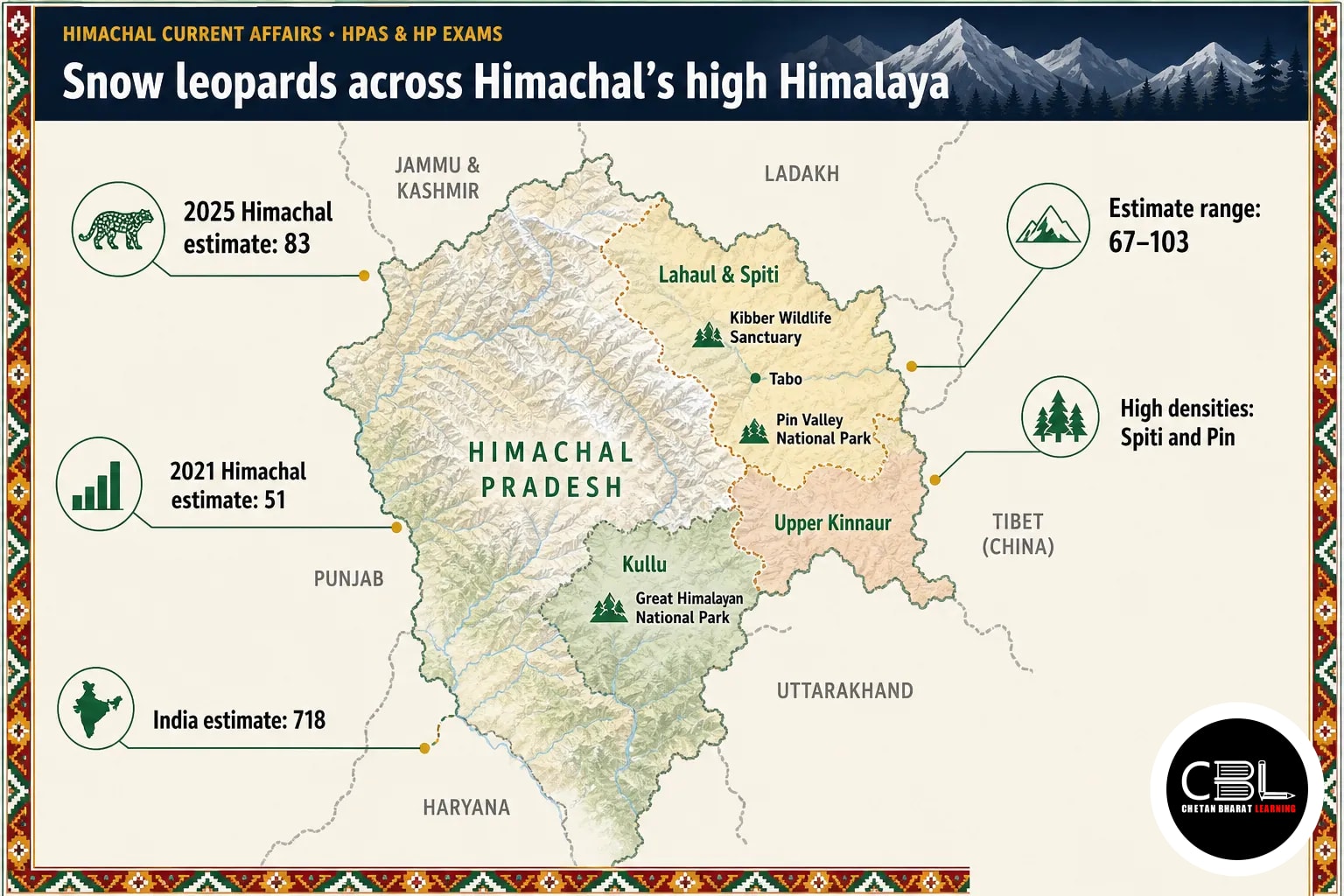
In October 2025, Himachal Pradesh’s second statewide assessment estimated 83 snow leopards, with a range of 67–103. The first assessment estimated 51 in 2021. The Wildlife Wing reported camera trapping across about 26,000 square kilometres. Spiti and Pin valleys had the highest densities. The survey followed the national Snow Leopard Population Assessment in India (SPAI) framework. The estimates provide a basis for monitoring Himachal’s state animal and its habitat.
Timeline: from protection to assessment
- 1972national lawLegal framework
The Wildlife (Protection) Act, 1972 provides the legal framework for wildlife protection.
- 2019national assessmentAssessment begins
The national SPAI assessment covered the period from 2019 to 2023.
- 2021HimachalFirst estimate
Himachal’s first statewide assessment estimated 51 snow leopards.
- Jan2024National estimate
The released national assessment estimated 718 snow leopards in India.
- Oct2025Second estimate
Himachal’s second statewide assessment estimated 83 snow leopards, with a range of 67–103.
- Himachal Pradesh’s state animal is the snow leopard.
- The 2025 statewide estimate was 83 snow leopards.
- The highest densities were recorded in the Spiti and Pin valleys.
- Pin Valley National Park is in Spiti.
- Himachal’s first statewide assessment estimated 51 snow leopards in 2021.
What does the snow leopard assessment measure?
The assessment estimates the population rather than giving an exact count of individual animals. The 2025 estimate was 83, with a range of 67–103; the reported fieldwork lasted about a year.
The snow leopard is listed as Vulnerable by the International Union for Conservation of Nature (IUCN). It is also listed in Schedule I of the Wildlife (Protection) Act, 1972. Pin Valley National Park and Kibber Wildlife Sanctuary are key habitats.
Why it matters
Conservation in inhabited landscapes requires attention to coexistence between people and wildlife.
The assessment identifies Spiti and Pin valleys as areas of high snow leopard density. Their habitats are important for conserving the species.
The statewide estimate uses the national SPAI framework. Its range helps administrators interpret the estimate rather than treat it as an exact count.
- National park: Pin Valley National Park is in Spiti.
- Sanctuary: Kibber Wildlife Sanctuary is a key snow leopard habitat.
- World heritage: Great Himalayan National Park in Kullu became a United Nations Educational, Scientific and Cultural Organization (UNESCO) World Heritage Site in 2014.
- State bird: The western tragopan, also called Jujurana, is Himachal’s state bird.
Key data
| Point | Details |
|---|---|
| First Himachal assessment | 2021: 51 estimated snow leopards |
| Second Himachal assessment | October 2025: 83 estimated; range 67–103 |
| Camera-trap area | About 26,000 square kilometres |
| National assessment | SPAI, 2019–2023; 718 estimated nationally, released January 2024 |
| Highest densities | Spiti and Pin valleys; followed by upper Kinnaur and Tabo |
| Conservation status | IUCN: Vulnerable; Schedule I, Wildlife (Protection) Act, 1972 |
| Key protected habitats | Pin Valley National Park and Kibber Wildlife Sanctuary |
Way forward
- Monitor consistently: Repeat assessments using comparable methods and report uncertainty alongside estimates.
- Protect habitat: Assess activities in sensitive high-altitude landscapes with care for Himalayan ecology.
- Support coexistence: Involve local communities in conservation planning and address wildlife-related concerns.
- Coordinate fieldwork: Share monitoring information among wildlife officials and relevant local institutions.
- Use evidence: Apply assessment findings to prioritise habitat management and evaluate conservation actions.
HPAS Mains practice questions
Explain the significance of Himachal’s 2025 snow leopard assessment. (150 words)
Answer pointers:
- Introduce the state animal and the 2025 estimate.
- Present the range and the earlier 2021 estimate.
- Identify high-density valleys and the national assessment framework.
- Conclude with the value of continued habitat monitoring.
Critically examine the use of population assessments in snow leopard conservation in Himachal Pradesh. (250 words)
Answer pointers:
- Introduce the 83 estimate and its 67–103 range.
- Discuss benefits for identifying habitats and planning conservation.
- Examine uncertainty, comparability and coexistence concerns.
- Conclude with repeated monitoring and community participation.
As Sub-Divisional Magistrate (SDM) in Lahaul and Spiti, how would you support snow leopard conservation alongside local livelihoods? (150 words)
Answer pointers:
- Begin with the need for coexistence in sensitive habitats.
- Consult communities and wildlife officials on local concerns.
- Coordinate habitat protection and appropriate responses to wildlife-related problems.
- Review outcomes with local participation.
Discuss how protected areas and the Wildlife (Protection) Act, 1972 can support snow leopard conservation in Himachal. (150 words)
Answer pointers:
- Introduce the species and its Schedule I listing.
- Use Pin Valley National Park and Kibber Wildlife Sanctuary as habitat examples.
- Link legal protection with monitoring and local cooperation.
- Conclude with landscape-sensitive implementation.
For Himachal Pradesh Administrative Service (HPAS) prelims and Himachal Pradesh Rajya Chayan Aayog (HPRCA) papers, memorise 51, 83 and 718 with their assessment contexts. For mains, connect population estimates with habitat protection and coexistence.
MCQ Practice Corner
Q1. Consider the following statements about Himachal’s snow leopard assessment:
1. The 2025 estimate was 83, with a range of 67–103.
2. The first statewide assessment estimated 51 snow leopards.
3. The highest densities were reported in the Spiti and Pin valleys.
Which statements are correct?
(a) 1 and 2 only (b) 2 and 3 only (c) 1 and 3 only (d) 1, 2 and 3
Show answer
Answer: (d) because all three statements match the reported assessments.
Q2. Which combination correctly describes the snow leopard’s conservation status?
(a) IUCN Vulnerable and Schedule I (b) IUCN Vulnerable and Schedule II (c) IUCN Least Concern and Schedule I (d) IUCN Least Concern and Schedule II
Show answer
Answer: (a) because the species is listed as Vulnerable by IUCN and in Schedule I of the Wildlife (Protection) Act.
Q3. What is the state animal of Himachal Pradesh?
(a) Snow leopard (b) Western tragopan (c) Musk deer (d) Himalayan monal
Show answer
Answer: (a) because the snow leopard is Himachal Pradesh’s state animal.
Q4. Pin Valley National Park is located in which region?
(a) Spiti (b) Kangra (c) Chamba (d) Sirmaur
Show answer
Answer: (a) because Pin Valley National Park is in Spiti.
Frequently Asked Questions
How many snow leopards were estimated in Himachal Pradesh in 2025?
The second statewide assessment estimated 83 snow leopards. Its reported range was 67–103.
Where are snow leopards found in Himachal Pradesh?
Key habitats include Pin Valley National Park and Kibber Wildlife Sanctuary. The 2025 assessment reported the highest densities in the Spiti and Pin valleys.
What is the conservation status of the snow leopard in India?
The snow leopard is listed as Vulnerable by IUCN and in Schedule I of the Wildlife (Protection) Act, 1972. It is Himachal Pradesh’s state animal.
Sources: Down To Earth, The Tribune, The Statesman
Related Current Affairs
More Himachal topics for HPAS & HP exams
Preparing for UPSC, PCS or HCS?
Talk to a mentor at Chetan Bharat Learning, Chandigarh. Free guidance on choosing the right exam and building a study plan.
Chat on WhatsAppCall 97793 53345UPSC / IAS / PCS coaching in Chandigarh · Trusted by aspirants across Punjab & Haryana



Leave a Reply
You must be logged in to post a comment.