
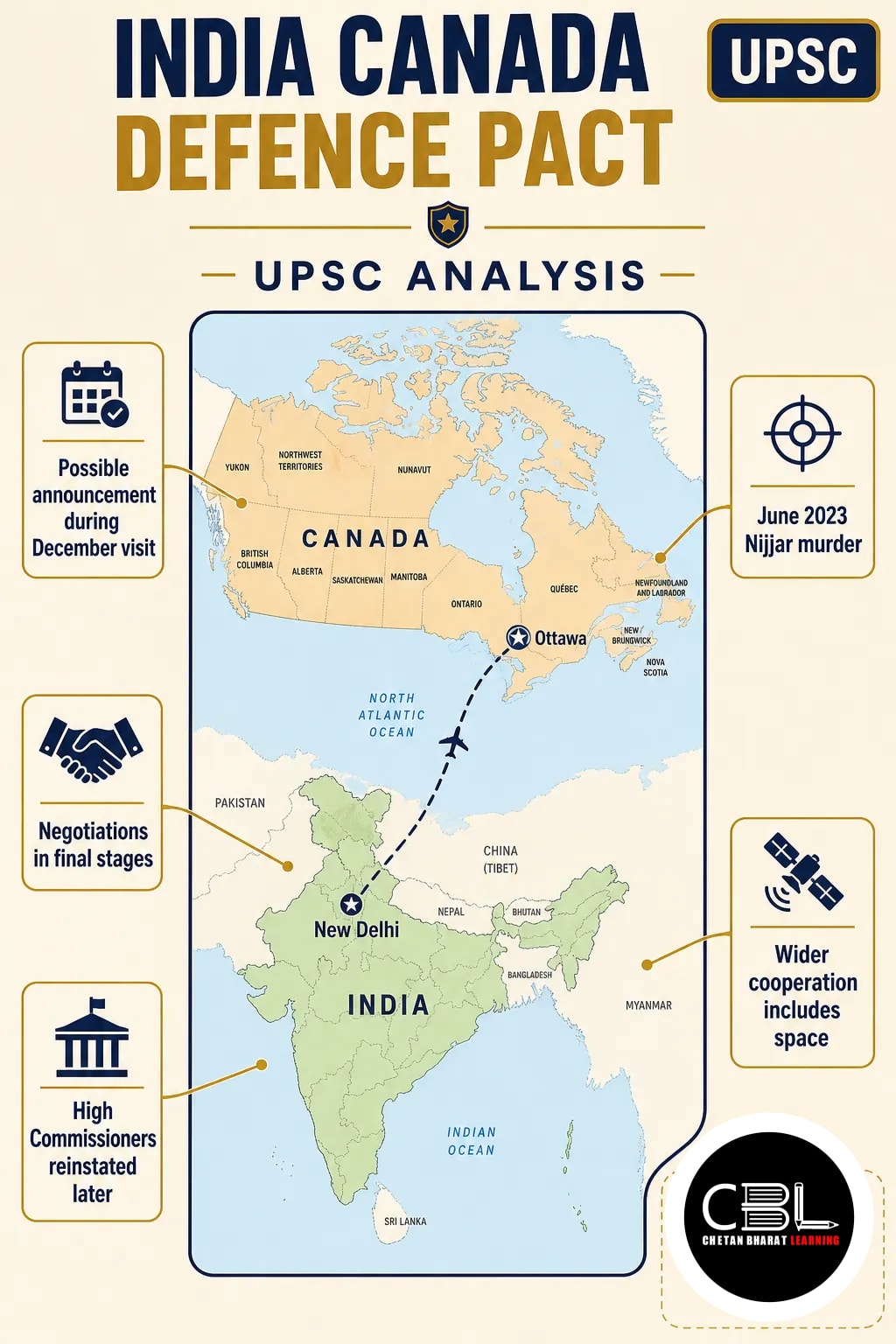
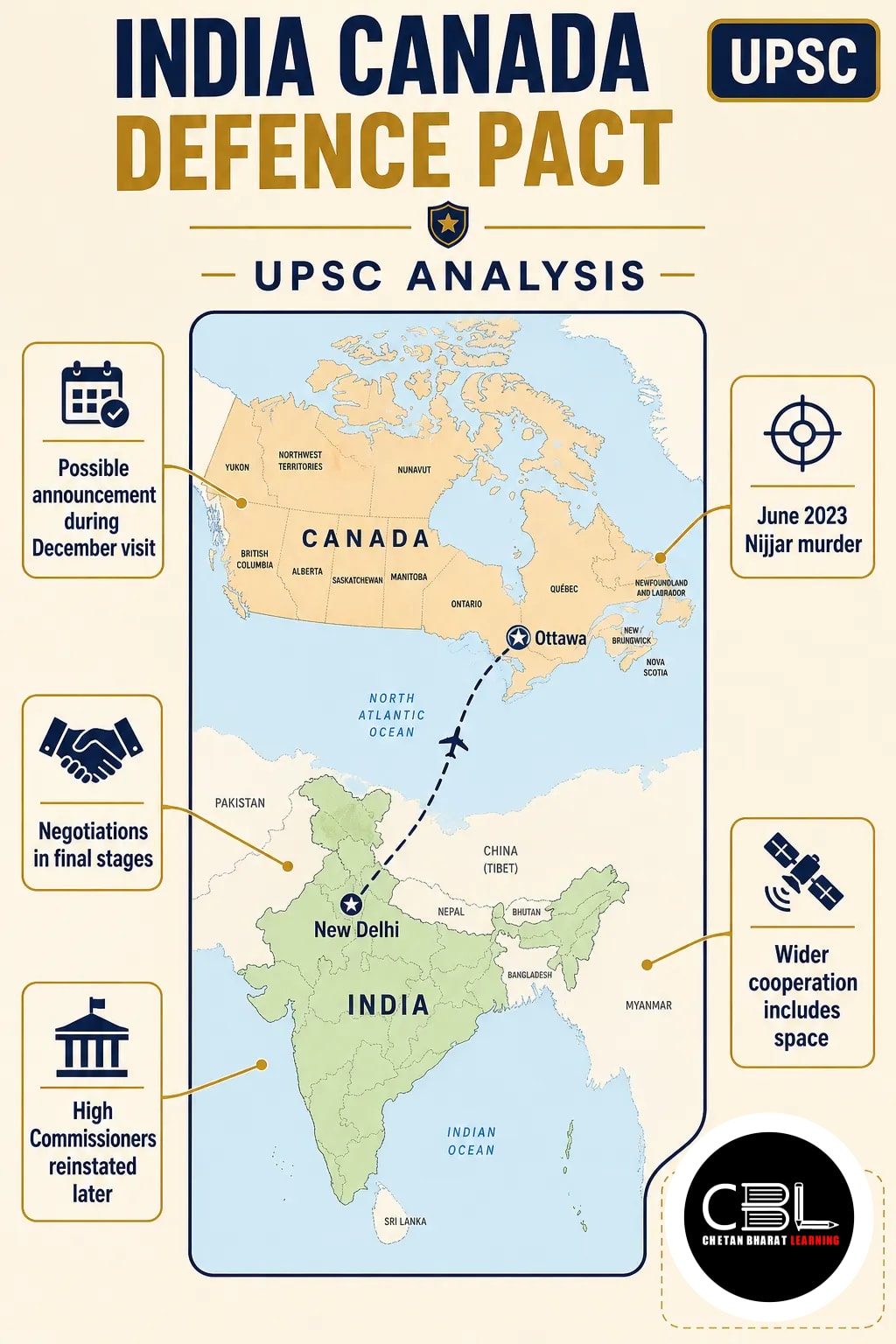
India Canada defence pact discussions could lead to an announcement during Prime Minister Narendra Modi’s December visit. The proposal adds a security dimension to the wider recovery of India’s international relations.
Quick answer: India and Canada may announce a defence agreement during Modi’s official visit on 11–12 December 2026, according to Indian High Commissioner Dinesh K. Patnaik. The possible India Canada defence pact comes as the countries rebuild trust after a diplomatic rupture and negotiate a Comprehensive Economic Partnership Agreement.
What happened in India–Canada relations?
India and Canada are considering a defence agreement for possible announcement during Modi’s upcoming official visit. Patnaik discussed the prospect at an Ottawa gathering organised by the Centre for Strategic Statecraft and the Canadian International Council.
He said the countries should prevent fringe issues from disrupting their broader mutual interests. He also described cooperation between their agencies as remaining at a high level.
However, the report does not specify the proposed agreement’s text or operational commitments. The India Canada defence pact is therefore a prospect, not a signed agreement. Read more on the strategic opportunities in defence collaboration.
What are the key developments and possible outcomes?
The visit could advance defence and economic engagement, although neither agreement is complete in the reported account.
| Development | Status and relevance |
|---|---|
| Defence | An agreement could be announced during the December visit; its terms are not specified. |
| Trade | Patnaik said negotiations on the Comprehensive Economic Partnership Agreement are in their final stages. |
| Diplomatic ties | The two countries reinstated their High Commissioners after an earlier reduction in diplomatic presence. |
| Wider cooperation | Patnaik identified space, nuclear energy, deep tech, trade and mobility alongside defence. |
In addition, the economic partnership negotiations provide a separate track for restoring bilateral engagement. Progress in one track, however, does not establish that the other has been concluded.
Why did relations deteriorate?
Relations deteriorated after the June 2023 murder of Sikh Khalistani activist Hardeep Singh Nijjar. Then Canadian Prime Minister Justin Trudeau accused India of orchestrating the murder.
The two countries subsequently expelled each other’s High Commissioners and reduced their diplomatic presence. Canadian agencies later listed India, alongside China and Russia, as an interferer in domestic politics.
Patnaik described a mutual trust deficit: India believed Canada promoted separatism in India, while Canada believed India organised violence in Canada. These are accounts of the two sides’ positions, not findings established by the proposed pact. For background, see the diplomatic row following Nijjar’s killing.
According to Patnaik, senior ministers, national security advisers and agencies held meetings to rebuild trust. Moreover, he said the relationship has moved beyond a simple reset towards cooperation across several sensitive sectors. He took charge as High Commissioner in September 2025.
What is the significance for India?
The possible agreement matters because it tests whether renewed trust can support sustained security cooperation.
- Strategic dialogue: Defence engagement could provide a structured channel for discussing shared concerns. Its practical value, however, depends on the terms the countries ultimately agree.
- Broader partnership: Linking defence dialogue with space and deep-tech engagement could widen the relationship beyond a single diplomatic dispute. Therefore, setbacks in one area need not automatically end every channel.
- Economic complement: Progress in trade talks could support a more diversified relationship. Nevertheless, the reported final stage of negotiations is not equivalent to an agreement in force.
- People-to-people ties: Mobility is among the areas Patnaik identified for cooperation. Consequently, the quality of bilateral relations also matters beyond government-to-government contacts.
What concerns could limit cooperation?
The main challenge is to make cooperation durable despite the distrust exposed by the Nijjar dispute.
- Security perceptions: The governments’ differing concerns about separatism and violence can complicate sensitive dialogue. Therefore, sustained agency-level communication remains important.
- Unclear commitments: The reported account does not detail the proposed pact’s scope. Consequently, claims about specific military activities or technology transfers would be premature.
- Implementation risk: Even an eventual announcement would require follow-through by the relevant institutions. Otherwise, political intent may not translate into sustained cooperation.
- Diplomatic resilience: A future disagreement could again affect cooperation across sectors. Hence, regular channels matter even when the two governments disagree.
What should be the way forward?
India and Canada should build predictable channels while addressing security concerns and protecting space for wider cooperation.
First, regular ministerial and agency dialogue can help prevent disputes from closing communication. Second, if an agreement is reached, both sides should clarify its scope and institutional responsibilities.
Third, progress on trade, mobility and technology should be assessed on its own merits. Finally, the countries should pair strategic engagement with attention to sovereignty, public accountability and the rule of law. An announcement would be a starting point; implementation would be the real test.
Source: The Hindu International, 19 November 2026
- India Canada CEPA Talks: Significance for UPSC (12 Nov 2026)
- India Canada Relations: December Visit and UPSC Analysis (31 Oct 2026)
- Canada India Defence Collaboration: Strategic Opportunities (22 Jul 2026)
Punjab PCS and Haryana HCS candidates can study this issue under international relations and current events. In addition, questions may connect diaspora-related concerns with diplomacy and the mobility of people.
Prelims Practice Corner
Mains Practice Questions
Frequently Asked Questions
Has India signed a defence pact with Canada during this visit?
No, the reported agreement is only a possible announcement for the forthcoming visit. Moreover, the source does not specify its terms.
When is the Indian Prime Minister’s visit to Canada scheduled?
The visit is scheduled for 11–12 December 2026. During it, the countries could announce a defence agreement.
What is the status of India–Canada trade agreement talks?
Negotiations are in their final stages, according to High Commissioner Patnaik. However, the source does not say that the agreement has been concluded.
Why were India–Canada diplomatic ties strained?
Ties deteriorated after the June 2023 murder of Hardeep Singh Nijjar and Canada’s accusation against India. Subsequently, both countries expelled each other’s High Commissioners and reduced their diplomatic presence.
Related Current Affairs
Preparing for UPSC, PCS or HCS?
Talk to a mentor at Chetan Bharat Learning, Chandigarh. Free guidance on choosing the right exam and building a study plan.
Chat on WhatsAppCall 97793 53345UPSC / IAS / PCS coaching in Chandigarh · Trusted by aspirants across Punjab & Haryana









Leave a Reply
You must be logged in to post a comment.