

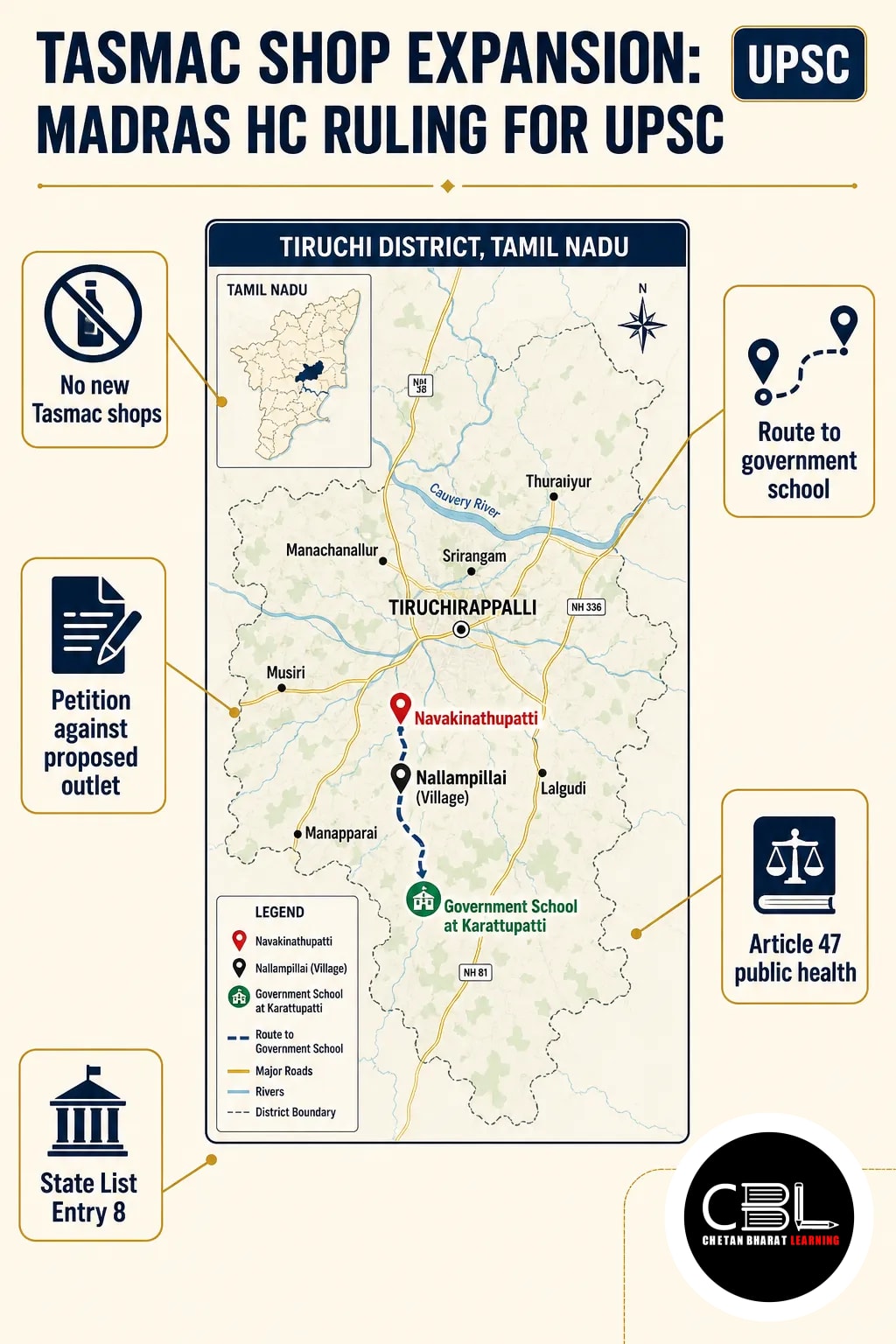
Tasmac shop expansion has come under scrutiny after the Madurai Bench of the Madras High Court directed Tamil Nadu not to open new outlets. The order links local safety concerns with wider questions of constitutional governance and public interest.
Quick answer: The Madurai Bench directed Tamil Nadu not to open new Tasmac shops, citing public interest and the large number of existing outlets. The Tasmac shop expansion direction came while allowing a petition against a proposed outlet near a school route in Tiruchi district. The petitioner said the village had around 30 families.
What did the High Court hold?
The Division Bench directed the State government not to open new Tasmac liquor shops in Tamil Nadu. Justices P. Velmurugan and K.K. Ramakrishnan noted the large number of existing outlets and considered the restriction necessary in public interest.
The court allowed a public interest litigation (PIL) petition concerning a proposed shop in Tiruchi district. A PIL allows a court to consider a matter affecting the public, rather than only an individual dispute.
The reported direction concerns new shops. It should not be described as an order closing all existing outlets or imposing complete prohibition.
For another aspect of the same retail network, see CBL’s coverage of Tasmac bottle return machines.
What prompted the petition?
V. Manikandan challenged a proposed outlet at Navakinathupatti in Nallampillai village, Tiruchi district. He said agriculture predominated there and about 30 families lived in the village.
According to the petitioner, students used the proposed site’s route to reach the government school at Karattupatti. He also described the area as accident-prone and raised concerns about women’s safety and students’ welfare.
Moreover, he said a Tasmac shop already operated in a nearby village. Residents had opposed another outlet in the village or surrounding villages, and his representation to the authorities had not produced action, he stated.
These are the petitioner’s submissions; the available report does not establish a causal link between an outlet and accidents or unsafe conditions.
Which constitutional provisions are relevant?
The Constitution assigns states a significant role in liquor regulation while recognising public health as a policy priority.
| Provision | Relevance |
|---|---|
| Article 226 | Empowers High Courts to issue writs for fundamental rights and other purposes. |
| Article 47 | Directs the State to improve public health and endeavour to prohibit intoxicating drinks and drugs injurious to health, except for medicinal purposes. |
| State List, Entry 8 | Covers intoxicating liquors, including their production, possession, transport, purchase and sale. |
| State List, Entry 51 | Covers excise duties on specified goods, including alcoholic liquor for human consumption, manufactured or produced in the state. |
Article 47 is a Directive Principle of State Policy, not a directly enforceable fundamental right. Nevertheless, it provides constitutional context for public-health policy; the source report does not say the Bench relied on it.
Similarly, Article 226 provides the general framework for High Court writ jurisdiction. The report does not specify the precise writ sought or issued in this case.
What are the governance implications?
The direction makes outlet location and administrative accountability central to the debate on Tasmac shop expansion.
- Public health and safety: Shop locations can raise questions about school routes, road safety and neighbourhood wellbeing. Therefore, authorities need site-specific evidence before taking decisions.
- Access to remedies: A PIL can bring community concerns before a High Court when residents contest an administrative decision. However, it does not replace routine public consultation.
- State finances: Liquor regulation also intersects with state excise revenue. Consequently, governments must consider fiscal effects alongside health and safety objectives.
- Executive accountability: Written responses to residents can show how officials evaluated objections. They also allow affected people to understand the basis of a decision.
CBL’s coverage of the Madras High Court ruling on a mineral ban offers another example of judicial scrutiny of state decisions, although the subject matter differs.
What concerns remain, and what should follow?
Implementation and policy design matter as much as the restriction on new shops.
- Scope of compliance: Officials must distinguish new outlets from existing ones and follow the court’s direction. However, the source report does not set out detailed implementation arrangements.
- Evidence gaps: A nearby outlet or an accident-prone road may warrant scrutiny, but each site’s actual risks require assessment. Therefore, decisions should not treat allegations as established findings.
- Policy balance: Restrictions can address availability concerns, while demand for alcohol and possible unregulated supply also need attention. Neither outcome is established by this report.
- Administrative response: Authorities should record objections, assess school routes and road safety, and give reasoned replies. In addition, they should monitor compliance with the court direction.
Overall, the case illustrates how a local objection can prompt a wider direction. For Mains answers, distinguish the court’s reported holding from constitutional context and policy recommendations.
Source: The Hindu National, 19 November 2026
- Tasmac Bottle Return Machines: UPSC Facts (3 Nov 2026)
Asked in State PCS: Previous Year Questions
- Haryana HCS Prelims 2024 (General Studies): How many statements are correct: PIL enforces public interest, reinforces locus standi, permits citizens and organisations to petition, and lies under Articles 32 and 226?
State PCS examinations can link PIL to court jurisdiction and access to justice.
Punjab PCS and Haryana HCS may test High Court writ jurisdiction, PIL and state powers over liquor. For governance answers, also consider how authorities should respond to community objections about outlet locations.
Prelims Practice Corner
Mains Practice Questions
Frequently Asked Questions
Did the Madras High Court order all Tasmac shops to close?
No, the reported direction concerns the opening of new shops. The report does not say that the court ordered all existing outlets to close.
Where was the proposed shop challenged in the petition?
It was proposed at Navakinathupatti in Nallampillai village, Tiruchi district. The petitioner also raised concerns about the route to the government school at Karattupatti.
What does Article 47 say about intoxicating drinks?
It directs the State to endeavour to prohibit intoxicating drinks and drugs injurious to health, except for medicinal purposes. However, Article 47 is a Directive Principle rather than a directly enforceable fundamental right.









Leave a Reply
You must be logged in to post a comment.