
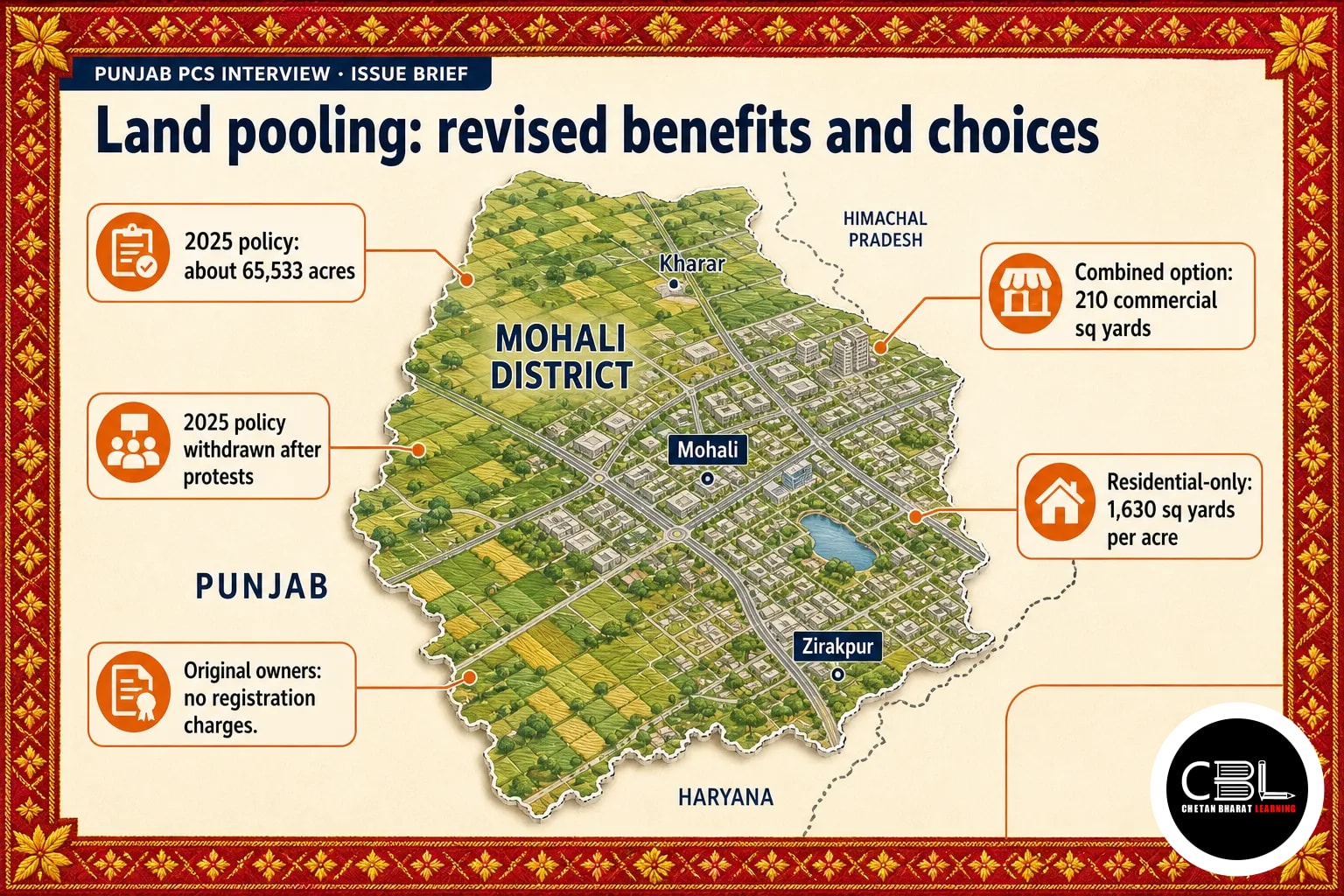

On 2 July 2026, the Punjab cabinet approved revised land-pooling benefits. Under the residential-and-commercial option, the commercial entitlement rose from 200 to 210 sq yards per acre. The earlier 2025 policy had been withdrawn after farmer protests and a High Court stay. The revision brings landowner benefits back into focus, alongside concerns about fertile land, fair value and the delivery of developed plots.
Timeline: from acquisition law to revised benefits
- 2013national lawAcquisition
Parliament enacted the 2013 land acquisition law, providing a framework for compensation and rehabilitation.
- 14 May2025Policy
Punjab notified its land-pooling policy for about 65,533 acres.
- 11 Aug2025Withdrawal
The policy was withdrawn after farmer protests and a High Court stay.
- 2 July2026Revision
The cabinet approved revised benefits, including 210 sq yards of commercial plot per acre under the combined option.
What is land pooling?
Land pooling brings land together for planned development. Landowners receive developed plots in return for their land, rather than only cash compensation.
Acquisition follows a statutory framework, including the Right to Fair Compensation and Transparency in Land Acquisition, Rehabilitation and Resettlement Act, 2013. The Greater Mohali Area Development Authority and other urban development authorities are relevant institutions for planned urban growth.
The two sides
Case for land pooling
- Developed plots can allow landowners to share in the value of urban development.
- Pooling can support coordinated layouts and infrastructure.
- Revised plot entitlements increase the stated benefits for landowners.
Farmers and landowner concerns
- Fertile agricultural land supports livelihoods and food production.
- Fair value depends on the location and usefulness of the developed plot.
- Farmers protested against the 2025 policy before its withdrawal.
Key data
| Point | Details |
|---|---|
| 2025 policy | Notified on 14 May for about 65,533 acres; withdrawn on 11 August. |
| Combined option | Residential entitlement remains 1,000 sq yards per acre; commercial entitlement rises from 200 to 210 sq yards per acre. |
| Residential-only option | Entitlement rises from 1,600 to 1,630 sq yards per acre. |
| Commercial-category projects | Entitlement rises from 800 to 840 sq yards. |
| Acquired land | Landowners whose land is acquired get 200, 300 or 500 sq yard plots, depending on acreage. |
| Charges | No stamp duty or registration charges for original landowners receiving developed plots. |
| Legal context | The 2013 land acquisition law provides a separate framework for acquisition, compensation and rehabilitation. |
Way forward
- Consult early: Explain the options to landowners and listen to farmers before planning proceeds.
- Make value transparent: Publish clear comparisons of plot entitlements, locations and expected infrastructure.
- Protect livelihoods: Assess impacts on agricultural land and affected households while planning development.
- Deliver reliably: Set out development milestones and a accessible grievance mechanism.
- Apply the right law: Distinguish pooling terms from statutory acquisition and communicate each process clearly.
Likely interview questions
What is land pooling, and how does it differ from acquisition?
Answer pointers:
- Pooling offers developed plots in return for land.
- Acquisition operates under a statutory compensation and rehabilitation framework.
- Explain the applicable terms clearly to landowners.
Do you think revised plot benefits will address farmers’ concerns?
Answer pointers:
- Higher entitlements can improve the offer to landowners.
- Fertile land, plot location and livelihood concerns remain important.
- Pair benefits with consultation and transparent delivery.
Do you think land pooling is preferable to acquisition for urban expansion?
Answer pointers:
- Pooling can let owners share in developed land value.
- Acquisition has a statutory framework for compensation and rehabilitation.
- Assess the project and communicate the appropriate process fairly.
As Sub-Divisional Magistrate in Mohali, how would you respond to landowners worried about pooling?
Answer pointers:
- Hear concerns through accessible public meetings.
- Explain entitlements and record questions about land and livelihoods.
- Coordinate with the competent authority and provide a grievance channel.
How would you link land pooling to agricultural livelihoods in Punjab?
Answer pointers:
- Urban growth requires land and infrastructure.
- Agricultural land also supports livelihoods and food production.
- Use transparent assessment and consultation to balance both needs.
Distinguish the 2025 withdrawal from the 2026 approval of revised benefits. Discuss urban growth and farmers’ livelihoods without treating either concern as minor.
Prelims Practice Corner
Q1. When was Punjab’s 2025 land-pooling policy withdrawn?
(a) 14 May 2025 (b) 11 August 2025 (c) 2 July 2026 (d) 14 May 2026
Show answer
Answer: (b) because the policy was withdrawn on 11 August 2025.
Q2. Under the revised combined option, what is the commercial plot entitlement per acre?
(a) 200 sq yards (b) 210 sq yards (c) 840 sq yards (d) 1,630 sq yards
Show answer
Answer: (b) because the commercial entitlement rose from 200 to 210 sq yards per acre.
Q3. Which year is associated with the national land acquisition law discussed here?
(a) 1966 (b) 2005 (c) 2013 (d) 2026
Show answer
Answer: (c) because the land acquisition, rehabilitation and resettlement law was enacted in 2013.
Frequently Asked Questions
What changed in Punjab land pooling in July 2026?
The cabinet approved increased plot entitlements under several categories. For example, the residential-only entitlement rose to 1,630 sq yards per acre.
Why was Punjab’s 2025 land-pooling policy withdrawn?
It was withdrawn after farmer protests and a High Court stay. The withdrawal took place on 11 August 2025.
Do original landowners pay registration charges for developed plots?
No stamp duty or registration charges apply to original landowners receiving developed plots. This was included in the revised benefits approved in July 2026.
Sources: The Tribune
Related Current Affairs
More Punjab interview issues
Preparing for UPSC, PCS or HCS?
Talk to a mentor at Chetan Bharat Learning, Chandigarh. Free guidance on choosing the right exam and building a study plan.
Chat on WhatsAppCall 97793 53345UPSC / IAS / PCS coaching in Chandigarh · Trusted by aspirants across Punjab & Haryana


Leave a Reply
You must be logged in to post a comment.