

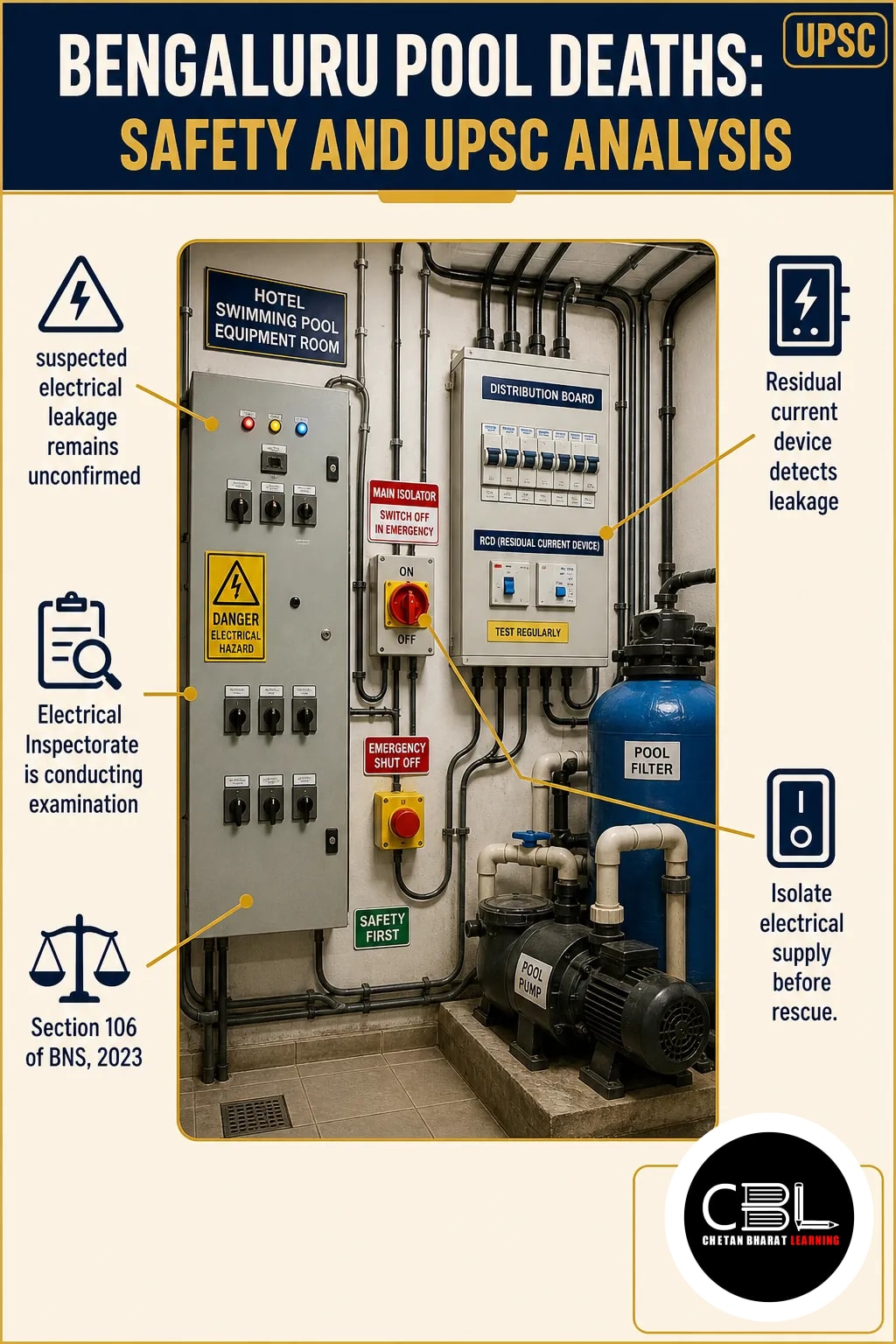
The Bengaluru pool deaths have brought electrical safety and emergency preparedness at hotels under scrutiny. The incident also offers a case study for national governance and public safety.
Quick answer: The Bengaluru pool deaths occurred on 30 October 2026 at Hotel Conrad, where a German and a Slovakian national died following suspected electrocution. A lifeguard also suffered shocks during rescue. The Electrical Inspectorate is examining the cause, while police are investigating possible negligence and the hotel’s safety response.
What happened at the hotel pool?
Two guests died after suspected electrocution in a third-floor swimming pool in central Bengaluru. The incident occurred at about 5:15 p.m. on 30 October 2026 at Hotel Conrad, operated by the Hilton Group.
The victims were Alexander Maximilian Theiss, 57, a German Lufthansa crew member, and Juraj Horvat, 45, a Slovakian visitor. Theiss had arrived from Frankfurt; Horvat was holidaying in India with his wife.
American guest Mathew Desantis, 41, sensed a strong current and swam to safety, according to Manipal Hospital. Meanwhile, lifeguard Rahul Tiwari, 28, entered the pool to rescue the victims and suffered shocks.
Hotel staff switched off the electricity before the victims were pulled out. Desantis attempted to administer cardiopulmonary resuscitation (CPR), and an ambulance took the victims to hospital.
Manipal Hospital said Theiss was brought dead; Horvat arrived in cardiac arrest and could not be revived. Tiwari and Desantis were subsequently discharged.
What is known about the suspected electrical fault?
The precise source of the suspected electrical leakage remains unconfirmed. The Electrical Inspectorate is conducting a technical examination, and its report is awaited; the pool has been shut for inspection.
Investigators initially suspected a short circuit, damaged lighting wires and poor earthing. However, these are lines of inquiry, not established findings about the Bengaluru pool deaths.
Pool lighting, filtration pumps, water circulation and heating equipment all use electricity. Therefore, damaged insulation, defective fittings or failed protective systems can create a leakage risk. Even an installation outside the pool can pose a danger if the pool’s electrical systems lack proper isolation and protection.
Which safeguards reduce electrical risks?
Electrical isolation, protective devices and regular testing reduce the risk of current reaching swimmers. The investigation must establish whether the relevant safeguards existed and worked at the hotel.
| Safeguard | Safety function |
|---|---|
| Earthing | Provides a path for fault current and supports protective operation. |
| Equipotential bonding | Connects conductive parts to limit dangerous voltage differences. |
| Residual current device | Detects leakage current and disconnects the supply. |
| Insulated, certified lighting | Reduces exposure to electrical faults in underwater equipment. |
| Periodic testing | Checks earthing and protective systems during operation. |
No single safeguard replaces maintenance. For example, a protective device must function correctly, while wiring and fittings also need inspection.
Why is the emergency response important?
Rescuers can face the same shock hazard as swimmers if pool water or nearby metal fittings are energised. Therefore, staff must isolate the electrical supply before anyone enters the affected water.
In this case, Tiwari entered the pool before staff switched off the power. The incident consequently raises questions about staff training, access to isolation controls and the speed of emergency decisions. These questions remain part of the investigation, not proof of negligence.
Facilities can plan for clear shutdown responsibilities, emergency communication and trained medical response after the electrical danger is removed. Regular drills can also help staff distinguish an electrical emergency from an ordinary drowning incident.
What are the legal and governance questions?
Police are investigating possible negligence alongside the separate technical inquiry into the electrical fault. Halasuru police registered a case against the hotel management under Section 106 of the Bharatiya Nyaya Sanhita (BNS), 2023, concerning death by negligence.
A registered case does not establish criminal liability. Investigators must examine the relevant evidence, including whether required electrical inspections occurred and whether management followed safety and maintenance procedures.
The source identifies two earlier fatal pool electrocutions in Bengaluru: a 17-year-old swimmer at a school in November 2022 and a nine-year-old girl at an apartment pool in December 2023. The Karnataka Swimming Association has now proposed a Karnataka Swimming Pools Act to standardise safety and quality control; it is a proposal, not an enacted law.
Implications for public safety
The Bengaluru pool deaths illustrate why safety governance must cover both technical compliance and emergency readiness. Inspection records alone cannot demonstrate that equipment will work unless testing is meaningful and defects are corrected.
Moreover, accountability requires clarity about the responsibilities of operators, maintenance personnel and inspecting authorities. A proposed state law could standardise expectations across facilities, but its effectiveness would depend on its eventual provisions and enforcement.
What should a preventive response include?
A preventive response should combine reliable electrical protection, documented maintenance and rehearsed emergency action. The following measures address distinct stages of risk:
- Test and maintain: Check earthing, bonding, insulation and protective devices periodically, and rectify identified defects.
- Prepare staff: Train personnel to recognise suspected electrical danger and isolate power before entering water.
- Document responsibility: Maintain inspection and repair records so that operators and authorities can verify follow-up.
- Learn from investigations: Use technical findings to refine standards and oversight without assuming the cause before the report.
For policymakers, the central lesson is to link standards with verification. Similarly, facility-level drills can turn written procedures into actions during an emergency.
Source: The Hindu, 2 November 2026
State PCS General Studies can use this case to examine inspection, public safety and emergency preparedness. In addition, candidates can consider how state authorities and facility operators coordinate preventive action.
Prelims Practice Corner
Mains Practice Questions
Frequently Asked Questions
What caused the Bengaluru pool deaths?
The precise cause remains unconfirmed. The Electrical Inspectorate is examining the suspected electrical leakage, and its report is awaited.
Which law did police invoke in the hotel pool case?
Police invoked Section 106 of the Bharatiya Nyaya Sanhita, 2023, concerning death by negligence. However, registration of a case does not establish guilt.
Has Karnataka enacted a swimming pools law following the incident?
No; the Karnataka Swimming Association has proposed such an Act. Its proposal seeks standardised safety measures and quality control across the state.

 Ananya RanaIAS · AIR 60
 Aditya SharmaIAS · AIR 70
 Ria Kaur SethiIPS · AIR 89
 Aman AloonIRS · AIR 295
 Sumer Singh VirkIRS · AIR 335
 Shivani PanchalIAS

Leave a Reply
You must be logged in to post a comment.