
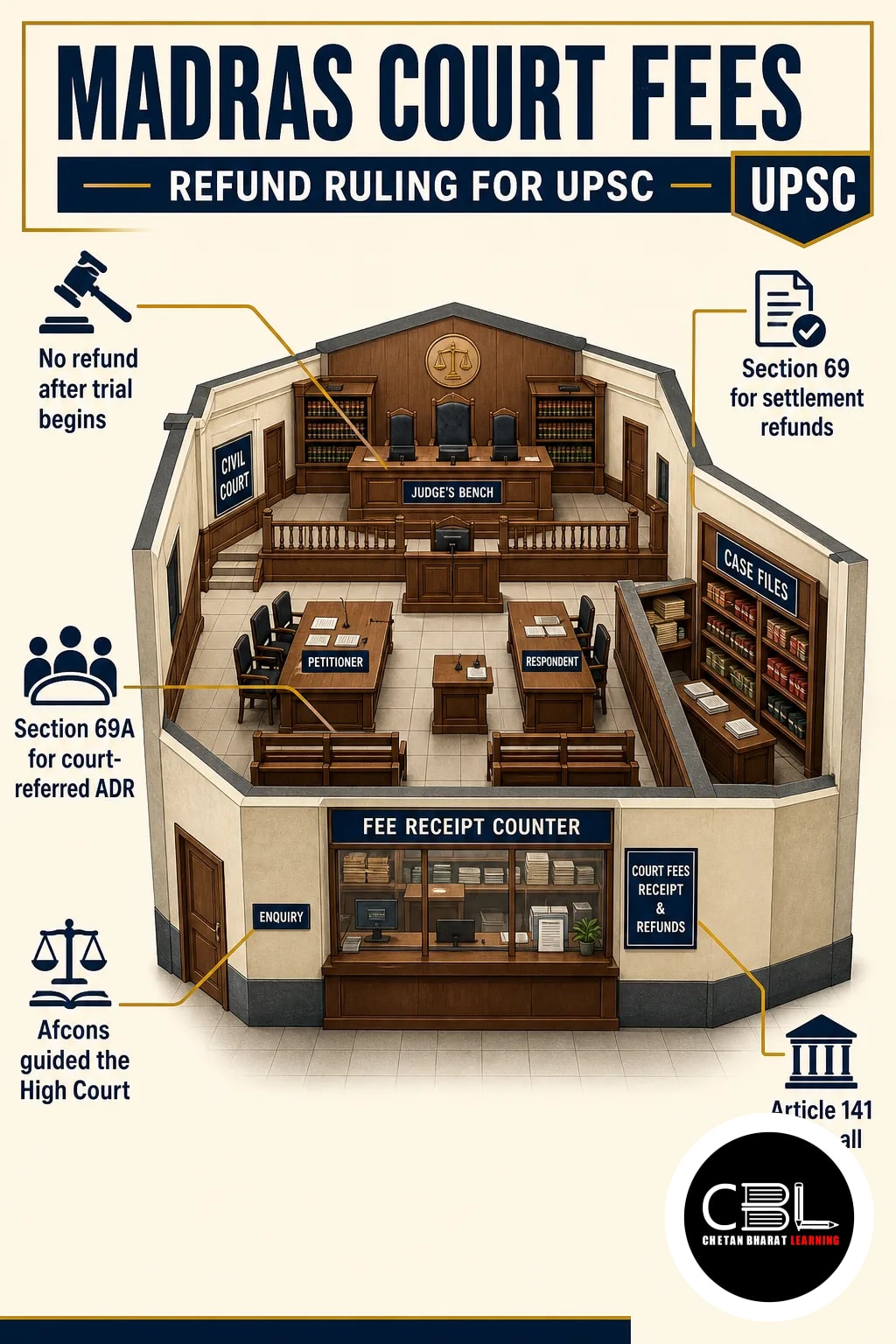

Madras court fees cannot be refunded for an out-of-court settlement reached after trial begins, the Madras High Court has held. The decision raises questions about settlement incentives, judicial precedent and public expenditure. For more on judicial institutions, see CBL’s polity current affairs.
Quick answer: In the Madras court fees ruling, Justice P.B. Balaji held that parties settling civil suits after trial begins cannot claim a fee refund. He dismissed two revision petitions, relied on the Supreme Court’s 2010 Afcons decision and asked the Tamil Nadu Law Commission to examine the refund provision.
What did the High Court hold?
The High Court held that an out-of-court settlement after trial begins does not entitle litigants to a court-fee refund. Justice Balaji connected that conclusion to the wording of Section 69 of the Tamil Nadu Court Fees and Suits Valuation Act, 1955, and the Supreme Court’s Afcons decision.
Section 69 refers to a suit dismissed as settled before evidence on the merits has been recorded. Moreover, the judge read Afcons as allowing court referrals under Section 89 of the Code of Civil Procedure (CPC) only before trial begins.
The judgment concerns the refund consequence; it does not state that parties cannot settle a dispute after trial starts. The distinction matters because a settlement and entitlement to recover fees are separate questions.
What were the two cases about?
Two litigants challenged separate district court orders concerning refunds after settlements. The High Court dismissed both civil revision petitions.
- Tiruvallur: One petitioner challenged an order granting only a 50% refund. However, the State had not challenged that order, so Justice Balaji left it undisturbed.
- Chengalpattu: The other petitioner challenged denial of a full refund of ₹2.54 lakh paid as court fees. The High Court held that no refund was due after trial had commenced.
In principle, the judge found neither petitioner entitled to a refund. Nevertheless, the first petitioner’s existing 50% order remained because the State had not sought its revision.
Which legal provisions govern refunds?
The 1955 state law distinguishes an out-of-court settlement under Section 69 from a court referral under Section 69A. Section 89 of the CPC supplies the framework for referral to alternative dispute resolution (ADR).
| Provision or change | Relevance |
|---|---|
| Section 69, 1955 Act | Originally provided a 50% refund for a suit dismissed as settled before evidence on the merits. |
| Section 69A, introduced in 2007 | Provided for a full refund certificate where a court-referred ADR dispute was settled. |
| 2017 amendments | Made the Section 69 refund 100% while retaining the evidence-stage condition; also changed Section 69A. |
| Section 89, CPC | Concerns court referral to mechanisms including arbitration, mediation, conciliation and Lok Adalat. |
Thus, the refund percentage and the stage at which a settlement occurs are distinct statutory issues. The judge considered the legislature’s retention of the evidence-related wording significant even after the 2017 change to a full refund.
Why did the court follow Afcons?
Justice Balaji preferred the earlier Afcons ruling because he considered it binding on a later Supreme Court bench of equal strength. He accepted Advocate General Vijay Narayan’s submission that the later M.C. Subramaniam decision had not considered Afcons.
According to the judge, a later coordinate bench that disagrees with an earlier bench’s ratio should refer the issue to a larger bench. Therefore, he followed Afcons rather than M.C. Subramaniam. This is the High Court’s reasoning on the relationship between the two decisions.
Article 141 of the Constitution states that the law declared by the Supreme Court binds all courts in India. Consequently, the order also illustrates how a High Court addresses an apparent conflict between Supreme Court precedents.
What are the implications and concerns?
The ruling links refund eligibility to the timing of settlement while recognising the public cost of running courts.
- Early settlement: A refund before evidence on the merits can create a financial incentive to resolve a suit early. However, parties who settle later cannot claim the same benefit under this ruling.
- Public expenditure: Court fees contribute towards court infrastructure, trials and staff salaries. Therefore, the judge considered the stage of proceedings relevant to retaining fees.
- Access to justice: Losing a refund may affect settlement calculations, particularly where fees are substantial. Nevertheless, the judgment does not prevent parties from reaching a later settlement.
- Predictability: Clear distinctions between private settlement and court-referred ADR can help litigants assess their options. In addition, clarity on precedent can guide lower courts.
What did the judge suggest for Section 69A?
The judge asked the Tamil Nadu Law Commission to examine restoring the earlier Section 69A formulation. He said the amended wording could trigger a full refund immediately upon an ADR referral, even if the dispute remained unresolved.
By contrast, the 2007 version linked the refund certificate to a successful settlement after referral. Restoring that approach, in the judge’s view, would better protect the State exchequer. A legislative review could therefore clarify both the trigger for refund and the outcome required for it.
For the wider constitutional context of High Court functioning, see CBL’s coverage of the Tamil petition on High Court language.
Source: The Hindu, 2 November 2026
State PCS General Studies can test court fees, civil procedure and the role of ADR in access to justice. However, candidates should distinguish the Tamil Nadu provisions discussed here from the law applicable in their own state.
Prelims Practice Corner
Mains Practice Questions
Frequently Asked Questions
Can litigants get a refund after settling a civil suit once trial has begun?
No, under the Madras High Court’s ruling, an out-of-court settlement after trial begins does not entitle litigants to a refund. The court relied on the 1955 state Act and Afcons.
What is the difference between Sections 69 and 69A?
Section 69 concerns qualifying out-of-court settlements, whereas Section 69A concerns court-referred ADR. The judge also asked for a review of the timing of refunds under Section 69A.
Why did the Tiruvallur litigant retain a 50% refund order?
The State had not challenged that order. Therefore, the judge left it undisturbed despite holding that no refund was due in principle.
Related Current Affairs
Preparing for UPSC, PCS or HCS?
Talk to a mentor at Chetan Bharat Learning, Chandigarh. Free guidance on choosing the right exam and building a study plan.
Chat on WhatsAppCall 97793 53345UPSC / IAS / PCS coaching in Chandigarh · Trusted by aspirants across Punjab & Haryana

 Ananya RanaIAS · AIR 60
 Aditya SharmaIAS · AIR 70
 Ria Kaur SethiIPS · AIR 89
 Aman AloonIRS · AIR 295
 Sumer Singh VirkIRS · AIR 335
 Shivani PanchalIAS

Leave a Reply
You must be logged in to post a comment.