
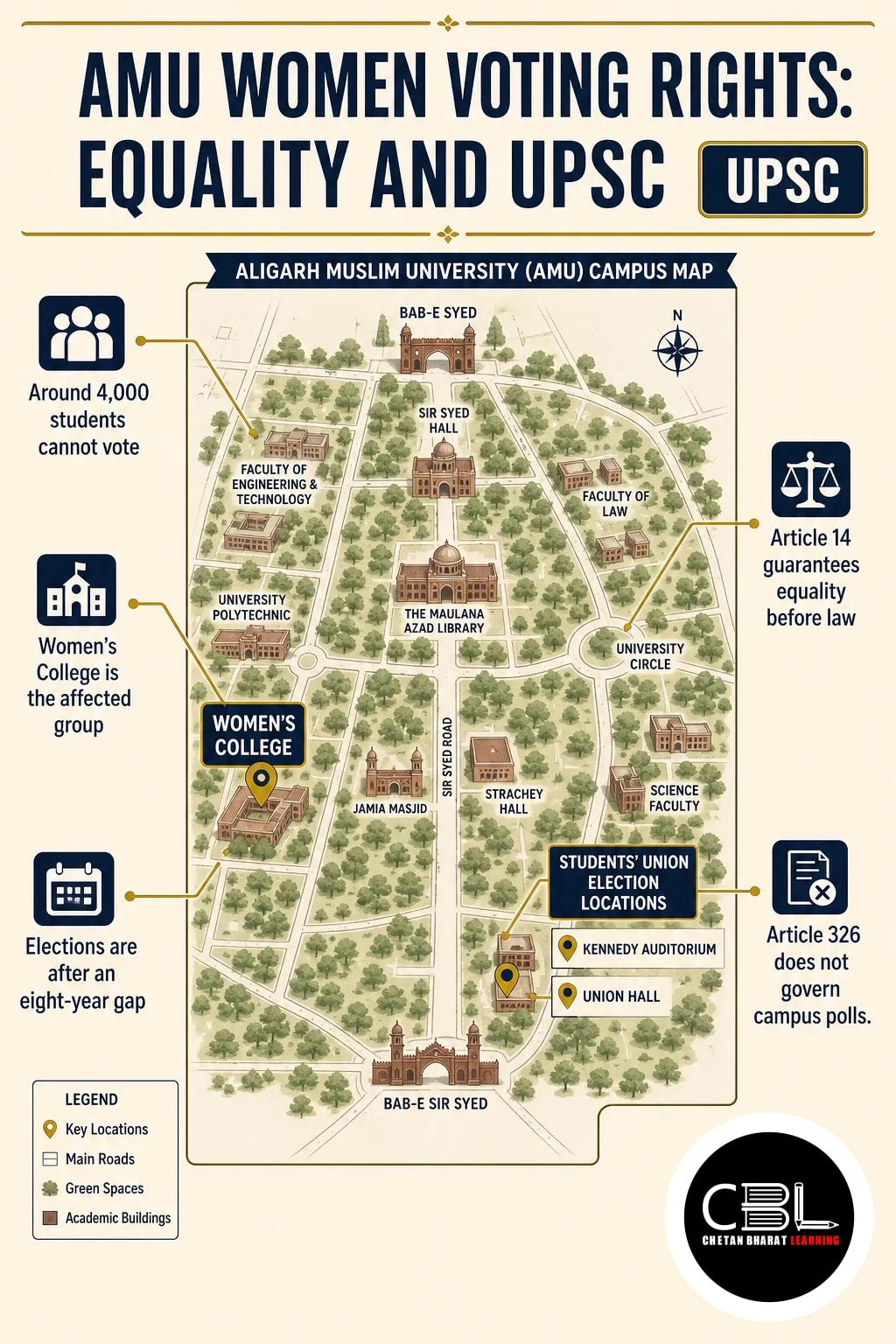

AMU women voting rights have become a question of representation as the university prepares for its students’ union elections. The issue connects campus governance with constitutional equality and democratic participation.
Quick answer: AMU women voting rights are in focus because around 4,000 students at Aligarh Muslim University’s Women’s College cannot vote in the Aligarh Muslim University Students’ Union elections. The elections are being held after an eight-year gap. The exclusion raises questions about gender equality, electoral eligibility and representation within university governance.
Why are AMU women voting rights in the news?
Around 4,000 Women’s College students have been denied a vote in the Aligarh Muslim University Students’ Union (AMUSU) elections. The poll follows an eight-year gap; therefore, the composition of its electorate has become an important question.
During campaigning, students Zunaira Habib Alvi and Rahat Ul Aien questioned vice-presidential candidate Saquib Ali Khan about their votes. The account also mentions women candidates; consequently, the exclusion of Women’s College voters should not be described as a ban on every woman’s participation.
The supplied account does not explain the eligibility rule or the university’s justification. Therefore, the distinction between a college-based rule and discrimination on grounds of sex requires examination of the actual election provisions.
Which constitutional provisions are relevant?
Articles 14 and 15 provide the central equality framework for examining a public institution’s rules. Other provisions offer context, but they do not automatically confer a campus-election vote.
| Provision | What it says |
|---|---|
| Article 14 | Equality before the law and equal protection of the laws. |
| Article 15(1) | Prohibits state discrimination against citizens on specified grounds, including sex. |
| Article 15(3) | Permits the State to make special provisions for women and children. |
| Article 19(1)(c) | Protects citizens’ freedom to form associations or unions, subject to applicable restrictions. |
| Article 326 | Provides for adult suffrage in elections to the Lok Sabha and State Legislative Assemblies, subject to constitutional conditions. |
Article 326 does not govern student-union elections. Their voting arrangements depend on applicable university rules; nevertheless, those rules can be assessed against relevant legal and constitutional standards.
Similarly, the freedom to form associations is distinct from a specific entitlement to vote in an institutional election. For another context in which constitutional freedoms shape public participation, see CBL’s analysis of the right to protest.
Why does the electorate matter for university governance?
The electorate determines whose preferences influence student representatives. When a large group cannot vote, representatives have less direct electoral accountability to that group.
- Voice in collective decisions: Voting lets students influence the choice of representatives; therefore, exclusion can limit their formal voice.
- Gender equality: A rule affecting a women’s college needs scrutiny of both its wording and its practical effect.
- Institutional legitimacy: Transparent eligibility criteria help students judge whether representation is fair; conversely, unexplained exclusions can weaken confidence.
- Democratic learning: Campus elections provide a setting for debate and accountability; moreover, participation connects those lessons to institutional decisions.
Access to education and access to electoral representation are different questions. Consequently, enrolment alone does not establish whether students can influence a union’s leadership.
What concerns need further examination?
The main concern is whether the exclusion has a defensible basis under the applicable rules and equality principles. A conclusion requires the rule’s text, its stated purpose and its effect on comparable student groups.
First, the stated reason for excluding Women’s College students is not available in the supplied account. Second, neither a court finding nor the complete electoral framework is provided. Therefore, it would be premature to state that a court has found the arrangement unconstitutional.
In addition, voting eligibility and eligibility to contest are separate questions. The presence of women candidates does not, by itself, answer whether Women’s College students can vote or contest.
How can universities strengthen inclusive representation?
Universities can strengthen representation by making election rules transparent and reviewing exclusions against equality principles.
- Publish eligibility rules: Explain who can vote or contest, the basis for distinctions and the process for correction.
- Review unequal effects: Compare the treatment of similarly placed students; additionally, assess whether exclusions fall disproportionately on women.
- Consult students: Hear affected students and representative bodies before revising electoral arrangements.
- Provide remedies: Establish a time-bound process to challenge voter-list omissions and communicate reasoned decisions.
Such measures would not predetermine a legal outcome. However, they would make the basis of representation clearer and allow students to seek correction where appropriate.
Source: The Hindu, 2 November 2026
State PCS General Studies can test equality provisions through examples of student representation and public-institution governance. In addition, compare campus electoral rules with adult suffrage for legislative elections.
Prelims Practice Corner
Mains Practice Questions
Frequently Asked Questions
How many AMU Women’s College students cannot vote?
Around 4,000 students cannot vote in the students’ union elections. The issue therefore raises questions about their electoral representation.
Does Article 326 apply to AMU student elections?
No, Article 326 concerns adult suffrage for Lok Sabha and State Legislative Assembly elections. University election eligibility instead depends on applicable institutional rules and legal standards.
Have all women been barred from participating in the AMUSU election?
No, the supplied account mentions women candidates as well as the exclusion of Women’s College voters. Therefore, the reported voting exclusion should not be generalised to every woman on campus.
Related Current Affairs
Preparing for UPSC, PCS or HCS?
Talk to a mentor at Chetan Bharat Learning, Chandigarh. Free guidance on choosing the right exam and building a study plan.
Chat on WhatsAppCall 97793 53345UPSC / IAS / PCS coaching in Chandigarh · Trusted by aspirants across Punjab & Haryana

 Ananya RanaIAS · AIR 60
 Aditya SharmaIAS · AIR 70
 Ria Kaur SethiIPS · AIR 89
 Aman AloonIRS · AIR 295
 Sumer Singh VirkIRS · AIR 335
 Shivani PanchalIAS

Leave a Reply
You must be logged in to post a comment.