
Char Dham helicopter rule has prompted operators to threaten a service suspension after a fatal crash in Uttarakhand. The dispute raises questions about aviation safety and public governance.
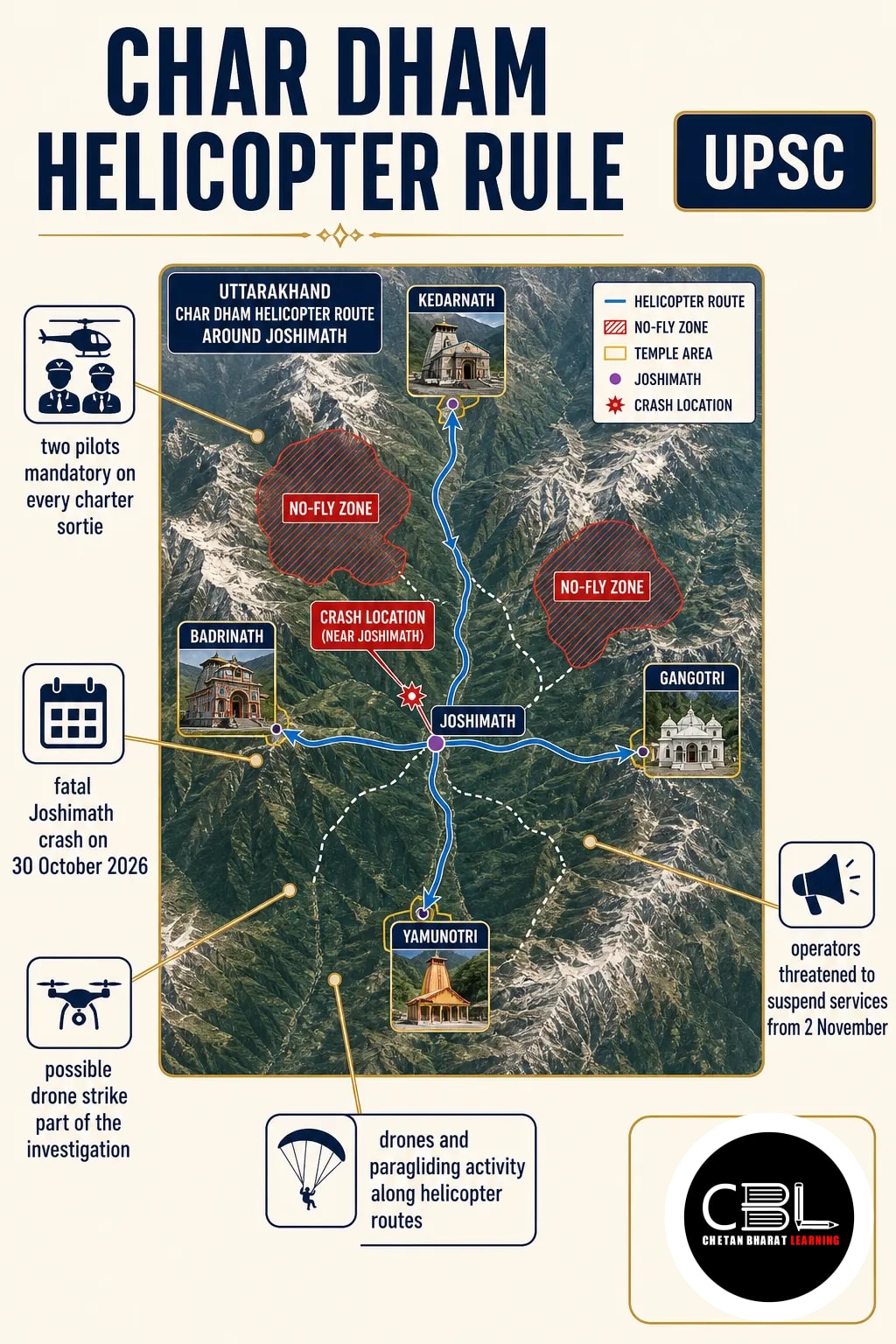
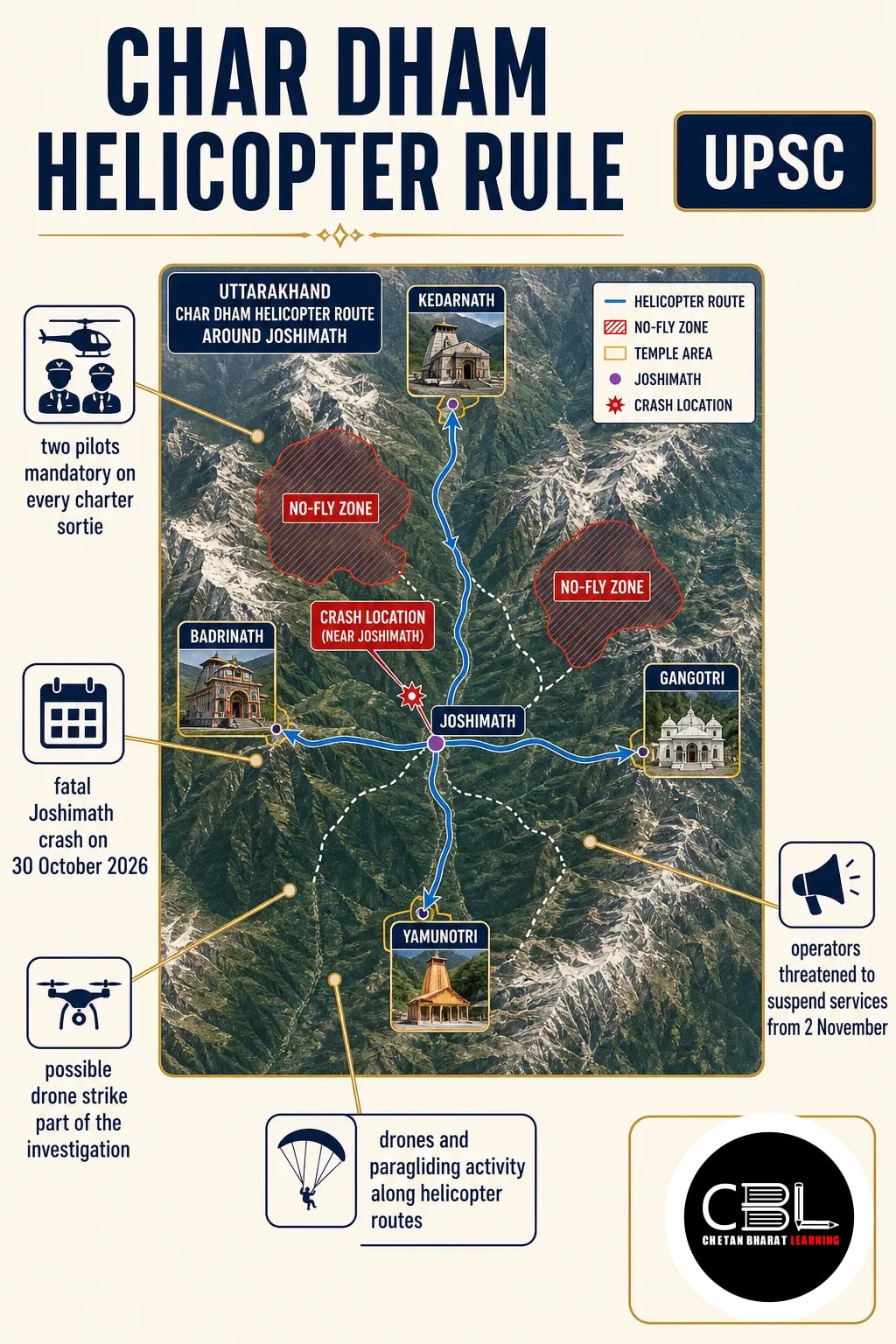
Quick answer: The Char Dham helicopter rule requires two pilots on every charter sortie. Authorities introduced it after the Joshimath crash on 30 October 2026 killed six people. However, operators say the extra costs are unsustainable and have threatened to suspend services from 2 November, pending a review.
What is the Char Dham helicopter rule?
The rule makes two pilots mandatory on every Char Dham charter sortie. The Directorate General of Civil Aviation (DGCA) and the Uttarakhand Civil Aviation Development Authority (UCADA) introduced the requirement after the Joshimath crash.
The measure adds a second crew member to each flight. However, the source does not specify its detailed implementation arrangements or establish that a second pilot would have prevented the crash.
| Issue | Key fact |
|---|---|
| Coverage | Every Char Dham charter sortie |
| Crew requirement | Two pilots on board |
| Authorities | DGCA and UCADA |
| Immediate context | Fatal Joshimath crash on 30 October 2026 |
Why is the rule in the news?
Operators have sought an urgent review and threatened to stop charter services from 2 November. Their collective representation says the directive was introduced without consultation or an assessment of commercial implications.
On 30 October, a helicopter crash at Joshimath killed six people, including the pilot. For background, see the coverage of the Uttarakhand helicopter crash. The threatened suspension is a proposal, not a confirmed halt in services.
Why do operators object to the mandate?
Operators argue that the second-pilot requirement increases costs that existing charter rates cannot absorb. Moreover, they say passing those costs to customers is not commercially feasible.
- Crew expenditure: Operators expect higher staffing costs for each sortie.
- Accommodation and logistics: They also anticipate additional expenses for housing and supporting crew.
- Consultation: They want regulators to assess commercial effects and find a mutually workable solution.
Their argument highlights a regulatory trade-off. A safety requirement must be implementable; however, commercial objections alone cannot establish that a safety measure is unnecessary.
What other safety concerns have emerged?
Operators have raised concerns about drones and paragliding activity along helicopter routes. One operator alleged that repeated complaints to UCADA had not led to action.
The same operator said the Indian Army had issued a Notice to Air Missions (NOTAM) on the crash day. However, the account does not establish that the notice caused the crash or identify its contents.
UCADA chief executive officer Prateek Jain said investigators had included a possible drone strike in their inquiry. He also said authorities were seeking the source of a ground video showing another object near the helicopter. Therefore, a drone strike remains a possibility under investigation, not an established cause.
Jain said UCADA had identified specific helicopter routes. In addition, police and district administrations across Uttarakhand had been asked not to permit drones near temples or along those routes. He said the authority was considering how to address the issue with the Army.
What are the governance challenges?
The dispute requires regulators to address flight safety, operational viability and coordination together. The Char Dham helicopter rule addresses crew composition, but the inquiry and route-safety concerns require separate attention.
- Evidence and accountability: Investigators must distinguish confirmed findings from speculation before assigning a crash cause.
- Airspace coordination: Civil authorities, district officials and other airspace users need clear communication on route hazards.
- Service continuity: A suspension could disrupt passengers; therefore, authorities need contingency communication without diluting safety standards.
- Regulatory credibility: Consultation can expose implementation constraints, while transparent reasons can explain why a requirement is necessary.
What should be the way forward?
Authorities should combine an evidence-led investigation with enforceable route controls and consultation on implementation. These steps are proposed safeguards, not measures established as already adopted.
- Complete the inquiry: Examine the available video and other evidence; then communicate findings without presuming a drone strike or pilot emergency.
- Review operational risks: Assess how two-pilot operations address identified risks, along with crew availability and logistical constraints.
- Coordinate route safety: Clarify responsibilities for drone permissions, paragliding activity and communication with relevant authorities.
- Plan continuity: Consult operators and inform passengers about any changes, while retaining safety as the governing criterion.
Overall, the Char Dham helicopter rule illustrates a wider governance challenge: designing safety regulation that can be enforced and evaluated in practice.
Source: The Hindu, 1 November 2026
State PCS General Studies can test the roles of civil aviation authorities and district administration in public safety. In addition, the dispute offers a case study in consultation, regulatory enforcement and coordination across agencies.
Prelims Practice Corner
Mains Practice Questions
Frequently Asked Questions
How many pilots are required on a Char Dham charter sortie?
Two pilots are required on every charter sortie. The authorities introduced the mandate after the Joshimath crash.
Have operators stopped Char Dham helicopter services?
No confirmed halt was stated in the source. Instead, operators threatened to suspend services from 2 November 2026 pending a review.
Did a drone cause the Joshimath helicopter crash?
The cause has not been established in the source. However, UCADA said a possible drone strike was part of the investigation.
Related Current Affairs
Preparing for UPSC, PCS or HCS?
Talk to a mentor at Chetan Bharat Learning, Chandigarh. Free guidance on choosing the right exam and building a study plan.
Chat on WhatsAppCall 97793 53345UPSC / IAS / PCS coaching in Chandigarh · Trusted by aspirants across Punjab & Haryana

 Ananya RanaIAS · AIR 60
 Aditya SharmaIAS · AIR 70
 Ria Kaur SethiIPS · AIR 89
 Aman AloonIRS · AIR 295
 Sumer Singh VirkIRS · AIR 335
 Shivani PanchalIAS

Leave a Reply
You must be logged in to post a comment.