
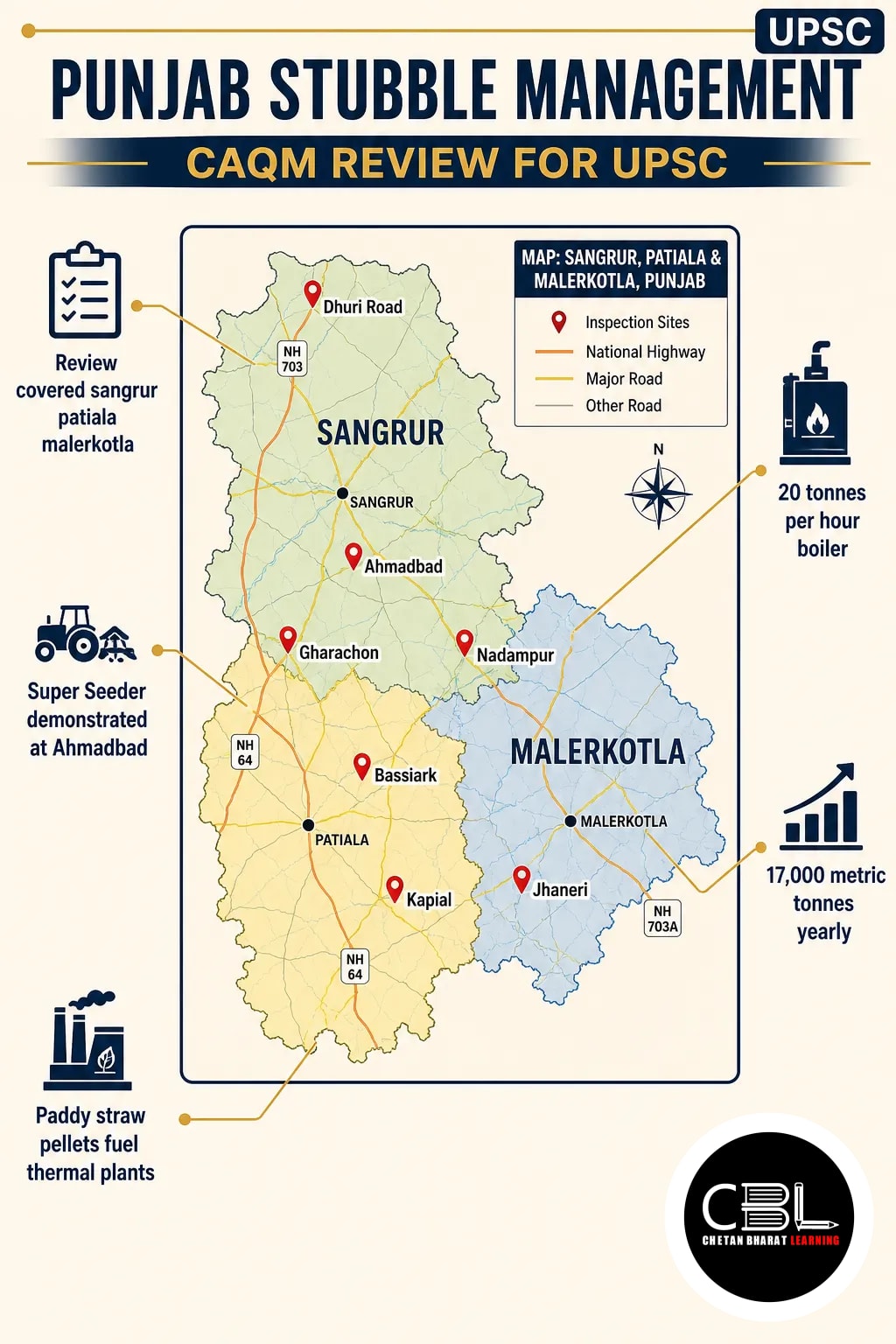

Punjab stubble management came under review on 31 October 2026, when a high-level air quality team met district officials in Sangrur. The visit connects agricultural practices with environment and air quality governance.
Quick answer: The Commission for Air Quality Management reviewed Punjab stubble management in Sangrur, Patiala and Malerkotla on 31 October 2026. Its team examined field machinery and industrial uses of paddy residue. One Malerkotla unit reported a 20-tonne-per-hour boiler and projected annual use of 17,000 metric tonnes of straw.
What did the Punjab stubble management review cover?
The review assessed district preparations to manage paddy residue and prevent field burning during the harvest season. It combined an official meeting in Sangrur with visits to farms and processing units.
The Commission for Air Quality Management (CAQM) for the National Capital Region (NCR) and adjoining areas sent technical member Dr S. D. Attri and Scientist C Vijay Kumar. Deputy Commissioners and Senior Superintendents of Police from the three districts attended. Officials from the Punjab Pollution Control Board (PPCB), the agriculture department and Central Pollution Control Board (CPCB) flying squads also participated.
The team asked departments to maintain close monitoring and align field action with district action-plan targets. However, the source does not quantify burning incidents or establish the review’s outcomes. For context on the wider problem, see why stubble burning persists in India.
Where did the team inspect residue management?
The team inspected field demonstrations and off-farm uses in Malerkotla and Sangrur districts. The following locations show how different parts of the residue chain fit together.
| Location | Observation |
|---|---|
| Dhuri Road, Malerkotla | A duplex board and paper unit uses straw as boiler fuel; representatives projected 17,000 metric tonnes of annual use. |
| Ahmadbad village, Malerkotla | The agriculture department demonstrated a Super Seeder; farmers said they would use machinery rather than burn residue. |
| Gharachon, Sangrur | In-situ and ex-situ methods were demonstrated in the identified hotspot village. |
| Nadampur, Bhawanigarh | A unit converts paddy straw into biomass pellets for use as fuel in thermal power plants. |
The team also visited Bassiark, Kapial and Jhaneri villages in Bhawanigarh tehsil. Farmers discussed difficulties in using crop residue management (CRM) machinery, although the source does not specify those difficulties.
How do in-situ and ex-situ methods differ?
In-situ management handles residue within the field, whereas ex-situ management uses it outside the field. Both can provide alternatives to open burning, but they require different support systems.
In-situ: machinery at the farm
The Super Seeder demonstration illustrated an in-field approach. Accordingly, farmers need access to suitable machinery and practical assistance during harvesting and subsequent sowing. District officials briefed the team on arrangements to make CRM machinery available.
Ex-situ: straw as an industrial input
The Malerkotla paper unit uses straw in a boiler with a capacity of 20 tonnes per hour. Its projected annual straw consumption is an industry estimate, not a figure for verified use. Meanwhile, the Nadampur unit makes pellets that can serve as thermal power plant fuel.
These examples show potential demand for residue beyond farms. However, moving straw from fields to users also requires collection, transport and reliable processing arrangements. The earlier explainer on the Pusa-44 paddy variety offers related crop context.
Why does the review matter for air quality governance?
Punjab stubble management matters because residue burning links farm decisions with air quality across administrative boundaries. Consequently, prevention requires coordination among farmers, district administrations, pollution regulators and residue users.
- Public health: Open burning adds smoke and particulate pollution to the air; therefore, preventing fires can reduce one source of exposure.
- Farm operations: Machinery offers an alternative, but access alone does not establish that farmers can use it effectively.
- Resource use: Industrial boilers and pellet units create uses for straw; moreover, they can complement field-based methods.
- Accountability: District action plans offer a basis for checking whether field operations match stated targets.
These benefits depend on implementation. The review documents preparations and demonstrations, not a measured reduction in pollution or fires.
What challenges remain and what should be done?
The central challenge is to make non-burning options workable for farmers throughout the harvest period. The review identifies machinery difficulties and the need for sustained monitoring, while leaving their precise scale unspecified.
- Machinery access and use: District teams should record farmer-reported difficulties and address availability, operation and timely support rather than count machines alone.
- Off-farm logistics: Administrations and users should coordinate straw collection and delivery; otherwise, industrial capacity may not translate to field-level uptake.
- Monitoring and trust: Officials should combine fire prevention with farmer engagement, since demonstrations and enforcement address different parts of the problem.
- Outcome measurement: Departments should compare action-plan targets with field implementation and track actual residue use, not only projected demand.
Punjab stubble management therefore needs a choice of locally workable methods, backed by clear district accountability. In addition, collaboration across agencies can connect farm-level action with the regional air quality objective.
Source: Press Information Bureau, 1 November 2026
- Stubble Burning in India: Why It Persists in 2026 (28 Oct 2026)
- Pusa-44 (6 May 2024)
Punjab PCS candidates should locate Sangrur, Patiala and Malerkotla and distinguish field-level from industrial residue management. Haryana HCS candidates can also use the review to study district coordination and regional air quality governance.
Prelims Practice Corner
Mains Practice Questions
Frequently Asked Questions
Which districts did the CAQM review cover?
Sangrur, Patiala and Malerkotla. The team met their officials in Sangrur on 31 October 2026.
What is the difference between in-situ and ex-situ stubble management?
In-situ management handles residue in the field, while ex-situ management uses it elsewhere. For example, a Super Seeder supports field management and a boiler uses straw off the farm.
How much straw does the Malerkotla unit expect to use?
About 17,000 metric tonnes a year, according to industry representatives. However, this is projected use rather than verified annual consumption.
What happens to pellets made from paddy straw?
They can be used as fuel in thermal power plants. The team visited a pellet-making unit at Nadampur in Sangrur district.
Related Current Affairs
Preparing for UPSC, PCS or HCS?
Talk to a mentor at Chetan Bharat Learning, Chandigarh. Free guidance on choosing the right exam and building a study plan.
Chat on WhatsAppCall 97793 53345UPSC / IAS / PCS coaching in Chandigarh · Trusted by aspirants across Punjab & Haryana

 Ananya RanaIAS · AIR 60
 Aditya SharmaIAS · AIR 70
 Ria Kaur SethiIPS · AIR 89
 Aman AloonIRS · AIR 295
 Sumer Singh VirkIRS · AIR 335
 Shivani PanchalIAS

Leave a Reply
You must be logged in to post a comment.