
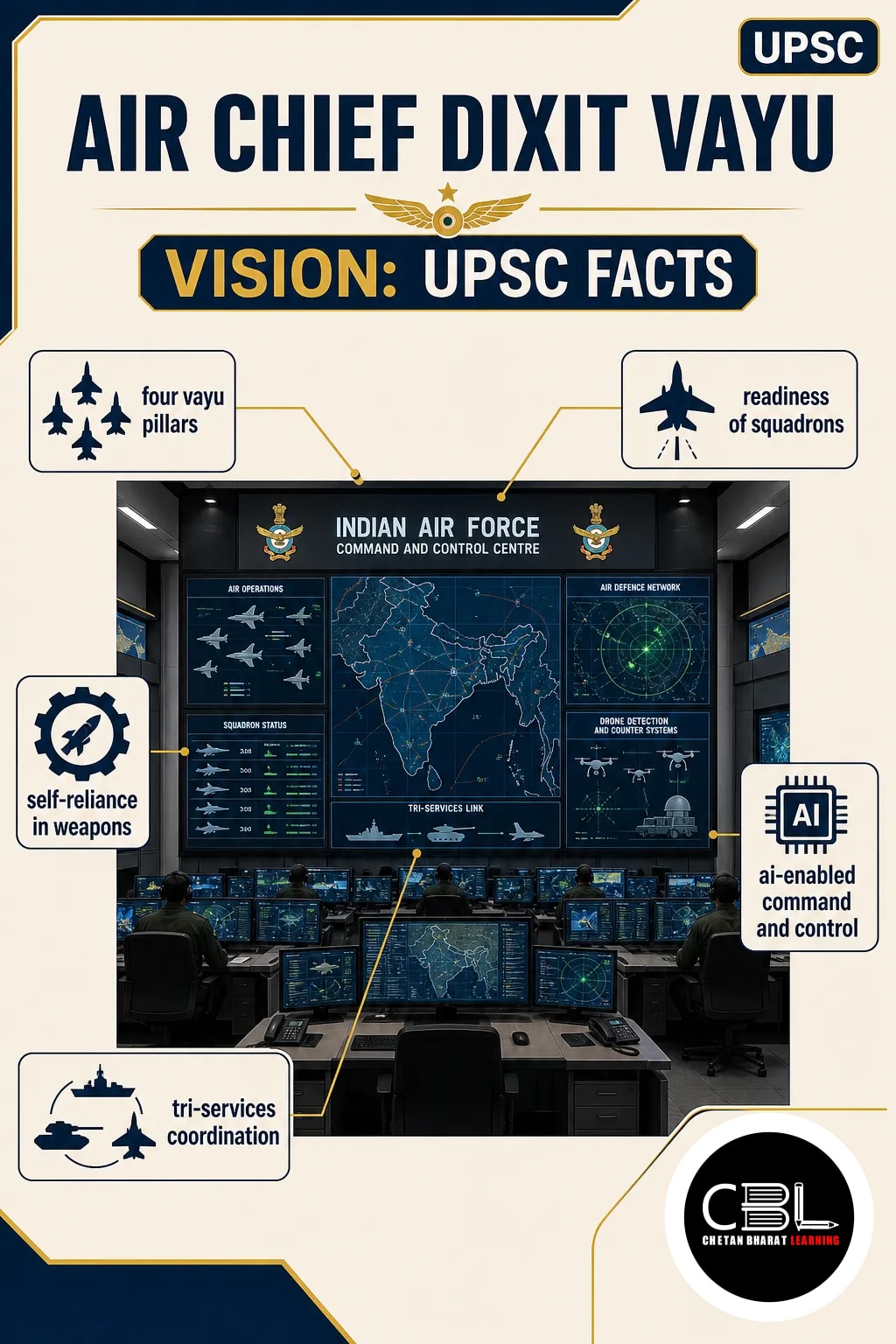

Air Chief Dixit VAYU vision sets out four priorities for the Indian Air Force. On 1 November 2026, a day after taking charge, Air Chief Marshal Ashutosh Dixit outlined the vision. The announcement follows CBL’s coverage of his appointment; explore more national current affairs.
Quick answer: Air Chief Dixit VAYU is a four-pillar vision announced on 1 November 2026 by the 29th Chief of the Air Staff. It combines vigilance, self-reliance, tactical innovation and tri-services unity. Dixit also prioritised restoring fighter squadron strength towards the sanctioned level and maintaining immediate operational readiness.
What is the Air Chief Dixit VAYU vision?
The vision groups the Air Chief’s operational priorities under four letters. Together, they cover readiness, indigenous capabilities, innovation and coordinated action across the services.
| Letter and pillar | Operational focus |
|---|---|
| V — Vigilance and readiness | Readiness of squadrons, radars, air defence units and personnel |
| A — Aatmanirbharta | Self-reliance in sensors, platforms and weapons |
| Y — Yukti | Ingenuity and innovation in doctrine, procedures and technology |
| U — Unity of effort | Coordination across the three services and national agencies |
The Air Chief Dixit VAYU framework also links readiness with deterrence. In other words, credible air power should help discourage conflict while remaining capable of fighting.
Why was the vision announced?
Dixit announced his priorities after assuming command as the 29th Chief of the Air Staff on 31 October 2026. In his assessment, new technologies and systems are changing the character of war.
He named drones, long-range precision weapons, space, cyber capabilities, artificial intelligence (AI) and the electromagnetic spectrum. Therefore, the Air Chief Dixit VAYU vision combines force transformation with immediate operational readiness.
His foremost task, he said, is to restore combat strength towards the Indian Air Force’s (IAF) sanctioned fighter squadron level. The source does not specify the sanctioned number; aspirants should not infer one from this announcement.
What operational measures did Dixit identify?
Dixit identified indigenous equipment, technological innovation and joint planning as areas for progress. In particular, he called for Indian sensors, platforms and weapons in quantities sufficient to sustain operational demands.
Under Yukti, he listed networked, AI-enabled command and control and layered counter-drone defence. He also identified responsive maintenance, force protection, resilience and the use of near-space as operational areas.
For unity of effort, he called for planning and fighting alongside the Army, Navy and national agencies. Moreover, he connected this approach with JAI: Jointness, Aatmanirbharta and Innovation.
Why does the vision matter for UPSC?
The vision brings defence preparedness, indigenous technology and inter-service coordination together in one current-affairs topic. For prelims, distinguish the four VAYU pillars from the three elements of JAI.
For example, Yukti concerns innovation, whereas unity of effort concerns coordination. Also revise the outgoing Air Chief’s retirement alongside the change in leadership.
Source: The Hindu, 1 November 2026
- Air Chief Ashutosh Dixit: Key Facts for UPSC (31 Oct 2026)
- Inderpal Singh Walia: Air Vice Chief for UPSC (31 Oct 2026)
Punjab PCS and Haryana HCS General Studies may test national defence appointments and the expansion of current-affairs acronyms. Therefore, revise the four VAYU pillars and the Air Chief’s position together.
Prelims Practice Corner
Mains Practice Questions
Frequently Asked Questions
What does VAYU stand for in the Air Chief’s vision?
VAYU stands for vigilance and readiness, Aatmanirbharta, Yukti and unity of effort. Together, these pillars cover preparedness, self-reliance, innovation and coordination.
Who announced the VAYU vision?
Air Chief Marshal Ashutosh Dixit announced it on 1 November 2026. He outlined it a day after taking charge as the 29th Chief of the Air Staff.
What does JAI mean in the defence context?
JAI means Jointness, Aatmanirbharta and Innovation. Dixit linked it to planning and operating with the Army, Navy and national agencies.
Related Current Affairs
Preparing for UPSC, PCS or HCS?
Talk to a mentor at Chetan Bharat Learning, Chandigarh. Free guidance on choosing the right exam and building a study plan.
Chat on WhatsAppCall 97793 53345UPSC / IAS / PCS coaching in Chandigarh · Trusted by aspirants across Punjab & Haryana

 Ananya RanaIAS · AIR 60
 Aditya SharmaIAS · AIR 70
 Ria Kaur SethiIPS · AIR 89
 Aman AloonIRS · AIR 295
 Sumer Singh VirkIRS · AIR 335
 Shivani PanchalIAS

Leave a Reply
You must be logged in to post a comment.