
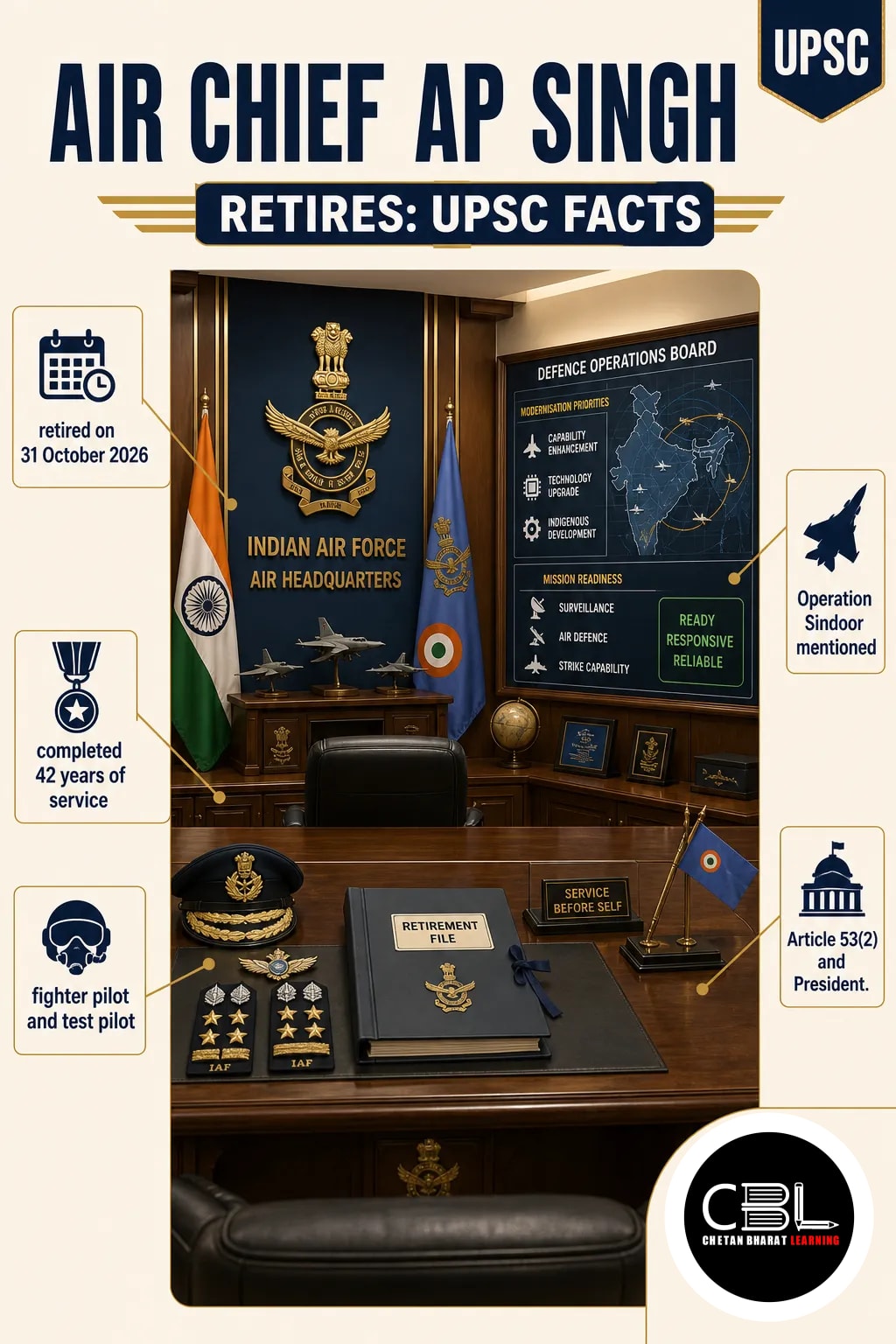

Air Chief AP Singh retired on 31 October 2026 after 42 years of service to the nation. His career and leadership are relevant to national security current affairs.
Quick answer: Air Chief AP Singh retired as Chief of the Air Staff on 31 October 2026, completing 42 years of service. A fighter pilot and experimental test pilot, he emphasised operational readiness, indigenisation and modernisation. During his tenure, the Indian Air Force took part in Operation Sindoor.
Who is Air Chief AP Singh?
Air Chief Marshal A.P. Singh served as Chief of the Air Staff and retired after 42 years of service. He has experience as a fighter pilot and an experimental test pilot.
As an experimental test pilot, he worked in a field concerned with evaluating aircraft through flight testing. The source also credits him with contributions to operational capability, combat readiness and modernisation.
Key facts about his service
The main facts concern his retirement, flying background and priorities as air chief.
| Fact | Detail |
|---|---|
| Retirement date | 31 October 2026 |
| Length of service | 42 years |
| Flying background | Fighter pilot and experimental test pilot |
| Operation mentioned | Operation Sindoor |
| Modernisation priorities | Indigenisation, innovation and adoption of advanced technologies |
For related leadership profiles, see the profile of Ashutosh Dixit and the profile of Air Vice Chief Inderpal Singh Walia.
Why was his tenure significant?
His tenure placed particular emphasis on operational readiness and a technologically capable air force. The Indian Air Force participated in Operation Sindoor under his leadership; the source highlights its combat capability and precise action.
In addition, he stressed indigenisation, innovation and advanced technology. He also interacted with personnel across ranks and encouraged professional competence, accountability and initiative.
Why does this matter for UPSC?
The retirement links defence leadership with operational readiness and indigenous capabilities. For Prelims, distinguish the Chief of the Air Staff from the President’s constitutional role.
Under Article 53(2), the supreme command of the defence forces is vested in the President. Its exercise is regulated by law; therefore, constitutional command and service leadership are distinct concepts.
Source: Press Information Bureau, 1 November 2026
- Air Chief Ashutosh Dixit: Key Facts for UPSC (31 Oct 2026)
- Inderpal Singh Walia: Air Vice Chief for UPSC (31 Oct 2026)
Punjab PCS and Haryana HCS may test the retirement date, service tenure and defence leadership in General Studies. Also revise the President’s constitutional role in defence command.
Prelims Practice Corner
Mains Practice Questions
Frequently Asked Questions
When did Air Chief AP Singh retire?
He retired on 31 October 2026. His retirement followed 42 years of service to the nation.
What was A.P. Singh’s flying background?
He was a fighter pilot and an experimental test pilot. In addition, he served as Chief of the Air Staff.
Who holds supreme command of India’s defence forces?
The President holds supreme command under Article 53(2). Its exercise is, however, regulated by law.
Related Current Affairs
Preparing for UPSC, PCS or HCS?
Talk to a mentor at Chetan Bharat Learning, Chandigarh. Free guidance on choosing the right exam and building a study plan.
Chat on WhatsAppCall 97793 53345UPSC / IAS / PCS coaching in Chandigarh · Trusted by aspirants across Punjab & Haryana

 Ananya RanaIAS · AIR 60
 Aditya SharmaIAS · AIR 70
 Ria Kaur SethiIPS · AIR 89
 Aman AloonIRS · AIR 295
 Sumer Singh VirkIRS · AIR 335
 Shivani PanchalIAS

Leave a Reply
You must be logged in to post a comment.