
The DPDP Act challenge now draws editorial attention to investigative journalism and access to public records. Following CBL’s earlier coverage of the petition, this update examines its implications for press freedom and transparency. Explore related polity current affairs.
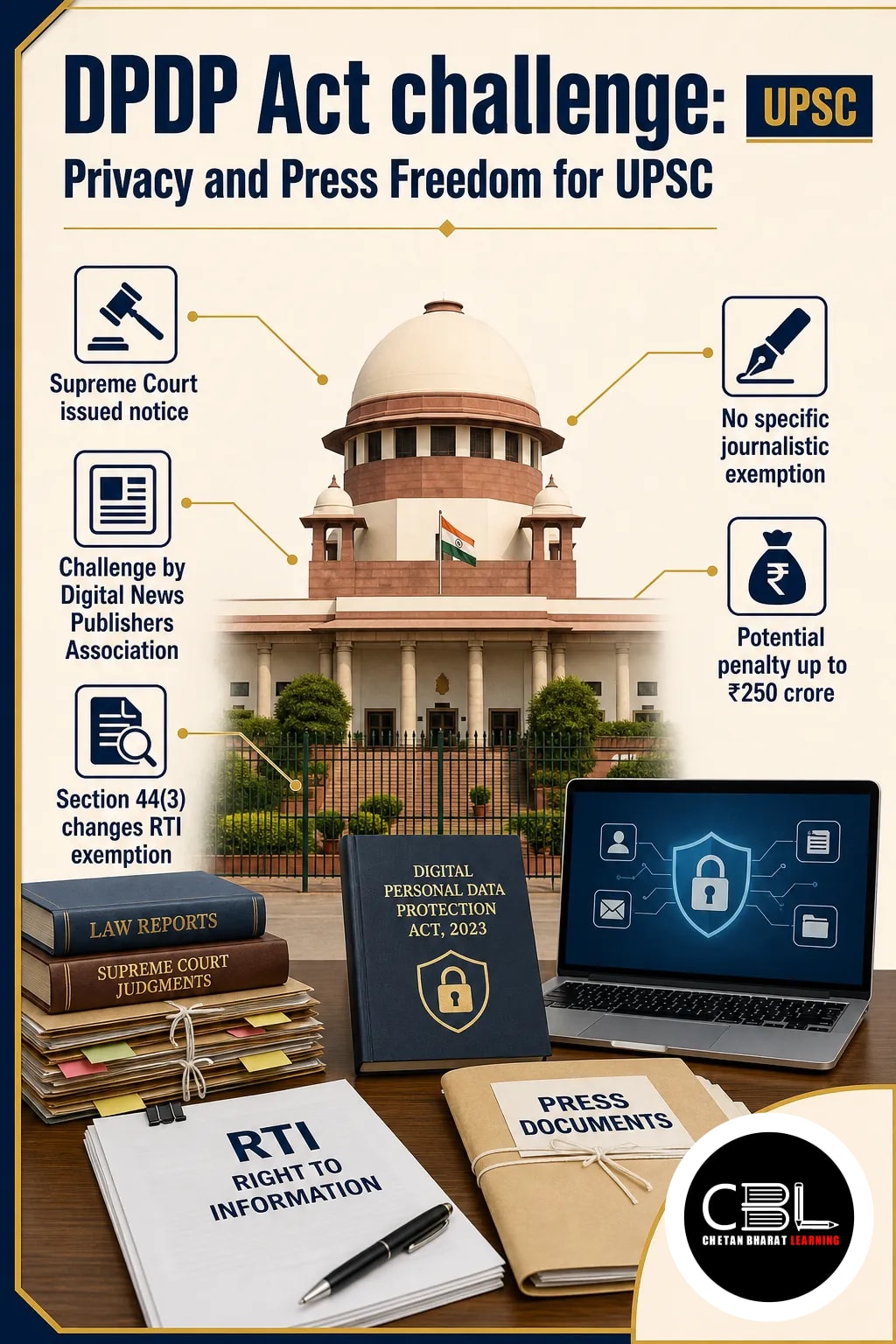
Quick answer: The DPDP Act challenge concerns a petition by the Digital News Publishers Association against the 2023 data protection law and its Rules. The Supreme Court has issued notice, not a final ruling. The petition raises concerns about journalistic data processing and changes to personal information disclosure under the Right to Information Act.
What has the Supreme Court done?
The Supreme Court issued notice on the petition and emphasised the balance between privacy and press freedom. It has not, on the facts supplied, delivered a final judgment on the challenge.
The Digital News Publishers Association (DNPA) contests the Digital Personal Data Protection (DPDP) Act, 2023 and its Rules. In particular, the case raises questions about the absence of a specific journalistic exemption and the Act’s amendment to the Right to Information (RTI) Act, 2005.
Why does the law concern journalists?
The concern is that ordinary reporting and investigations can involve processing personal data without a specific exemption for journalism. A data fiduciary is a person or entity that determines the purpose and means of processing personal data.
Consequently, reporters could face data fiduciary obligations, including notice and consent requirements. In a corruption investigation, asking the subject for consent could alert that person before publication. Moreover, the concern extends beyond investigations: routine news gathering can also involve personal information.
Earlier drafts in 2018, 2019 and 2021 included a journalistic exemption. The enacted law provides exemptions for certain processing, including research and statistical purposes, but no comparable specific exemption for journalistic activity. The potential penalty of up to ₹250 crore also heightens concerns for smaller newsrooms.
Privacy protection remains important beyond journalism. For a related security context, see CBL’s coverage of data breaches and the CERT-In advisory.
Which constitutional and legal provisions matter?
The case brings freedom of expression, privacy and access to official information into the same legal discussion.
| Provision | Relevance |
|---|---|
| Article 19(1)(a) | Protects freedom of speech and expression, which includes press freedom. |
| Article 19(2) | Permits reasonable restrictions on speech on specified grounds. |
| Article 21 | Protects life and personal liberty; the Supreme Court has recognised privacy as intrinsic to it. |
| DPDP Act, Section 44(3) | Amends the RTI Act’s exemption concerning personal information. |
The amendment removes the earlier public-interest qualification concerning disclosure of personal information. Thus, the petition questions whether privacy could unduly limit access to records held by public authorities. The amendment concerns an exemption under RTI; it does not itself prohibit every form of reporting.
How could the DPDP Act challenge affect accountability?
The dispute matters because investigations often rely on records that contain personal details as well as information about public decisions.
- Public expenditure: Tender documents can help journalists examine procurement; however, they may also contain personal data.
- Official conduct: Asset disclosures can assist scrutiny of public functionaries. Therefore, restrictions on disclosure may affect investigations into corruption.
- Independent reporting: Large potential penalties may discourage smaller newsrooms from pursuing contested stories. This is a chilling effect: anticipated legal consequences can deter lawful expression.
- Individual dignity: Privacy safeguards also protect people against unnecessary exposure. Consequently, public interest should not become a licence to publish every personal detail.
The question is not simply whether information is personal. Rather, it is whether disclosure serves a sufficiently strong public interest and whether less intrusive disclosure can achieve that purpose.
What makes a journalistic exemption difficult?
A workable exemption must identify protected journalistic activity without giving unchecked access to personal data. However, defining who qualifies has become more difficult as independent creators distribute news alongside established organisations.
The source cites a 2026 Reuters Institute report on changing news consumption. Among people aged 18–24, the share identifying social media as their primary news source rose from 21% in 2015 to 39% in 2025. This illustrates the changing news environment; it does not by itself establish who should receive legal protection.
Moreover, an exemption based only on an organisation’s status could exclude independent reporting. Conversely, an unlimited exemption could weaken privacy safeguards. The Centre has also raised the difficulty of distinguishing eligible journalistic activity.
What could a balanced way forward look like?
A balanced framework would protect public-interest reporting while limiting unnecessary intrusion into personal lives. Its design remains a matter for legal and stakeholder consideration, not a settled outcome of the petition.
- Activity-based protection: Consider safeguards for genuine public-interest journalism, including independent reporting, rather than relying solely on institutional labels.
- Public-interest assessment: Examine whether disclosure exposes misconduct or use of public funds; meanwhile, protect details unrelated to that purpose.
- Proportionate disclosure: Where feasible, remove irrelevant personal details from documents while retaining information needed for accountability.
- Consultation: Bring editors, independent creators, privacy stakeholders and the government into discussions. Union Minister Ashwini Vaishnaw has indicated that he would meet editors.
Ultimately, the DPDP Act challenge tests whether privacy and transparency can reinforce, rather than displace, constitutional accountability.
Source: The Hindu Editorial, 31 October 2026
- Digital Data Protection Act Challenge: UPSC Analysis (30 Oct 2026)
- Data Breaches: CERT-In Advisory and UPSC Angle (21 Oct 2026)
Asked in UPSC: Previous Year Questions
- UPSC CSE Mains 2024 (GS Paper III): Describe the context and salient features of the Digital Personal Data Protection Act, 2023.
- UPSC CSE Prelims 2024 (GS Paper I): Under which Article of the Constitution has the Supreme Court placed the right to privacy?
- UPSC CSE Prelims 2019 (GS Paper I): Which entity adopted the General Data Protection Regulation in April 2016 and began implementing it in May 2018?
UPSC tests both the data protection law and the constitutional basis of privacy; therefore, revise both dimensions.
Punjab PCS and Haryana HCS can test the constitutional basis of privacy alongside the RTI framework. For state governance answers, consider how public authorities can protect personal details while enabling scrutiny of procurement records.
Prelims Practice Corner
Mains Practice Questions
Frequently Asked Questions
Who filed the DPDP Act challenge?
The Digital News Publishers Association filed the petition. It challenges the Act and its Rules, including their implications for journalism.
Does the DPDP Act specifically exempt journalism?
No, the enacted law does not contain a specific journalistic exemption. However, the 2018, 2019 and 2021 drafts included one.
What does Section 44(3) change?
Section 44(3) amends the RTI Act’s personal information exemption. In particular, it removes the earlier public-interest qualification concerning disclosure.
Has the Supreme Court struck down the DPDP Act?
No final ruling striking down the Act is described in the source. Instead, the Court issued notice and emphasised the need to balance privacy and press freedom.
Related Current Affairs
Preparing for UPSC, PCS or HCS?
Talk to a mentor at Chetan Bharat Learning, Chandigarh. Free guidance on choosing the right exam and building a study plan.
Chat on WhatsAppCall 97793 53345UPSC / IAS / PCS coaching in Chandigarh · Trusted by aspirants across Punjab & Haryana

 Ananya RanaIAS · AIR 60
 Aditya SharmaIAS · AIR 70
 Ria Kaur SethiIPS · AIR 89
 Aman AloonIRS · AIR 295
 Sumer Singh VirkIRS · AIR 335
 Shivani PanchalIAS

Leave a Reply
You must be logged in to post a comment.