
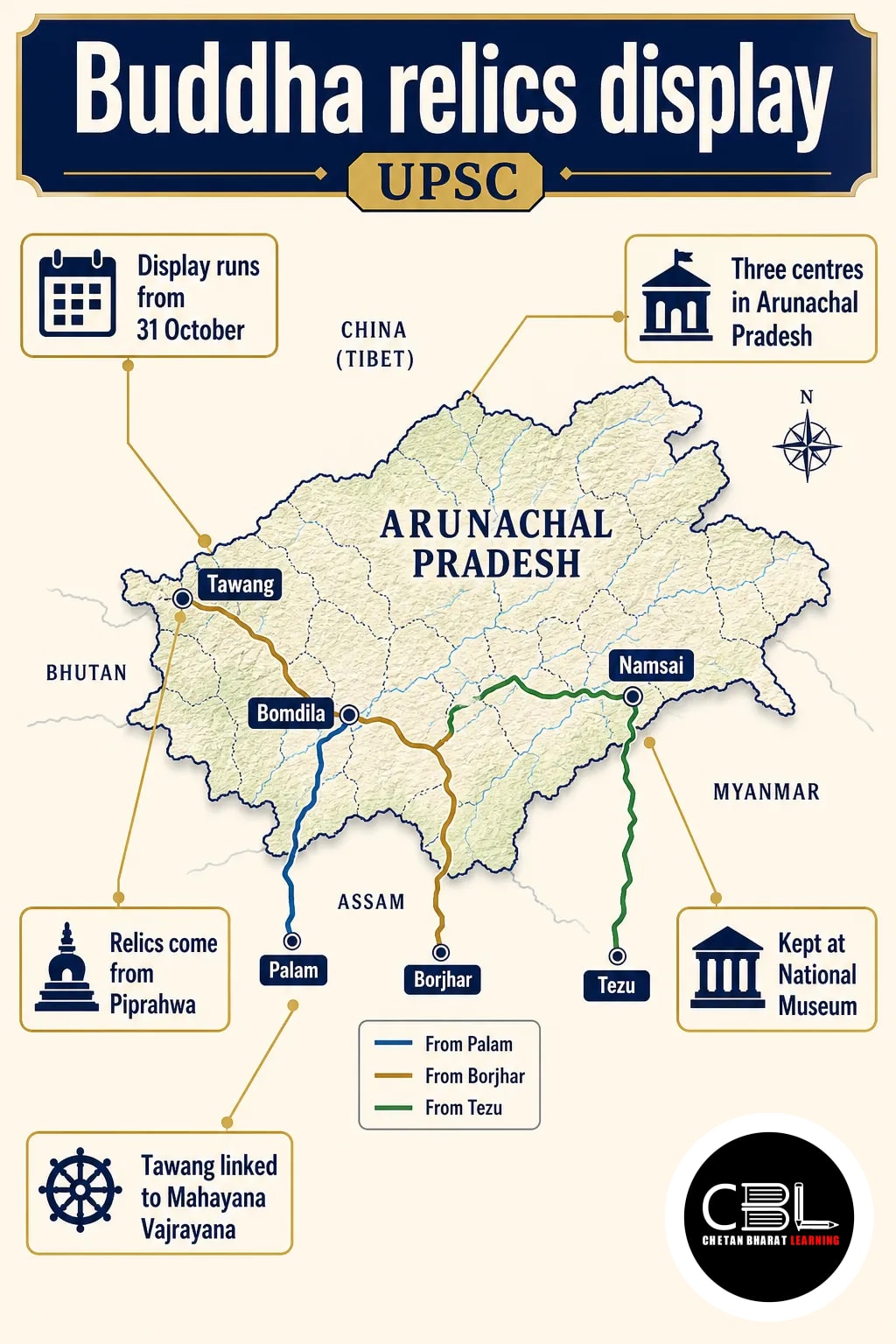

The Buddha relics display will travel to three Buddhist centres in Arunachal Pradesh from 31 October 2026. For related updates, explore national current affairs.
Quick answer: The Buddha relics display will run from 31 October to 21 November 2026 in Tawang, Bomdila and Namsai. The Union Ministry of Culture and its partners are organising it for public worship and heritage awareness. The relics come from Piprahwa in Uttar Pradesh and are kept at the National Museum, New Delhi.
What is the programme for the display?
The Buddha relics display is scheduled to begin at Tawang Monastery and move to Bomdila and Namsai. The Culture Ministry is working with the Arunachal Pradesh government, the International Buddhist Confederation (IBC) and the National Museum.
| Date | Scheduled event |
|---|---|
| 31 October | Installation and inaugural ceremony at Tawang Monastery, 10:00–11:30 am |
| 1 November | Another inaugural ceremony, with Chief Minister Pema Khandu as chief guest |
| 8 November | Transfer to Bomdila; installation at Lower Gompa |
| 14 November | Installation at the Golden Pagoda, Namsai |
| 21 November | Scheduled return to the National Museum via Tezu and Palam |
The Indian Air Force will transport the relics from Palam to Borjhar, Guwahati, before their helicopter journey to Tawang. However, movement depends on operational, weather and security conditions. Read more about Tawang and its tourism context.
Where were the Piprahwa relics discovered?
The relics originate from Piprahwa, an archaeological site in Siddharthnagar district, Uttar Pradesh, associated with ancient Kapilavastu and the Shakya tradition. In 1898, William Claxton Peppé excavated a stupa there and found bone fragments and precious objects.
Later, the Archaeological Survey of India excavated the site under K. M. Srivastava between 1971 and 1977. Two caskets yielded 22 bone relics: 20 are kept at the National Museum and two at the Indian Museum, Kolkata. The Piprahwa jewel collection associated with the 1898 discovery returned to India in 2025.
Which Buddhist traditions are represented?
The three venues connect the display to distinct Buddhist traditions in Arunachal Pradesh.
- Tawang and Bomdila: Western Arunachal is associated with Himalayan Mahayana and Vajrayana traditions. Tawang Monastery is also called Gaden Namgyal Lhatse.
- Namsai: Theravada traditions are practised among the Tai Khamti and other Buddhist communities in eastern Arunachal.
- Lhabab Duechen: This Tibetan Buddhist festival commemorates the Buddha’s descent from heaven and coincides with the programme.
In addition, the IBC and the state government plan an international conference in Tawang on 2 November. For broader context, see CBL’s coverage of the Global Buddhist Summit.
Why does the display matter?
The Buddha relics display brings archaeological heritage closer to communities with living Buddhist traditions. After the Buddha’s Mahaparinirvana at Kushinagar, the placing of relics in stupas became important to Buddhist devotion. Stupas also served as places of pilgrimage and commemoration.
Source: Press Information Bureau, 30 October 2026
- Global Buddhist Summit (24 Apr 2023)
Asked in UPSC: Previous Year Questions
- UPSC CSE Prelims 2023 (GS Paper I): Consider statements that stupas originated in Buddhism, generally housed relics, and served votive and commemorative purposes in Buddhist tradition. How many are correct?
UPSC connects stupas with relics and their functions, so revise both their origins and Buddhist uses.
State PCS General Studies can test the locations of Piprahwa, Tawang and Namsai alongside Buddhist traditions. Also revise the role of stupas as relic repositories and commemorative structures.
Prelims Practice Corner
Mains Practice Questions
Frequently Asked Questions
Where will the Buddha relics be displayed in Arunachal Pradesh?
Tawang, Bomdila and Namsai are the three scheduled centres. The programme runs from 31 October to 21 November 2026.
Where is Piprahwa located?
Piprahwa lies in Siddharthnagar district, Uttar Pradesh. It is also associated with ancient Kapilavastu and the Shakya tradition.
What is the significance of a Buddhist stupa?
A stupa can house relics and serve as a commemorative or devotional structure. In addition, stupas have been centres of pilgrimage and religious learning.
Related Current Affairs
Preparing for UPSC, PCS or HCS?
Talk to a mentor at Chetan Bharat Learning, Chandigarh. Free guidance on choosing the right exam and building a study plan.
Chat on WhatsAppCall 97793 53345UPSC / IAS / PCS coaching in Chandigarh · Trusted by aspirants across Punjab & Haryana
Leave a Reply
You must be logged in to post a comment.