
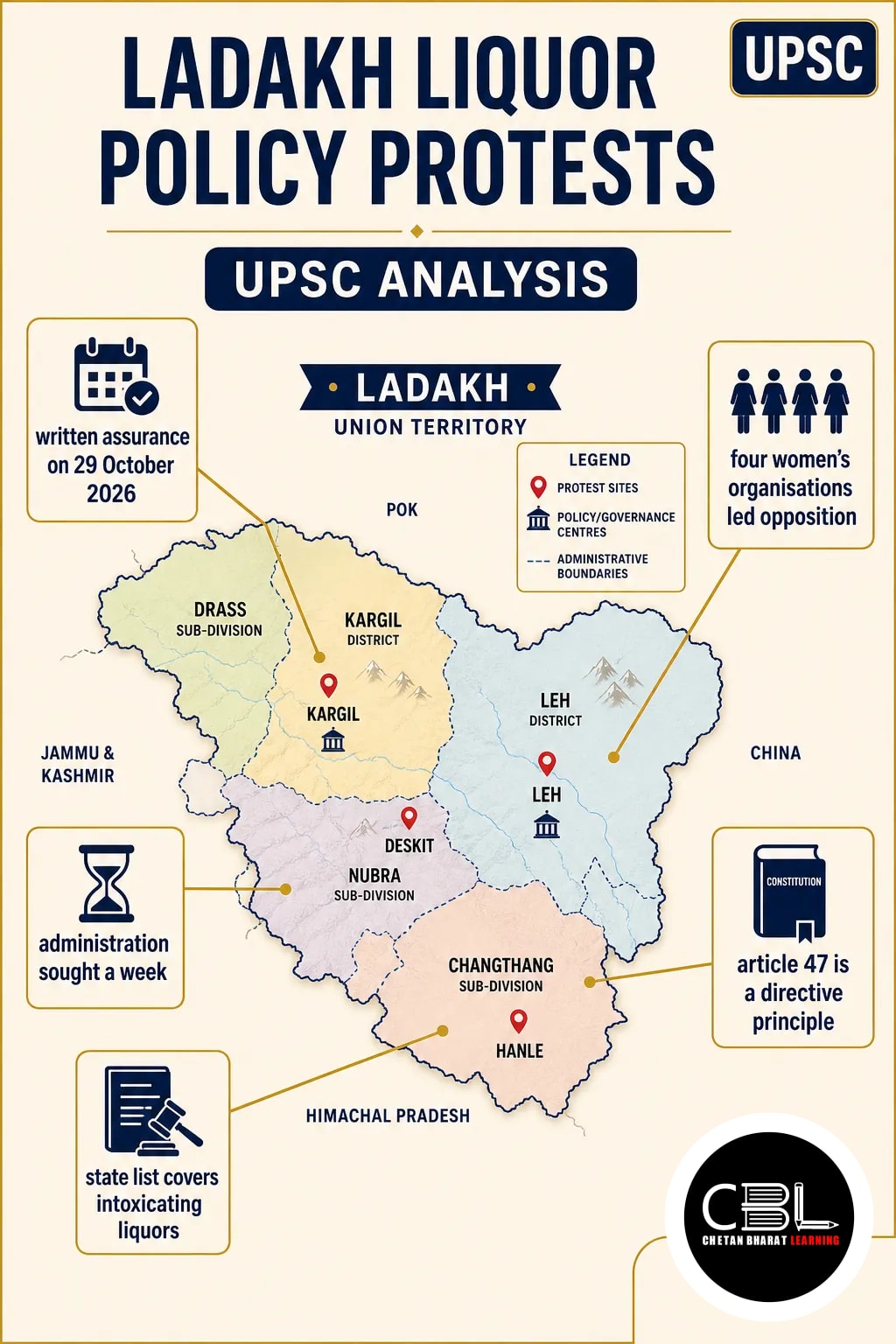

Ladakh liquor policy protests have paused after a written administrative assurance, bringing public health and participation into focus. The issue also offers a case study for polity and governance preparation.
Quick answer: Ladakh liquor policy protests were suspended on 29 October 2026 after the Union Territory administration accepted the organisations’ recommendations in principle. Four women’s organisations sought a policy rollback and dry status for Ladakh. The administration requested a week to finalise the agreement; the assurance itself does not establish that either demand has been implemented.
What happened in the Ladakh liquor policy protests?
Four women’s organisations suspended a planned dharna after the administration gave a written assurance on 29 October 2026. The groups had opposed the newly introduced liquor policy and sought both its complete rollback and a dry Union Territory.
Climate activist Sonam Wangchuk said the administration had agreed to the demands and sought a week to formalise an agreement. However, the Home Department letter described acceptance of the submitted points and recommendations as in principle; a final agreement and implementation remain distinct steps.
| Event | Detail |
|---|---|
| Trigger | Opposition to expanded liquor availability, including recent bar licences and wine shops |
| Written assurance | Home Department letter signed by Special Secretary Tashi Dolma on 29 October |
| Protest response | Temporary suspension of the dharna planned for 29 October to 5 November |
| Next step | Administration sought a week to finalise the agreement |
Who raised the demands and why?
Women’s wings from four community organisations led the opposition to the policy. They were the Ladakh Buddhist Association, Anjuman-e-Imamia, Anjuman Moin-ul-Islam and the Christian Community.
The organisations linked their demands to youth well-being, social cohesion and Ladakh’s cultural and spiritual values. Moreover, they expressed a long-term commitment to an alcohol-addiction-free Ladakh. Their demands concern both the immediate policy and the wider legal status of alcohol availability.
A dry territory generally refers to a jurisdiction that prohibits liquor through law or regulation, subject to any applicable exceptions. However, the source does not specify the legal terms or exceptions sought for Ladakh.
What does the Constitution say about alcohol regulation?
The Constitution connects alcohol regulation with public health and distributes legislative powers through the Seventh Schedule. Ladakh’s Union Territory status also makes Parliament’s legislative authority relevant.
| Provision | What it says |
|---|---|
| Article 47 | Directs the State to endeavour to prohibit intoxicating drinks and drugs injurious to health, except for medicinal purposes. |
| State List, Entry 8 | Covers intoxicating liquors, including production, manufacture, possession, transport, purchase and sale. |
| State List, Entry 51 | Covers excise duties on alcoholic liquors for human consumption manufactured or produced in the state. |
| Article 246(4) | Empowers Parliament to legislate for territories outside a state, including on matters in the State List. |
| Article 239 | Provides for Union Territory administration by the President through an appointed administrator. |
Article 47 is a Directive Principle of State Policy, not an automatically enforceable prohibition. Therefore, its public-health objective must be distinguished from the actual legal measures adopted in a territory.
Why does the dispute matter for governance?
The dispute illustrates how a licensing decision can become a question of public health, community trust and administrative accountability.
- Participation: The women’s groups brought community concerns into policymaking; therefore, consultation matters beyond the formal licensing process.
- Public health: Restrictions can address availability, but prevention and treatment also require attention. For a related substance-use governance issue, see the analysis of Punjab’s drug crisis.
- Revenue and livelihoods: Alcohol regulation can affect excise receipts and licensed businesses; thus, any policy change needs a transparent assessment of these implications.
- Rights and dialogue: Peaceful collective action can communicate policy objections, while public authorities must manage assemblies within the constitutional framework. See also the discussion of rally restrictions and constitutional rights.
What are the challenges and the way forward?
The immediate challenge is to convert an in-principle assurance into an intelligible, lawful and verifiable outcome. The Ladakh liquor policy protests have paused, but that pause should not be confused with a completed rollback.
Policy design and implementation
First, the administration should publish the final agreement and identify which measures require formal orders or rules. It should also clarify how any decision affects existing licences, enforcement and permissible exceptions.
Second, consultations should include the women’s organisations and other affected groups. A prohibition or tighter licensing regime would also need credible enforcement, safeguards against unregulated supply, and accessible prevention and treatment services.
Accountability and review
Finally, a public timetable and periodic review can help residents assess whether commitments have been fulfilled. Clear responsibilities and grievance channels would also help distinguish implementation gaps from disagreements over the policy itself.
Source: The Hindu, 30 October 2026
Punjab PCS and Haryana HCS can test State List entries on liquor, excise and Article 47. In addition, the case supports questions on public consultation, addiction prevention and the implementation of state policies.
Prelims Practice Corner
Mains Practice Questions
Frequently Asked Questions
Why were the Ladakh liquor policy protests suspended?
The organisations suspended their dharna after a written assurance accepting their recommendations in principle. The administration also sought a week to finalise the agreement.
Has Ladakh been declared a dry Union Territory?
The source does not establish that Ladakh has been declared dry. The demand remains distinct from the in-principle assurance and the agreement still to be finalised.
Which constitutional provision addresses prohibition of intoxicating drinks?
Article 47 directs the State to endeavour to prohibit intoxicating drinks and drugs injurious to health, except for medicinal purposes. However, it is a Directive Principle rather than an automatically enforceable prohibition.
Who issued the written assurance to the Ladakh organisations?
The Ladakh Home Department issued the assurance on 29 October 2026. Special Secretary Tashi Dolma signed the letter accepting the submitted points and recommendations in principle.
Related Current Affairs
Preparing for UPSC, PCS or HCS?
Talk to a mentor at Chetan Bharat Learning, Chandigarh. Free guidance on choosing the right exam and building a study plan.
Chat on WhatsAppCall 97793 53345UPSC / IAS / PCS coaching in Chandigarh · Trusted by aspirants across Punjab & Haryana
Leave a Reply
You must be logged in to post a comment.