
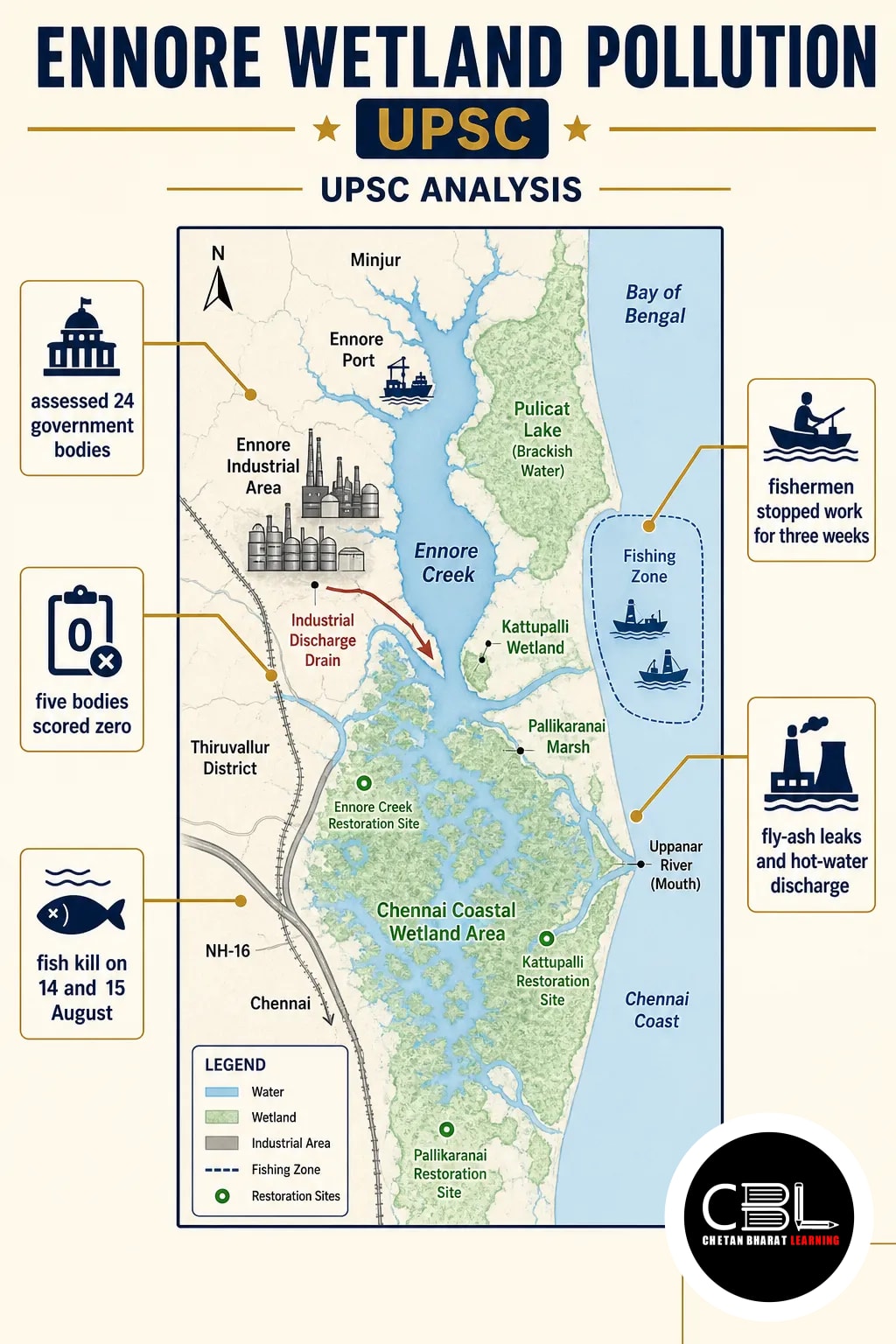

Ennore wetland pollution has prompted residents to assess government action on restoration, industrial emissions and livelihoods. The findings also raise questions about environmental governance in industrial coastal areas.
Quick answer: A residents’ report card on Ennore wetland pollution assessed 24 government bodies and gave five a zero score. It flagged fly-ash leaks, illegal emissions and hot-water discharge into Ennore Creek. A fish kill on 14–15 August also disrupted fishing, while residents highlighted incomplete restoration and healthcare gaps.
Where is Ennore Creek and why does it matter?
Ennore Creek is a coastal water body in the Chennai area of Tamil Nadu, supporting local fishing livelihoods. Its condition connects wetland conservation with industrial regulation, public health and access to work.
Wetlands provide habitats and support ecological processes, while fishing communities depend on functioning aquatic ecosystems. Therefore, damage to a creek can affect both biodiversity and household incomes. The broader balance between conservation and livelihoods also arises in the Western Ghats conservation debate.
| Feature | Fact or concern |
|---|---|
| Location | Ennore, Chennai area, Tamil Nadu |
| Livelihood | Local fishing and fish trade |
| Pollution concerns | Fly-ash leaks, illegal emissions and hot-water discharge |
| Restoration concern | Incomplete dredging for the invasive mussel locally called kaaka azhi |
What did the residents’ report card find?
The report card found major gaps in wetland restoration, industrial pollution control and fisheries commitments. Residents assessed 24 government bodies against commitments and legal obligations; this was their second consecutive poor assessment of the State government.
Five bodies scored zero because they had not initiated any of their assessed commitments. They were the Chennai Metropolitan Development Authority, the Chief Secretary’s office, the Energy Department, the Public Works Department and the Tamil Nadu State Coastal Zone Management Authority. However, residents noted some progress in solid waste management, the Ennore bus depot and the public library.
Fish kill and the information gap
The report estimated that four to six tonnes of fish died in Ennore Creek on 14 and 15 August. Consequently, fishermen stopped work for three weeks.
A Right to Information response dated 25 September said no official report had established the cause or documented the action taken. Therefore, the fish kill should not be attributed to a particular discharge without an investigation. The absence of a documented finding also makes it harder to assess responsibility and prevent recurrence.
What are the restoration and pollution control gaps?
Ennore wetland pollution persists alongside incomplete work to address an invasive mussel. Residents identified several connected concerns:
- Industrial discharges: The report flagged continuing fly-ash leaks, illegal emissions and hot-water discharge into the creek. Together, these concerns require monitoring across air and water.
- Incomplete dredging: Resident R.L. Srinivasan said dredging remained incomplete across at least half the identified micro-plan area. The work aimed to address kaaka azhi.
- Damage and disposal: Srinivasan said dredging had damaged fishing grounds. He also said dredged material continued to be dumped along the river, contrary to a National Green Tribunal direction.
- Service gaps: The upgraded Kathivakkam Primary Health Centre has 10 beds, but they remain unused for inpatient care. Moreover, it operates only half a day and lacks maternity services.
Invasive-species removal requires attention to its ecological side effects and disposal arrangements. For comparison, see the discussion on invasive trees and restoration in Delhi’s Central Ridge.
How does the issue affect livelihoods and governance?
The creek’s condition affects fishing work, market access and confidence in public oversight. A fish kill can interrupt earnings immediately; meanwhile, damaged fishing grounds can complicate recovery.
Women traders face an additional infrastructure problem. Kaatukuppam resident Subashini said the fisheries market and community hall remained unfinished, leaving traders, particularly fisherwomen, selling produce on roadsides. Separately, pregnant women must travel to Tiruvottiyur for maternity services, including during emergencies.
The report card also illustrates an accountability gap: commitments span several departments, but residents found that some had not begun their assessed tasks. A zero score reflects the residents’ assessment, not an independent finding that an entire department did no work. Nevertheless, the score draws attention to the need for task-wise public reporting.
The National Green Tribunal is a statutory body established under the National Green Tribunal Act, 2010, for environmental adjudication. However, a direction alone does not demonstrate compliance. Authorities must also document implementation and address credible complaints about violations.
What should a response prioritise?
A credible response should combine pollution control, transparent investigation and livelihood-sensitive restoration. The following steps address the gaps identified in the report:
- Investigate incidents: Authorities should document fish-kill investigations, test relevant samples and publish findings. Consequently, action can follow evidence rather than assumptions.
- Assign responsibility: Each assessed commitment should have a named lead agency, a timeline and publicly accessible progress updates. In addition, departments should explain delays.
- Monitor restoration: Dredging plans should assess impacts on fishing grounds and track where material is deposited. Furthermore, officials should check compliance with tribunal directions.
- Include residents: Fishers and local residents should participate in inspections and feedback. Subashini also called for the Manali Ennore Restoration and Rejuvenation Company to have an office within the area.
- Restore services: Completing the fisheries market and reviewing healthcare capacity can address needs beyond pollution control. Meanwhile, maternity access requires attention during emergencies.
Overall, Ennore wetland pollution shows why environmental outcomes must be judged alongside implementation and community wellbeing. Restoration is stronger when public agencies measure both ecological recovery and livelihood effects.
Source: The Hindu, 30 October 2026
Asked in UPSC: Previous Year Questions
- UPSC CSE Prelims 2018 (GS Paper I): How does the National Green Tribunal differ from the Central Pollution Control Board in their legal origins and functions?
UPSC compares environmental institutions by their establishment and responsibilities; therefore, revise both alongside current issues.
State PCS General Studies can test wetland protection, pollution-control institutions and coordination between departments. In addition, use this case to practise linking environmental enforcement with local livelihoods.
Prelims Practice Corner
Mains Practice Questions
Frequently Asked Questions
What did the Ennore residents’ report card assess?
It assessed 24 government bodies against commitments and legal obligations. Of these, five scored zero because they had not initiated any assessed commitments.
What caused the fish kill in Ennore Creek?
The cause had not been established in an official report, according to the 25 September Right to Information response. Therefore, the reported pollution concerns should not be treated as a confirmed cause.
What is kaaka azhi in Ennore?
Kaaka azhi is the local name for an invasive mussel. However, a resident said dredging to address it remained incomplete across at least half the identified micro-plan area.
How did the fish kill affect fishing work?
Fishermen stopped work for three weeks after the fish kill. The report estimated the loss at four to six tonnes of fish.
Related Current Affairs
Preparing for UPSC, PCS or HCS?
Talk to a mentor at Chetan Bharat Learning, Chandigarh. Free guidance on choosing the right exam and building a study plan.
Chat on WhatsAppCall 97793 53345UPSC / IAS / PCS coaching in Chandigarh · Trusted by aspirants across Punjab & Haryana
Leave a Reply
You must be logged in to post a comment.