
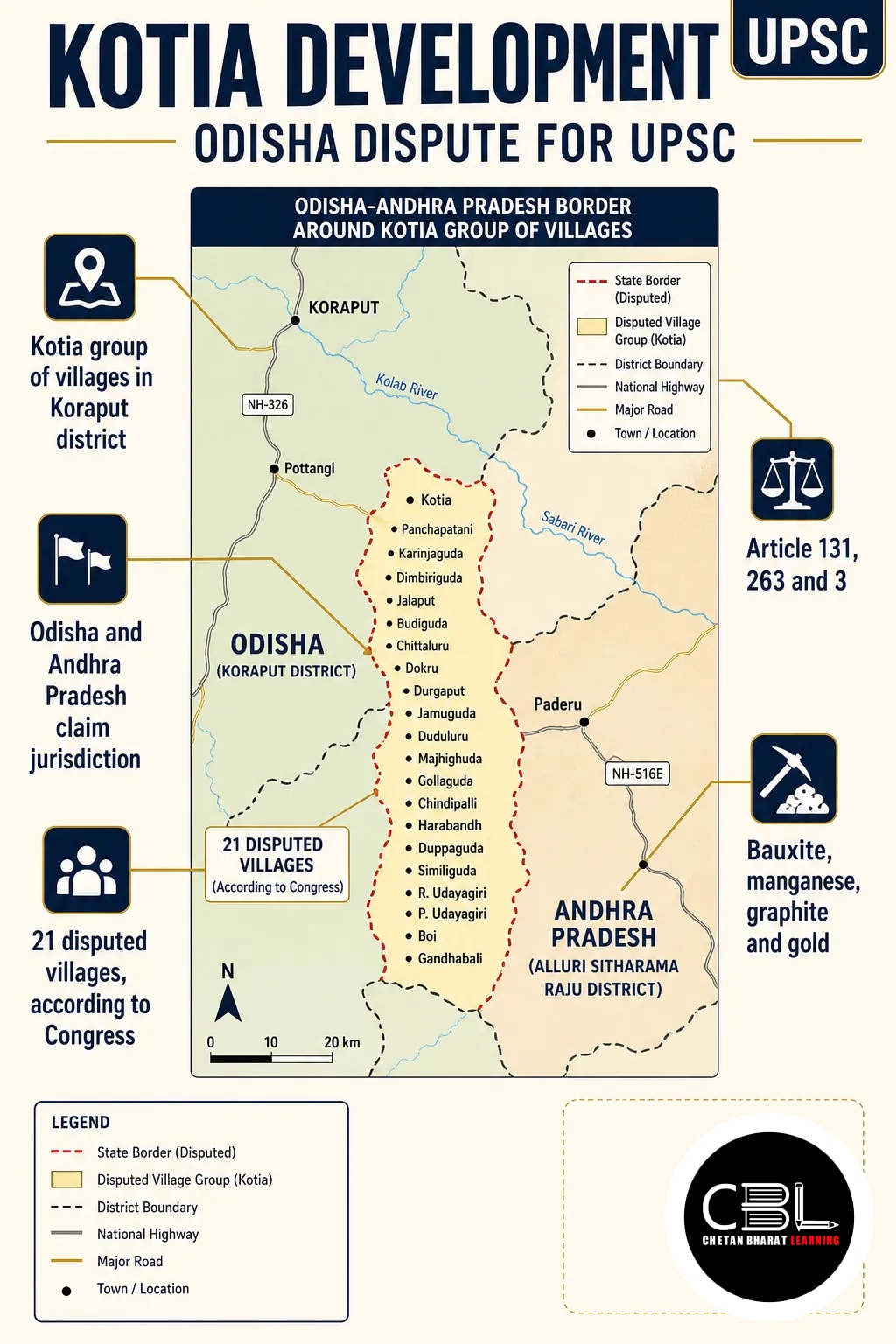
The Kotia development board demand has brought a contested Odisha-Andhra Pradesh border region back into focus. It offers a case study in federalism and local governance for UPSC.
Quick answer: On 29 October 2026, the Odisha Pradesh Congress Committee demanded a Kotia development board for villages in Koraput district. Odisha and Andhra Pradesh claim jurisdiction over the area. The demand followed Andhra Pradesh’s announcement of local polls and concerns raised by Congress about welfare delivery in 21 disputed villages.
What is the Kotia development board proposal?
The proposed board is a Congress demand for a dedicated body to accelerate welfare programmes in Kotia. It is a proposal, not an announced or established institution. Its powers, membership and budget have not been specified in the source.
Odisha Pradesh Congress Committee (OPCC) president Bhakta Charan Das also sought a special package. In addition, he called for more Odisha police personnel in sensitive border villages and a stronger administrative presence. These demands followed a Congress delegation’s visit to the area.
Why is Kotia in the news?
Andhra Pradesh’s announcement of local polls brought the competing jurisdictional claims into focus. Both Odisha and Andhra Pradesh claim the Kotia group of villages; the source does not establish a final resolution of the dispute.
Das argued that Odisha’s creation as a province on 1 April 1936 supported its claim. However, that argument is a political position and should not be treated as a judicial finding. He also accused successive political administrations of neglecting the region.
| Issue | What the source says |
|---|---|
| Location | Kotia group of villages in Koraput district |
| Political trigger | Andhra Pradesh announced local polls in the area |
| Resources | Bauxite, manganese, graphite and gold |
| Electoral constituencies | Pottangi in Odisha and Salur in Andhra Pradesh, as cited by Das |
Das alleged that Andhra Pradesh used competing welfare schemes to win over local tribal residents. He also claimed that many residents held documents linked to both states and voted in both constituencies. The source attributes these claims to him; it does not independently establish their extent.
For context on electoral administration, see CBL’s explanation of electoral roll revision and judicial review. Nevertheless, a document by itself does not settle a territorial claim.
Which constitutional provisions matter?
The Constitution provides distinct routes for discussing interstate issues, adjudicating eligible disputes and changing state boundaries.
| Provision | UPSC relevance |
|---|---|
| Article 131 | Provides the Supreme Court original jurisdiction over specified disputes between states involving a legal right, subject to constitutional limits. |
| Article 263 | Allows the President to establish an Inter-State Council for inquiry, discussion and recommendations on specified matters. |
| Article 3 | Empowers Parliament to alter state boundaries by law, following the prescribed presidential recommendation and reference to affected state legislatures. |
| Fifth Schedule | Provides a framework for administering Scheduled Areas and Scheduled Tribes; its area-specific application must be verified. |
These provisions perform different functions. For example, an Inter-State Council facilitates deliberation, whereas Article 131 concerns judicial jurisdiction. Article 3 concerns legislative boundary alteration; the source does not say that it has been invoked for Kotia.
Why does the dispute matter for governance?
Kotia illustrates how a boundary dispute can complicate welfare delivery, political representation and public accountability. Its significance extends beyond which administration asserts a claim.
Services and electoral administration
Residents need reliable access to benefits regardless of the dispute. However, competing administrative arrangements can make it difficult to identify which authority should resolve a complaint or maintain records. A board could coordinate delivery, but its effectiveness would depend on its mandate and funding.
Electoral claims require careful verification by the competent authorities. For instance, allegations about duplicate documents and voting should not substitute for scrutiny of electoral rolls. The distinction between registration and voting rights is also relevant; see the constitutional status of voting in India.
Tribal participation and resources
The region’s tribal residents must be participants in decisions, not merely the objects of competing claims. Therefore, consultation should address access to services, livelihoods and local priorities. Where applicable, constitutional and statutory protections for Scheduled Areas and forest rights must guide decisions.
The reported presence of minerals also raises questions about resource governance. Any future extraction proposal would require scrutiny under applicable laws and procedures. Moreover, development planning should consider environmental impacts and community interests rather than treating mineral presence as proof of an approved project.
What are the challenges and the way forward?
The immediate challenge is to protect residents’ access to services while the states address their competing claims.
- Coordination: Odisha and Andhra Pradesh should pursue structured dialogue; meanwhile, residents should not lose access to essential services.
- Board design: If Odisha creates a board, it should define responsibilities, funding, local representation and measurable delivery outcomes.
- Accountability: A village-level grievance mechanism and public reporting could help residents identify the responsible authority.
- Electoral integrity: Competent election authorities should verify records under applicable law, while protecting eligible residents’ participation.
- Rights and consent: Authorities should consult affected communities and apply relevant safeguards before decisions on land or resources.
Finally, stronger administration and police deployment must remain consistent with residents’ rights. Development measures can improve service delivery, but they do not by themselves resolve the legal boundary question.
Source: The Hindu, 30 October 2026
Asked in UPSC: Previous Year Questions
- UPSC CSE Mains 2026 (GS Paper II): Does India’s tribal development policy reflect aspirations for socially grounded, equity-based governance? Justify your answer.
UPSC links tribal development to participation and equity; therefore, connect welfare delivery with governance safeguards.
State PCS General Studies can test interstate coordination, Article 3 and local welfare administration through the Kotia example. In addition, candidates should distinguish political claims from constitutional mechanisms for resolving disputes.
Prelims Practice Corner
Mains Practice Questions
Frequently Asked Questions
Has the Kotia development board been established?
No establishment is confirmed in the source. Rather, the Odisha Pradesh Congress Committee demanded the board on 29 October 2026.
Which states claim the Kotia villages?
Odisha and Andhra Pradesh both claim jurisdiction. The dispute gained attention after Andhra Pradesh announced local polls there.
How many Kotia villages are disputed?
Congress referred to 21 disputed villages. Its president made the statement while presenting the party’s assessment of the area.
Does a development board settle an interstate boundary dispute?
No, a development board does not itself settle a boundary dispute. Instead, it may coordinate services if given an appropriate mandate.
Related Current Affairs
Preparing for UPSC, PCS or HCS?
Talk to a mentor at Chetan Bharat Learning, Chandigarh. Free guidance on choosing the right exam and building a study plan.
Chat on WhatsAppCall 97793 53345UPSC / IAS / PCS coaching in Chandigarh · Trusted by aspirants across Punjab & Haryana
Leave a Reply
You must be logged in to post a comment.