
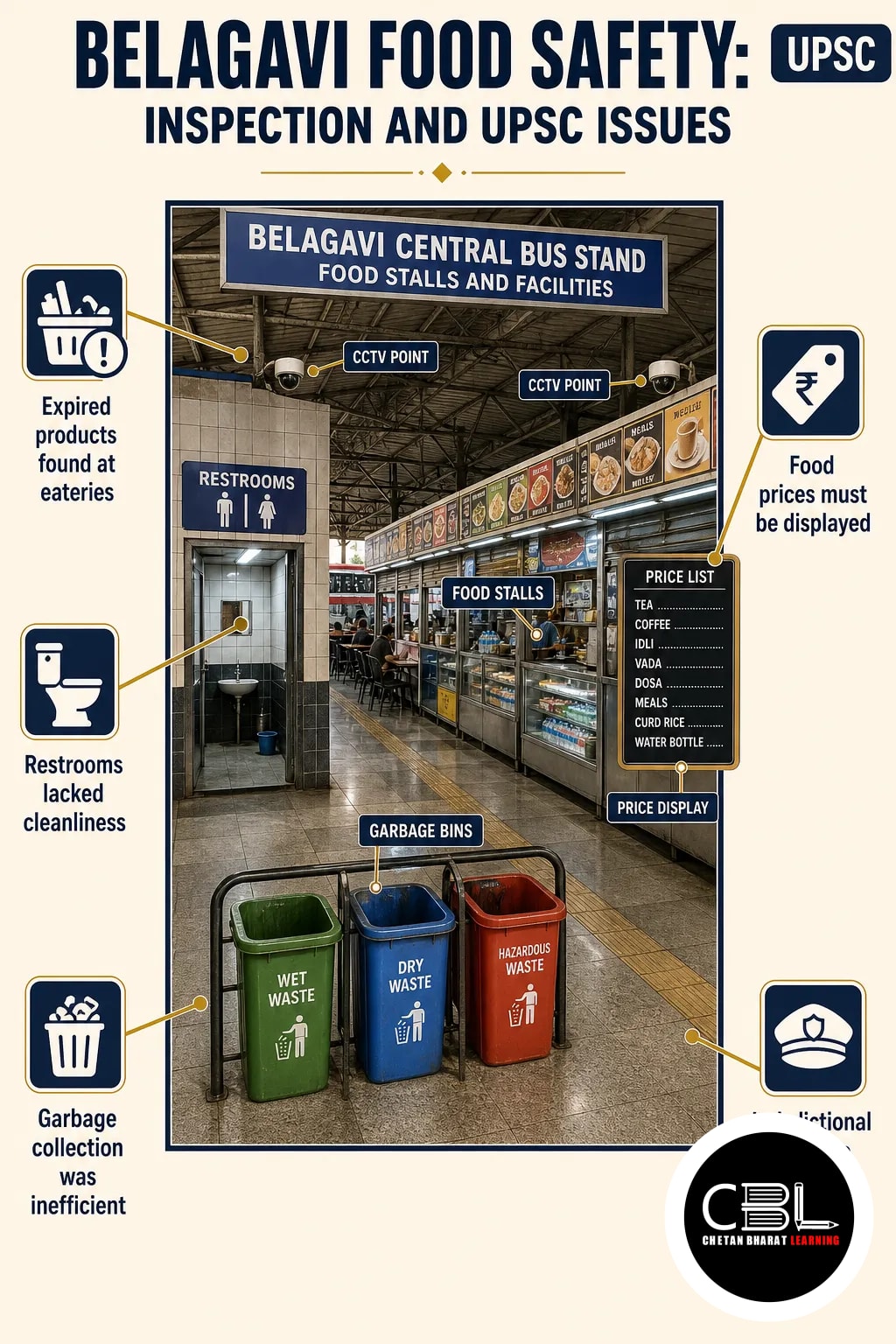

Belagavi food safety came under scrutiny after Karnataka Upa Lokayukta Justice (retd.) B. Veerappa inspected the city’s Central Bus Stand. The visit connects food regulation with sanitation and public accountability; explore more current affairs for civil services.
Quick answer: On 29 October 2026, Justice B. Veerappa found expired food products during a surprise Belagavi food safety inspection at the Central Bus Stand. He ordered their seizure, questioned irregular inspections and sought displayed price lists. He also flagged unclean restrooms, inefficient garbage collection and security gaps.
What is food safety regulation in India?
Food safety regulation sets standards for food and provides for their enforcement to protect consumers. The Food Safety and Standards Act, 2006 consolidated earlier food laws and established the Food Safety and Standards Authority of India (FSSAI).
FSSAI sets science-based standards and regulates food manufacture, storage, distribution, sale and import. State food safety authorities also play an important enforcement role, including inspections of food businesses.
Food safety differs from price transparency, sanitation and security, although all affect users of public facilities. Therefore, the Belagavi visit offers a wider governance case study as well as a regulatory example.
Why is Belagavi food safety in the news?
Justice Veerappa found expired products during a surprise inspection of eateries and stalls at the Central Bus Stand. He directed Food and Drug Administration officials to seize them and criticised food safety officials for not inspecting the eateries regularly.
He also asked shops to display food prices and follow rules. The bus stand belongs to the North Western Karnataka Road Transport Corporation (NWKRTC).
At a pharmacy, he checked documents and found that its food safety certificate had expired. He also directed officials to ensure minimum wages for employees and prevent their harassment. The source does not establish whether the pharmacy’s drug licence had expired.
What did the inspection reveal?
The inspection exposed shortcomings across food sales and other services at the bus stand. The findings and directions are distinct from evidence of whether subsequent corrections occurred.
| Area | Finding or direction |
|---|---|
| Food stalls | Expired products found; officials were told to seize them and shops to display prices. |
| Restrooms and premises | Restrooms lacked cleanliness, while garbage collection was inefficient. |
| Namma Clinic | The Upa Lokayukta examined medicines dispensed and asked about treatment procedures. |
| Lodging facility | Bills lacked tax details; the absence of closed-circuit television (CCTV) cameras raised security concerns. |
| Security | He directed jurisdictional police to conduct regular inspections. |
The visit also identified a failure to issue receipts for use of facilities. However, the source does not specify which facilities were involved.
What governance challenges does the case highlight?
The findings highlight gaps in routine oversight and coordination at a shared public facility.
- Inspection gap: Expired products and criticism of irregular checks point to the need for sustained monitoring, not only surprise visits.
- Shared responsibility: Food regulators, the transport corporation, municipal authorities and police have different roles; consequently, corrective work requires coordination.
- Consumer information: Missing price lists and incomplete bills make it harder for users to verify charges.
- Public health environment: Unclean restrooms and weak waste collection require attention alongside food handling.
- Accountability: An oversight visit can identify deficiencies; however, its impact depends on follow-up by responsible agencies.
The source does not establish that any passenger fell ill or quantify the affected products. Therefore, the inspection findings should not be treated as evidence of an outbreak.
What is the way forward?
Regular, documented follow-up can translate inspection directions into safer and more accountable services.
- Track corrective action: Food safety officials can record seizures and verify compliance during subsequent inspections.
- Coordinate facility management: The transport corporation and relevant local authorities can assign clear responsibilities for toilets and waste collection.
- Improve transparency: Shops and facility operators should display prices and provide proper bills or receipts as applicable.
- Review security and employment: Police inspections and labour-related checks can address the separate concerns raised during the visit.
Finally, a time-bound review can help authorities distinguish completed remedies from directions still awaiting action.
Source: The Hindu, 29 October 2026
Asked in UPSC: Previous Year Questions
- UPSC CSE Prelims 2018 (GS Paper I): Did the Food Safety and Standards Act, 2006 replace the Prevention of Food Adulteration Act, 1954? Is FSSAI under the charge of the Director General of Health Services?
UPSC tests both the history of food safety legislation and the institutional position of its regulator.
State PCS General Studies can test food safety enforcement, public sanitation and the role of state oversight institutions. For Punjab PCS and Haryana HCS, use the case to examine coordination between regulators and agencies managing public facilities.
Prelims Practice Corner
Mains Practice Questions
Frequently Asked Questions
What did the Upa Lokayukta find at Belagavi bus stand?
He found expired food products at eateries and stalls. He also raised concerns about restrooms, garbage collection and missing price lists.
When did the inspection take place?
It took place on 29 October 2026. Justice B. Veerappa made a surprise visit to the Central Bus Stand in Belagavi.
Which law established FSSAI?
The Food Safety and Standards Act, 2006 established FSSAI. It also consolidated earlier food safety laws.
Did the source report a foodborne illness outbreak?
No, the source does not report an outbreak. It records expired products and inspection directions, but gives no account of passengers falling ill.
Related Current Affairs
Preparing for UPSC, PCS or HCS?
Talk to a mentor at Chetan Bharat Learning, Chandigarh. Free guidance on choosing the right exam and building a study plan.
Chat on WhatsAppCall 97793 53345UPSC / IAS / PCS coaching in Chandigarh · Trusted by aspirants across Punjab & Haryana
Leave a Reply
You must be logged in to post a comment.