
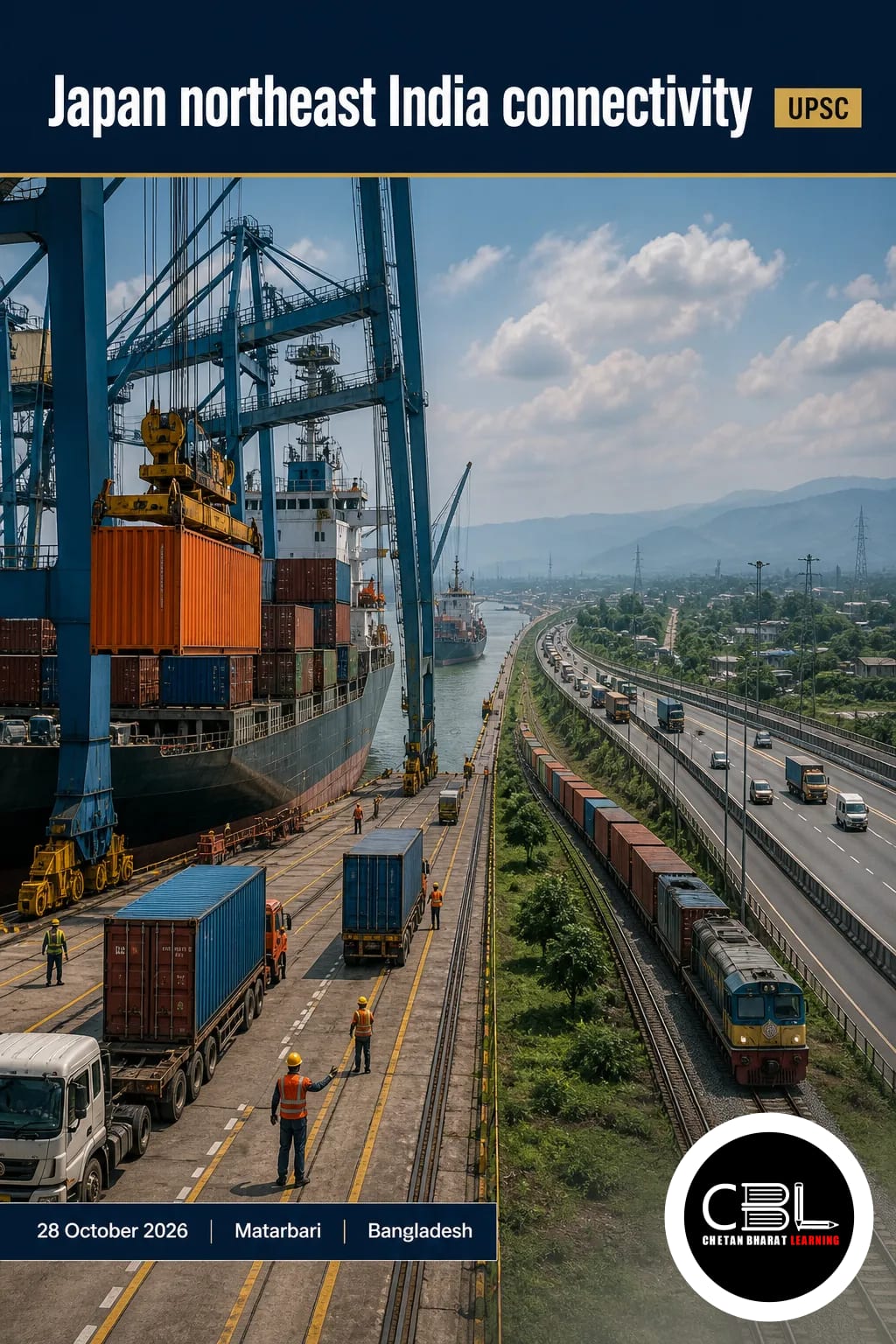

Japan northeast India connectivity gained attention on 28 October 2026 after India welcomed stronger regional linkages involving Japan. The proposed connection with Bangladesh’s Matarbari port adds a regional dimension to the current affairs developments relevant to India’s external relations.
Quick answer: On 28 October 2026, India’s Ministry of External Affairs highlighted Japan northeast India connectivity after Japanese and Bangladeshi leaders agreed to strengthen regional links. Their agreements provide for further Japanese assistance to Bangladesh’s Matarbari deep sea port, which Japan envisages connecting with northeast India to support a wider industrial hub.
What happened?
India highlighted its partnership with Japan after Japan and Bangladesh agreed to advance regional connectivity. The announcement followed Bangladesh Prime Minister Tarique Rahman’s meeting with Japanese Prime Minister Sanae Takaichi in Tokyo.
On 28 October, Ministry of External Affairs (MEA) spokesperson Randhir Jaiswal said India wanted to strengthen existing linkages between Japan and the northeastern States. He also said Japanese-language instruction for the region’s working population formed part of these initiatives.
Meanwhile, Japan and Bangladesh signed agreements that enable additional Japanese assistance for Matarbari. Sources from Japan envisage a connection between the port and northeast India; however, the source does not identify a route or completion date.
Key outcomes and the Matarbari plan
The leaders agreed to develop the Matarbari-Maheshkhali area around a deep sea port and strengthen regional connectivity. Their joint statement places the port under the connectivity section and records Japan’s intention to intensify work on it.
| Element | Source-based detail |
|---|---|
| Location | Matarbari-Maheshkhali area, Bangladesh |
| Framework | Bay of Bengal Industrial Growth Belt (BIG-B) for Shared Prosperity |
| Planned role | A hub for logistics, energy and industry centred on the port |
| Northeast link | Japan envisages a connection; the source does not specify its route or schedule |
The project centres on Bangladesh’s first deep sea port. Bangladesh currently depends on ports in Malaysia and Singapore to handle large vessels; therefore, the port could change how such cargo reaches the region once facilities become operational.
Why does Japan northeast India connectivity matter?
The proposal links India-Japan economic cooperation with Bangladesh’s port and industrial development. Consequently, its significance extends beyond a single infrastructure project.
Economic and regional dimensions
- Access to maritime trade: A workable port connection could offer northeast India another route for regional commerce; however, benefits would depend on the actual transport arrangements.
- Industrial linkages: The proposed logistics, energy and industry hub could create opportunities for businesses across the region, provided firms can use the connection competitively.
- Bilateral partnership: Jaiswal said stronger links would also boost the Japan-India economic partnership within India.
- Skills: Japanese-language instruction adds a workforce dimension; therefore, cooperation is not limited to physical infrastructure.
Diplomatic significance
The initiative brings together interests that span India, Bangladesh and Japan. India-Japan projects in the northeast form one part; meanwhile, the Matarbari agreements belong to the Japan-Bangladesh relationship.
For India, the prospective connection illustrates how cooperation with neighbouring countries can complement bilateral partnerships. Nevertheless, the source describes an envisaged link, not a completed three-country corridor or a specific tripartite agreement.
What challenges could affect the proposed link?
Implementation will depend on connecting the port effectively with production and consumption centres across borders. The following are analytical considerations, not problems identified in the source report.
- Cross-border coordination: India and Bangladesh would need compatible arrangements for movement of goods; otherwise, delays could offset transport benefits.
- Last-mile infrastructure: Port capacity alone cannot ensure access, because goods must also move reliably between the port and users.
- Commercial viability: Businesses will weigh costs, reliability and demand before choosing a route; therefore, infrastructure must serve actual trade needs.
- Social and environmental safeguards: Project planning should assess local impacts and consult affected communities; this can reduce avoidable implementation risks.
Way forward
India, Bangladesh and Japan can translate the connectivity vision into practical benefits through coordinated planning. First, any proposed route needs clear technical and commercial assessment, alongside transparent information on timelines.
Second, authorities should align border procedures with transport capacity and consult businesses and local communities. Finally, workforce training can complement infrastructure, while environmental and social assessments guide implementation.
Source: The Hindu, 28 October 2026
- Trade Treaty Architecture: India’s Arbitration Push (28 Oct 2026)
Asked in UPSC: Previous Year Questions
- UPSC CSE Mains 2022 (GS Paper II): The Gati-Shakti Yojana needs meticulous coordination between the government and the private sector to achieve the goal of connectivity. Discuss.
UPSC also tests the coordination needed to turn connectivity plans into functioning infrastructure.
State PCS General Studies may test Matarbari’s location and the countries involved in the connectivity proposal. In addition, aspirants should connect infrastructure planning with trade and intergovernmental coordination.
Prelims Practice Corner
Mains Practice Questions
Frequently Asked Questions
Where is Matarbari deep sea port?
Matarbari is in Bangladesh. The port is also central to the proposed Matarbari-Maheshkhali industrial hub.
What is the proposed link with northeast India?
Japan envisages connecting Matarbari port with northeast India. However, the source does not specify a route or completion date.
What does BIG-B stand for?
BIG-B stands for Bay of Bengal Industrial Growth Belt. The Japan-Bangladesh statement links this framework to development around Matarbari.
Is the Matarbari link to northeast India complete?
No completed link is identified in the source. Instead, the report describes it as a connection envisaged by Japan.
Related Current Affairs
Preparing for UPSC, PCS or HCS?
Talk to a mentor at Chetan Bharat Learning, Chandigarh. Free guidance on choosing the right exam and building a study plan.
Chat on WhatsAppCall 97793 53345UPSC / IAS / PCS coaching in Chandigarh · Trusted by aspirants across Punjab & Haryana
Leave a Reply
You must be logged in to post a comment.