
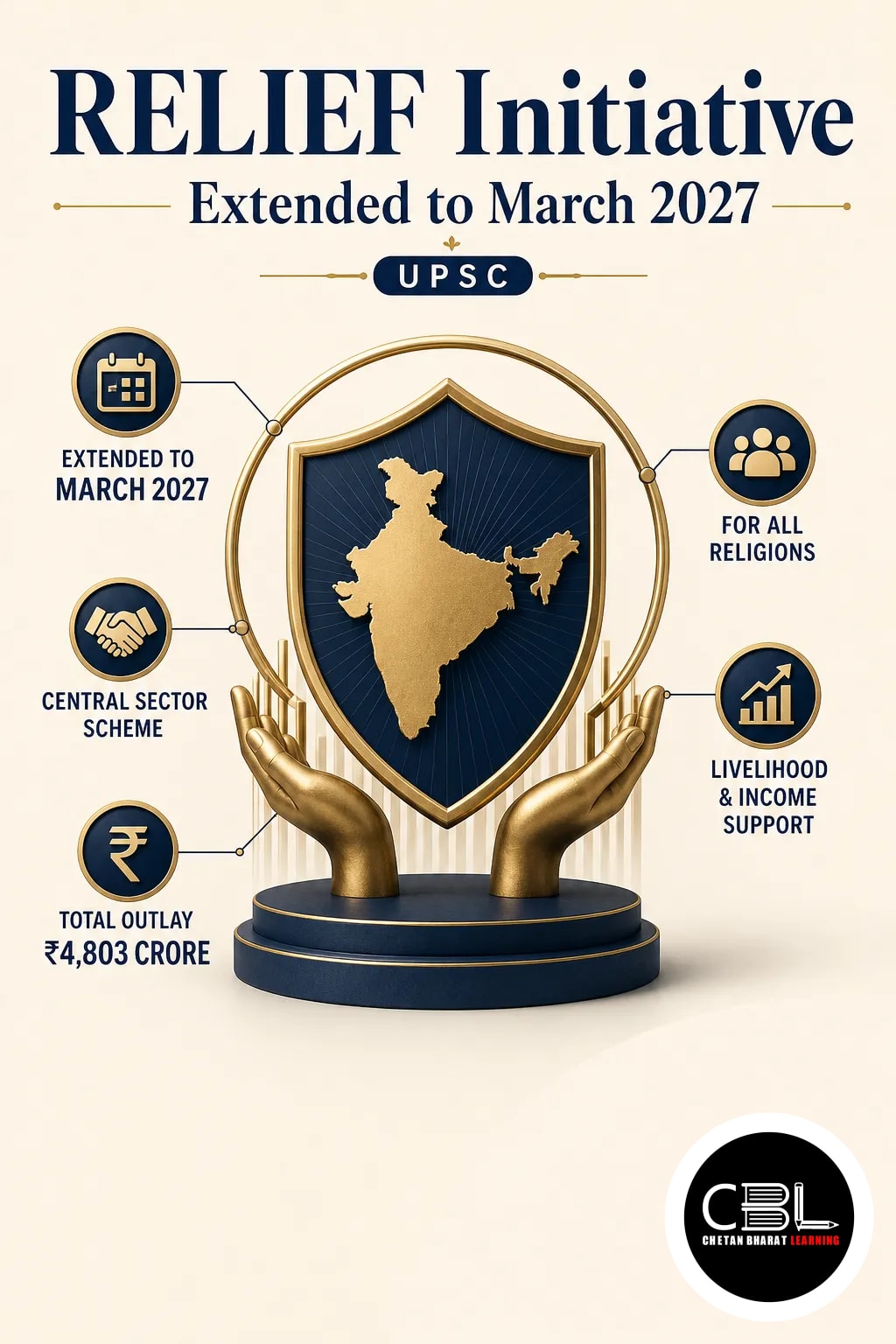
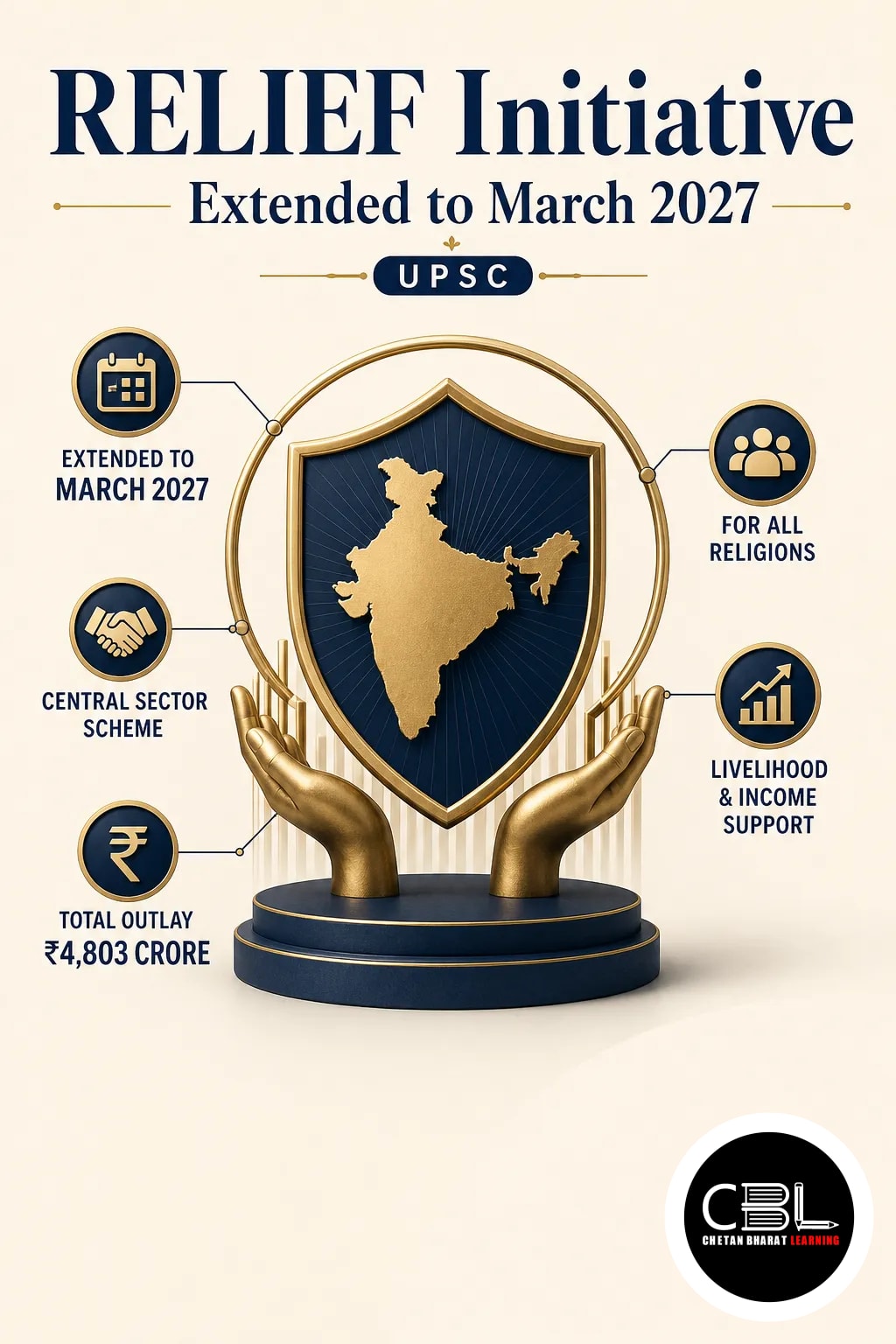
The RELIEF Initiative under India’s Export Promotion Mission has received an important extension following prolonged maritime disruptions in West Asia. On 26 October 2026, the Department of Commerce announced that Component II will remain operational until 31 March 2027. The measure provides eligible exporters with enhanced insurance protection through ECGC Limited, helping them manage shipping-related uncertainty and political risks. The development is important for UPSC Economy, international trade and government schemes. Explore related policies in the daily current affairs archive.
What Is the RELIEF Initiative?
RELIEF stands for Resilience and Logistics Intervention for Export Facilitation. It is a targeted, time-bound government intervention designed to protect Indian exporters from extraordinary freight costs, higher insurance premiums and war-related commercial risks.
Launched on 19 March 2026, the scheme operates under the Export Promotion Mission (EPM). It focuses on exporters affected by geopolitical instability in the Gulf and wider West Asian maritime corridor.
The initiative recognises that international trade depends on predictable transport costs, reliable insurance and timely payments. When conflict disrupts shipping routes, even commercially viable export orders can become financially risky.
The Department of Commerce formulated the intervention, while ECGC Limited serves as its nodal implementing agency. ECGC manages eligible insurance-related support, verification, claims and disbursement.
Why in News?
The government extended the operational timeline of RELIEF Component II until 31 March 2027 through Notification No. 37/2026-27, dated 30 September 2026. The Ministry of Commerce and Industry publicly reiterated the extension on 26 October.
The extension responds to continuing geopolitical instability across West Asia, particularly disruptions affecting maritime logistics in the Gulf and nearby shipping corridors.
Under Component II, eligible exporters can obtain ECGC protection covering 95% of specified risks. The benefit applies to eligible Standalone Policies and Whole Turnover Policies obtained on or after 16 March 2026.
The government also protects eligible exporters against insurance premium increases beyond the pre-disruption level during the applicable period.
Official source: PIB announcement dated 26 October 2026.
Key Features of the RELIEF Initiative
- Enhanced insurance protection: Component II offers up to 95% risk coverage through eligible ECGC policies for specified export shipments.
- Extended operational window: The government extended Component II until 31 March 2027 to address continuing maritime disruptions.
- Premium protection: Eligible exporters receive protection against insurance premium increases beyond pre-disruption levels.
- Eligible policy categories: Benefits apply to qualifying Standalone Policies and Whole Turnover Policies obtained on or after 16 March 2026.
- Cargo eligibility: Covered categories include Full Container Load, Less than Container Load and refrigerated container shipments, excluding energy shipments.
- Digital administration: ECGC processes applications and claims through its online customer portal using specified documentation.
- Government risk support: The framework provides additional government backing for eligible compensation beyond ordinary policy arrangements.
Important clarification: The October extension specifically concerns Component II. It should not be interpreted as an automatic extension of every RELIEF component.
Three Components of the RELIEF Framework
The intervention was structured to address different exporter requirements, including shipments already affected by disruption, upcoming shipments and extraordinary costs faced by uninsured MSME exporters.
| Component | Beneficiaries | Key Support |
|---|---|---|
| I | Existing ECGC-insured exporters | Enhanced compensation up to 100% for eligible war and political risks. |
| II | Exporters obtaining qualifying ECGC cover | 95% risk coverage and premium protection; operational window extended to March 2027. |
| III | Eligible MSME exporters without ECGC cover | Reimbursement of up to 50% of specified extraordinary freight and insurance costs, capped at ₹50 lakh per exporter or IEC. |
The components offer different forms of support. Component I addresses eligible existing policyholders, Component II encourages insurance for future shipments, and Component III provides cost relief to qualifying uninsured MSMEs.
The distinction is important because each component has separate eligibility conditions, shipment periods and documentation requirements.
Reference: ECGC official RELIEF framework.
About ECGC Limited
ECGC Limited, formerly known as the Export Credit Guarantee Corporation of India Limited, is a government-owned enterprise under the Ministry of Commerce and Industry.
Established in 1957, ECGC provides export credit insurance and related risk-management services to Indian exporters and banks. Its products help protect against specified commercial and political risks affecting international trade.
Commercial risks may include an overseas buyer’s insolvency or failure to pay under covered circumstances. Political risks can involve war, government restrictions and other specified events that prevent the normal completion of trade transactions.
Through export credit insurance, ECGC can support exporters’ confidence in overseas sales and facilitate access to trade finance. Coverage remains subject to the terms, exclusions and limits of individual policies.
Significance for India’s Economy
- Export continuity: Risk protection can help exporters maintain shipments during periods of geopolitical instability.
- MSME resilience: Smaller exporters may benefit from reduced exposure to unexpected logistics and insurance expenses.
- Working capital support: Reliable insurance arrangements may improve access to bank financing and credit facilities.
- Market diversification: Better risk management can encourage exporters to preserve commercial relationships in challenging overseas markets.
- Foreign exchange earnings: Sustained export activity supports India’s external sector and international trade performance.
- Employment protection: Stable export orders can help maintain jobs in labour-intensive and manufacturing industries.
The initiative is particularly relevant for firms operating with narrow margins. Sudden freight increases or insurance costs can make otherwise profitable orders commercially unviable.
Government-backed export risk mitigation may therefore prevent temporary geopolitical disruptions from causing lasting damage to export competitiveness.
Challenges and Limitations
- Persistent geopolitical uncertainty: Insurance support cannot independently restore disrupted shipping routes or eliminate conflict-related risks.
- Limited geographical coverage: Benefits apply to specified destinations and eligible shipments rather than every export market.
- Documentation requirements: Exporters must maintain appropriate shipment, policy and claims records to receive benefits.
- Awareness gaps: Smaller firms may lack information about eligibility, application procedures and available insurance products.
- Fiscal considerations: Government-backed compensation requires adequate monitoring, verification and financial management.
- Implementation coordination: Effective relief depends on cooperation among exporters, ECGC, banks and trade authorities.
Way Forward
India should combine short-term export insurance support with long-term improvements in maritime logistics, trade facilitation and market diversification. Exporters also require transparent guidance on insurance coverage, claims procedures and eligibility.
ECGC and trade institutions can expand outreach to MSMEs while strengthening digital verification and claim settlement. Better coordination with banks and industry associations can improve access to affordable export credit.
The government should regularly evaluate the scheme’s effectiveness, including claim outcomes, exporter participation and continuity of trade flows. Evidence-based assessment can help determine whether additional intervention is necessary.
The RELIEF Initiative demonstrates how targeted public policy can help manage external economic shocks while supporting India’s export ambitions. Further economic developments are available through the CBL UPSC current affairs platform.
Punjab PCS and Haryana HCS aspirants should connect the scheme with export promotion, MSME development and international trade disruptions. Export-oriented industries in both states, including agricultural processing, textiles, engineering goods and manufacturing, can face indirect effects from rising freight and insurance costs. Prelims questions may focus on ECGC, the Export Promotion Mission, the 95% coverage provision and the 31 March 2027 extension deadline.
Related Current Affairs
Preparing for UPSC, PCS or HCS?
Talk to a mentor at Chetan Bharat Learning, Chandigarh. Free guidance on choosing the right exam and building a study plan.
Chat on WhatsAppCall 97793 53345UPSC / IAS / PCS coaching in Chandigarh · Trusted by aspirants across Punjab & Haryana
Leave a Reply
You must be logged in to post a comment.