
UPSC Mapping
- Prelims: World Geography, European Seas, Brackish Water, Marine Pollution and Straits
- Mains: GS Paper 1: Geography; GS Paper 3: Environment and Biodiversity
Article
The Baltic Sea has returned to international attention after the Nordic Council Committee for a Sustainable Nordic Region announced new initiatives to protect its marine environment. On 19 October 2026, the committee highlighted persistent pollution, declining fish stocks and the need for stronger cross-border cooperation. The development is important for UPSC current affairs preparation, particularly world geography, marine ecosystems and international environmental cooperation.
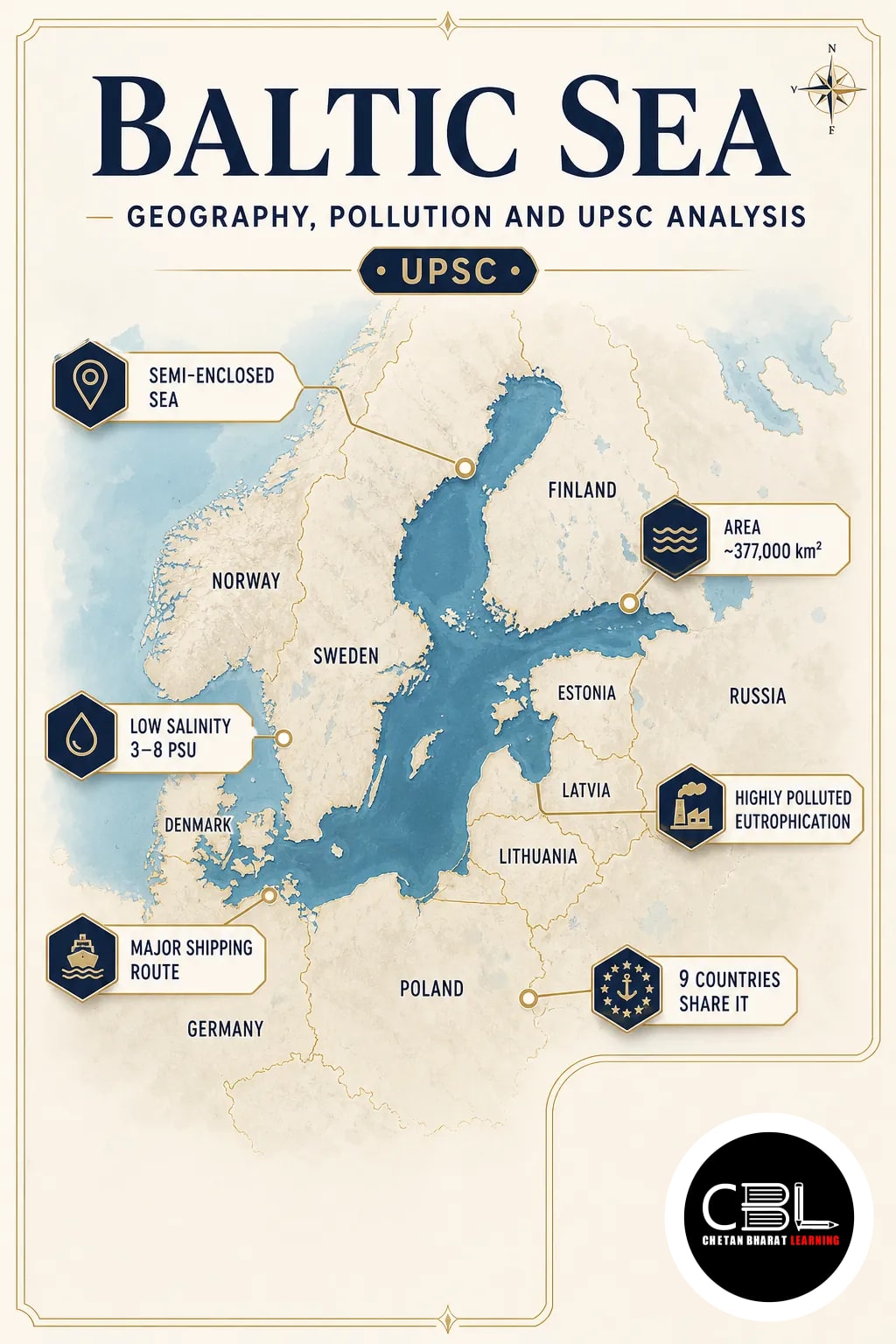
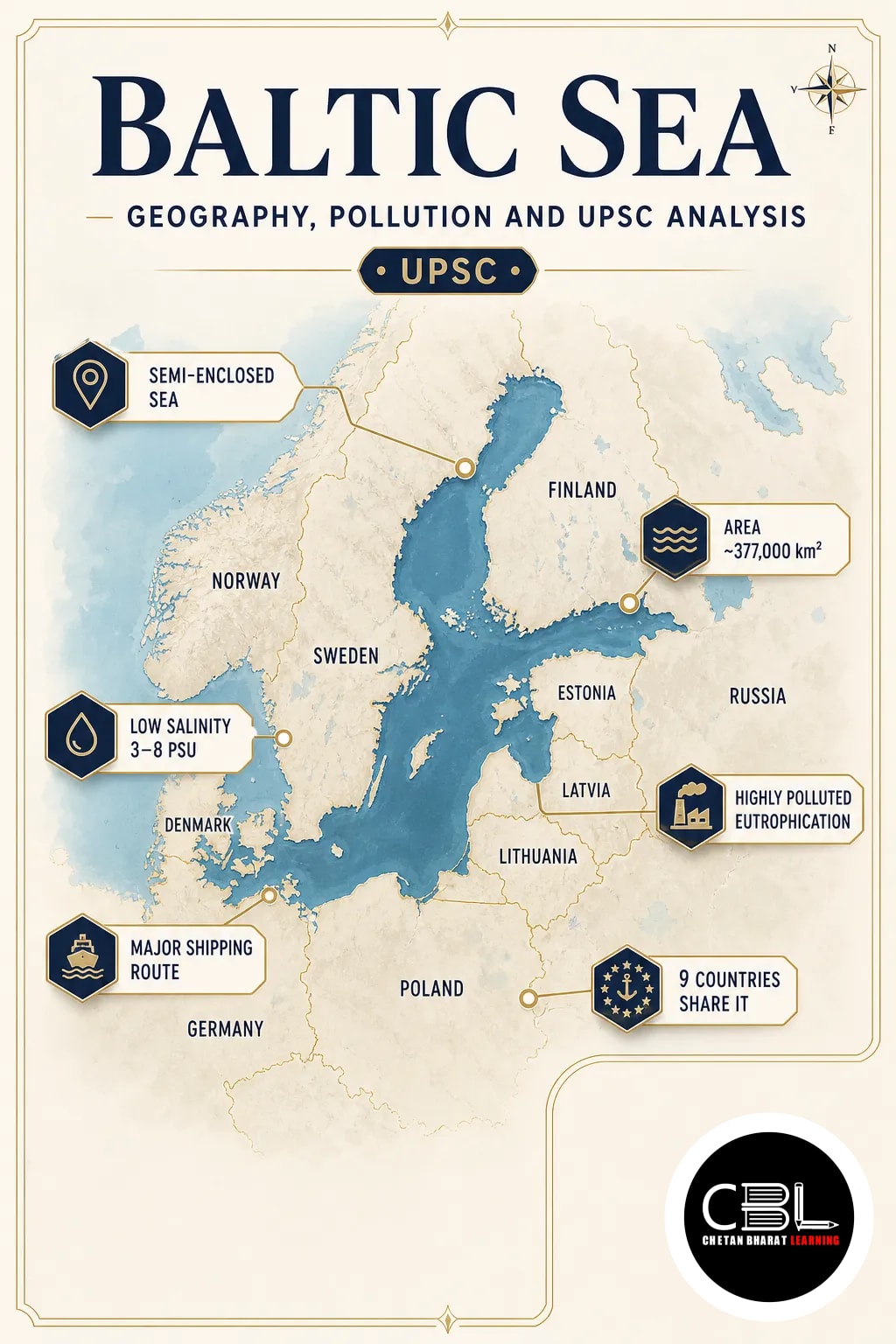
This semi-enclosed sea in Northern Europe experiences unusually low salinity and restricted water exchange with the North Sea. These characteristics make its ecosystem particularly vulnerable to nutrient pollution, oxygen depletion and environmental degradation.
Quick Facts
| Item | Details |
|---|---|
| Location | Northern Europe |
| Type | Semi-enclosed Brackish Sea |
| Coastal Countries | Nine |
| Main Environmental Threat | Eutrophication |
Location and Key Features
The Baltic Sea is a semi-enclosed inland sea of the Atlantic Ocean system, situated in Northern Europe. It connects indirectly with the North Sea through narrow passages around Denmark.
The sea extends between the Scandinavian Peninsula and the mainland of northern and northeastern Europe. Its irregular coastline includes numerous islands, gulfs, bays and archipelagos.
It is a comparatively young sea in geological terms. Its modern development followed the retreat of continental ice sheets after the last Ice Age, approximately 10,000 to 15,000 years ago.
Countries Bordering the Baltic Sea
Nine countries share the coastline of the Baltic Sea. Their geographical positions make the region important for trade, environmental cooperation and European maritime security.
| Region | Coastal Countries |
|---|---|
| Scandinavian and Nordic Region | Sweden, Finland and Denmark |
| Baltic States | Estonia, Latvia and Lithuania |
| Other Coastal Countries | Germany, Poland and Russia |
Important for Prelims: Norway does not directly border the Baltic Sea, although it is a Nordic country. Russia has Baltic coastlines near Saint Petersburg and its Kaliningrad exclave.
Major Gulfs and Straits
- Gulf of Bothnia: Located between Sweden and Finland, forming the northern extension of the sea.
- Gulf of Finland: Extends eastward between Finland and Estonia towards the Saint Petersburg region of Russia.
- Gulf of Riga: Located between Latvia and Estonia, including the waters around parts of western Estonia.
- Danish Straits: The Øresund, Great Belt and Little Belt provide connections between the Baltic region and the Kattegat.
- Kattegat and Skagerrak: These waterways form the broader connection towards the North Sea.
Major Islands
Gotland, belonging to Sweden, is the largest island in the Baltic Sea. Other important islands include Öland, Bornholm, Saaremaa and Hiiumaa.
The Åland Islands form an autonomous region of Finland near the entrance to the Gulf of Bothnia. These islands contribute to the region’s distinctive geographical and political landscape.
Why in News?
On 19 October 2026, the Nordic Council Committee for a Sustainable Nordic Region announced that it would pursue additional measures to protect the sea’s marine environment.
The committee emphasised that nutrient pollution from agriculture and wastewater systems continues to damage aquatic ecosystems. Persistent eutrophication has contributed to oxygen-depleted seabeds and declining ecological conditions.
According to the Nordic Council, only four of fifteen assessed commercial fish stocks were in good condition on average during 2016-2021. The finding demonstrates the continuing vulnerability of regional fisheries.
The committee is considering proposals involving stronger marine biodiversity protection and fisheries management. It has also identified the upcoming biodiversity and climate conferences, COP17 and COP31, as platforms for international engagement.
The Nordic Council announcement of 19 October 2026 highlights the need for coordinated political action across national boundaries.
Ecological and Strategic Significance
1. One of the World’s Largest Brackish Water Bodies
The sea contains brackish water, which has lower salinity than seawater but generally higher salinity than freshwater.
Numerous rivers discharge freshwater into the basin. Meanwhile, relatively saline North Sea water enters through narrow Danish passages, producing a distinctive salinity gradient.
Salinity generally decreases towards the northern and eastern parts of the basin. These conditions influence the distribution of marine, freshwater and brackish-water organisms.
2. Restricted Water Exchange
The semi-enclosed geographical setting limits water exchange with the open ocean. Narrow straits restrict the movement of water between the Baltic and North seas.
This slow exchange allows pollutants and excess nutrients to remain within the ecosystem for extended periods. It also makes environmental recovery comparatively slow.
3. Marine Biodiversity
The ecosystem supports marine and freshwater species adapted to relatively low salinity. Fish, seabirds, marine mammals and benthic organisms form important components of its food webs.
Environmental changes can affect species that already live near their salinity tolerance limits. Habitat protection and improved water quality are therefore essential for biodiversity conservation.
4. Economic and Maritime Importance
The region supports international shipping, commercial fisheries, coastal settlements and maritime industries. Its shipping routes connect several important European economies.
Marine environmental deterioration can affect fish production, tourism and other economic activities. Fisheries sustainability is also linked to regional food security and economic resilience.
Major Environmental Threats
- Eutrophication: Excess nitrogen and phosphorus encourage algal growth, reduce water clarity and contribute to oxygen depletion.
- Oxygen-deficient seabeds: Decomposition of excessive organic matter can reduce dissolved oxygen and threaten bottom-dwelling organisms.
- Agricultural runoff: Fertilisers and other nutrient inputs from surrounding land areas contribute to marine pollution.
- Wastewater discharge: Municipal and industrial discharges may introduce nutrients and other contaminants into the sea.
- Overfishing and declining stocks: Unsustainable harvesting and ecosystem deterioration can undermine the recovery of commercial fish populations.
- Climate change: Rising water temperatures and changing salinity patterns can alter habitats and species distributions.
- Shipping-related pollution: Vessel traffic creates potential risks involving oil spills, emissions and other marine contaminants.
Understanding Eutrophication
Eutrophication occurs when a waterbody receives excessive nutrients, particularly nitrogen and phosphorus. These nutrients stimulate rapid growth of algae and other primary producers.
When algal biomass decomposes, microorganisms consume dissolved oxygen. Severe oxygen depletion can damage aquatic habitats and contribute to areas commonly described as marine dead zones.
According to HELCOM’s assessment for 2016-2021, approximately 93.8% of the Baltic Sea’s assessed surface area failed to achieve good environmental status for eutrophication.
This assessment indicates that reducing nutrient pollution remains a major environmental priority. Further information is available through HELCOM’s eutrophication assessment.
Conservation and Policy Measures
Role of HELCOM
The Helsinki Commission (HELCOM), formally the Baltic Marine Environment Protection Commission, coordinates regional cooperation to protect the marine environment.
It operates under the Convention on the Protection of the Marine Environment of the Baltic Sea Area, commonly called the Helsinki Convention. Its work includes pollution monitoring, ecosystem assessments and regional environmental planning.
Baltic Sea Action Plan
The Baltic Sea Action Plan provides a regional framework for improving ecological conditions. It addresses issues including eutrophication, hazardous substances, biodiversity and maritime activities.
The Nordic Council has encouraged closer cooperation based on this framework. Its recent discussions seek to translate environmental objectives into stronger practical measures.
Proposals Under Discussion
- Marine biodiversity protection: Strengthen research and conservation efforts supporting protection of marine and coastal habitats.
- 30 by 30 objective: Support efforts to conserve at least 30% of marine and coastal areas by 2030 under the global biodiversity framework.
- Fisheries resilience: Consider management approaches that improve long-term fish stocks and emergency preparedness.
- Research cooperation: Encourage collaborative scientific monitoring and sharing of environmental information.
- Coordinated regulation: Improve cooperation among governments on marine management and pollution reduction.
These proposals remain part of policy discussions and should not all be treated as adopted or implemented measures.
Way Forward
- Reduce nutrient inputs: Improve agricultural practices and wastewater treatment to limit nitrogen and phosphorus pollution.
- Restore marine habitats: Protect important habitats and support ecosystem recovery through science-based management.
- Strengthen fisheries management: Use ecological assessments to support sustainable harvesting and recovery of depleted stocks.
- Improve regional cooperation: Coordinate monitoring, legislation and marine conservation across all coastal countries.
- Address climate-related risks: Integrate changing temperatures, salinity and ecosystem conditions into environmental planning.
- Monitor conservation outcomes: Evaluate water quality, oxygen conditions, biodiversity and fish stock recovery over time.
The Baltic Sea demonstrates why shared marine ecosystems require sustained international cooperation. Its environmental challenges cannot be solved by individual countries acting independently, particularly when pollution crosses national boundaries.
Prelims Package
Prelims Practice Corner
Q1. Which of the following countries does NOT directly border the Baltic Sea?
(a) Sweden (b) Latvia (c) Norway (d) Poland
Answer: (c). Norway is a Nordic country but does not directly border the Baltic Sea.
Q2. Gotland Island belongs to which country?
(a) Finland (b) Sweden (c) Denmark (d) Estonia
Answer: (b). Gotland, the largest island in the Baltic Sea, belongs to Sweden.
Q3. The Gulf of Bothnia lies between which two countries?
(a) Sweden and Finland (b) Germany and Poland (c) Estonia and Russia (d) Denmark and Norway
Answer: (a). The Gulf of Bothnia separates Sweden and Finland.
Q4. Consider the following statements: 1. The Baltic Sea is a semi-enclosed brackish waterbody. 2. It receives freshwater from several rivers. 3. It has unrestricted water exchange with the Atlantic Ocean. Which statements are correct?
(a) 1 and 2 only (b) 2 and 3 only (c) 1 and 3 only (d) 1, 2 and 3
Answer: (a). The sea receives substantial freshwater inflows but has restricted exchange with the North Sea.
Q5. Eutrophication of marine waters is primarily associated with:
(a) Excess nitrogen and phosphorus (b) Reduction in solar radiation (c) Increased tectonic activity (d) Changes in Earth’s magnetic field
Answer: (a). Excess nitrogen and phosphorus stimulate algal growth and contribute to oxygen depletion.
Mains Package
Q1. Explain the geographical characteristics of the Baltic Sea and examine why its ecosystem is particularly vulnerable to pollution. (150 words, 10 marks)
Answer Structure
Intro: Locate the sea in Northern Europe and identify its semi-enclosed character.
Body: Discuss low salinity, restricted water exchange, freshwater inflows, eutrophication and oxygen depletion.
Conclusion: Highlight the need for integrated pollution control and marine ecosystem protection.
Q2. Marine pollution often crosses national boundaries, making regional cooperation essential for ecosystem conservation. Discuss with reference to the Baltic Sea and the role of international environmental institutions. (250 words, 15 marks)
Answer Structure
Intro: Explain the transboundary nature of marine pollution.
Body: Examine eutrophication, wastewater discharge, fisheries decline, climate risks and shared maritime resources. Discuss HELCOM, the Baltic Sea Action Plan and Nordic Council cooperation.
Conclusion: Recommend coordinated regulation, scientific monitoring and measurable conservation outcomes.
FAQs
Which nine countries border the Baltic Sea?
Sweden, Finland, Denmark, Germany, Poland, Lithuania, Latvia, Estonia and Russia share the Baltic Sea coastline.
Where is Gotland Island located?
Gotland is located in the Baltic Sea and belongs to Sweden. It is the largest island in the Baltic Sea.
Why does the Baltic Sea have low salinity?
It receives substantial freshwater from rivers while exchanging relatively limited amounts of saline water with the North Sea through the Danish Straits. This creates brackish conditions and a strong regional salinity gradient.
Related Current Affairs
Preparing for UPSC, PCS or HCS?
Talk to a mentor at Chetan Bharat Learning, Chandigarh. Free guidance on choosing the right exam and building a study plan.
Chat on WhatsAppCall 97793 53345UPSC / IAS / PCS coaching in Chandigarh · Trusted by aspirants across Punjab & Haryana
Leave a Reply
You must be logged in to post a comment.