
UPSC Mapping
| Exam | Topic |
|---|---|
| Prelims | Plant Pathology, Coconut Diseases, Oomycetes and Crop Protection |
| Mains (GS Paper 3) | Agriculture, Crop Protection and Farmer Welfare |
Quick Facts
| Affected Crop | Coconut Palm |
|---|---|
| Pathogen | Phytophthora palmivora |
| Favourable Conditions | Monsoon and high humidity |
| News Location | Tiptur, Tumakuru, Karnataka |
What is Bud Rot Disease?
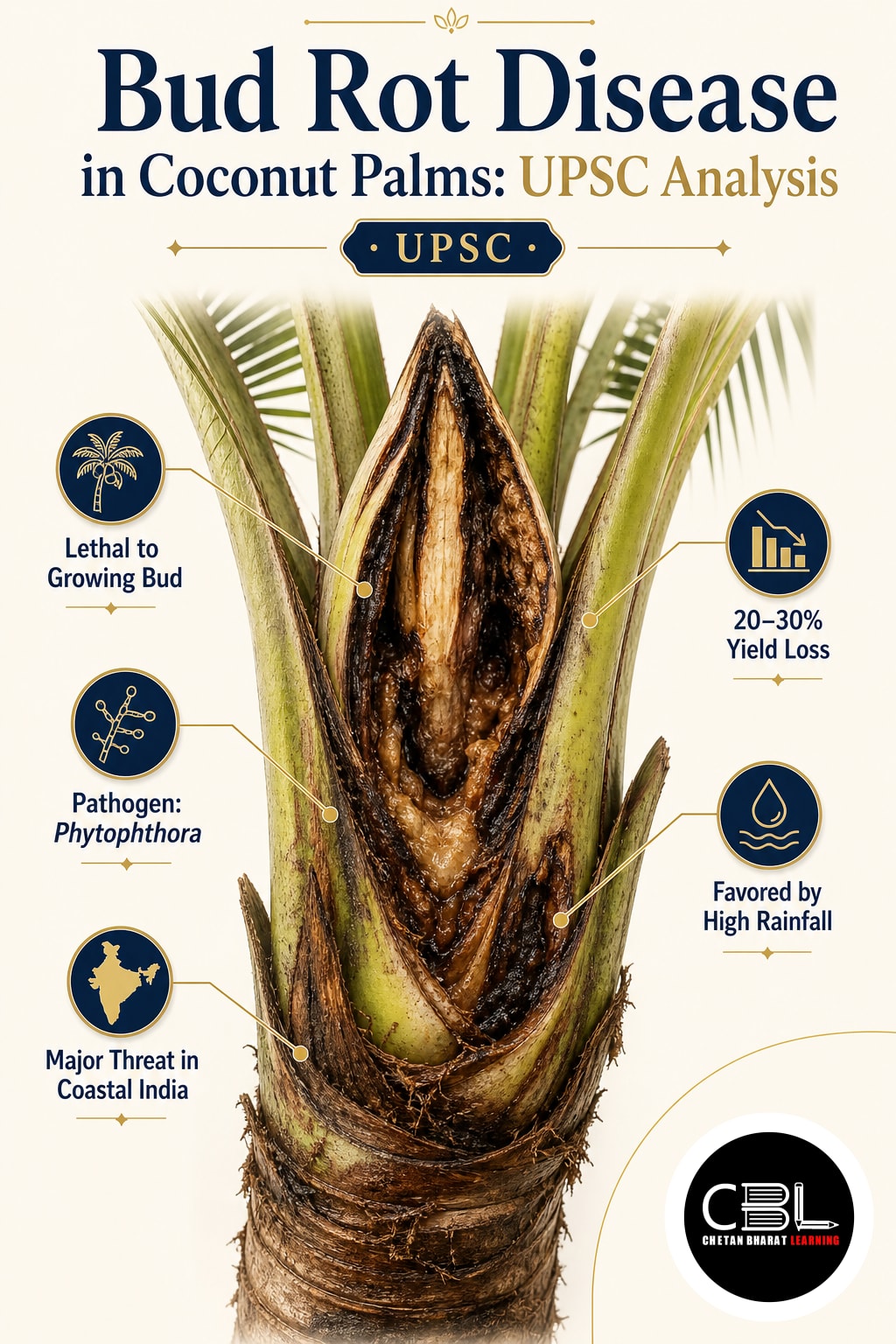
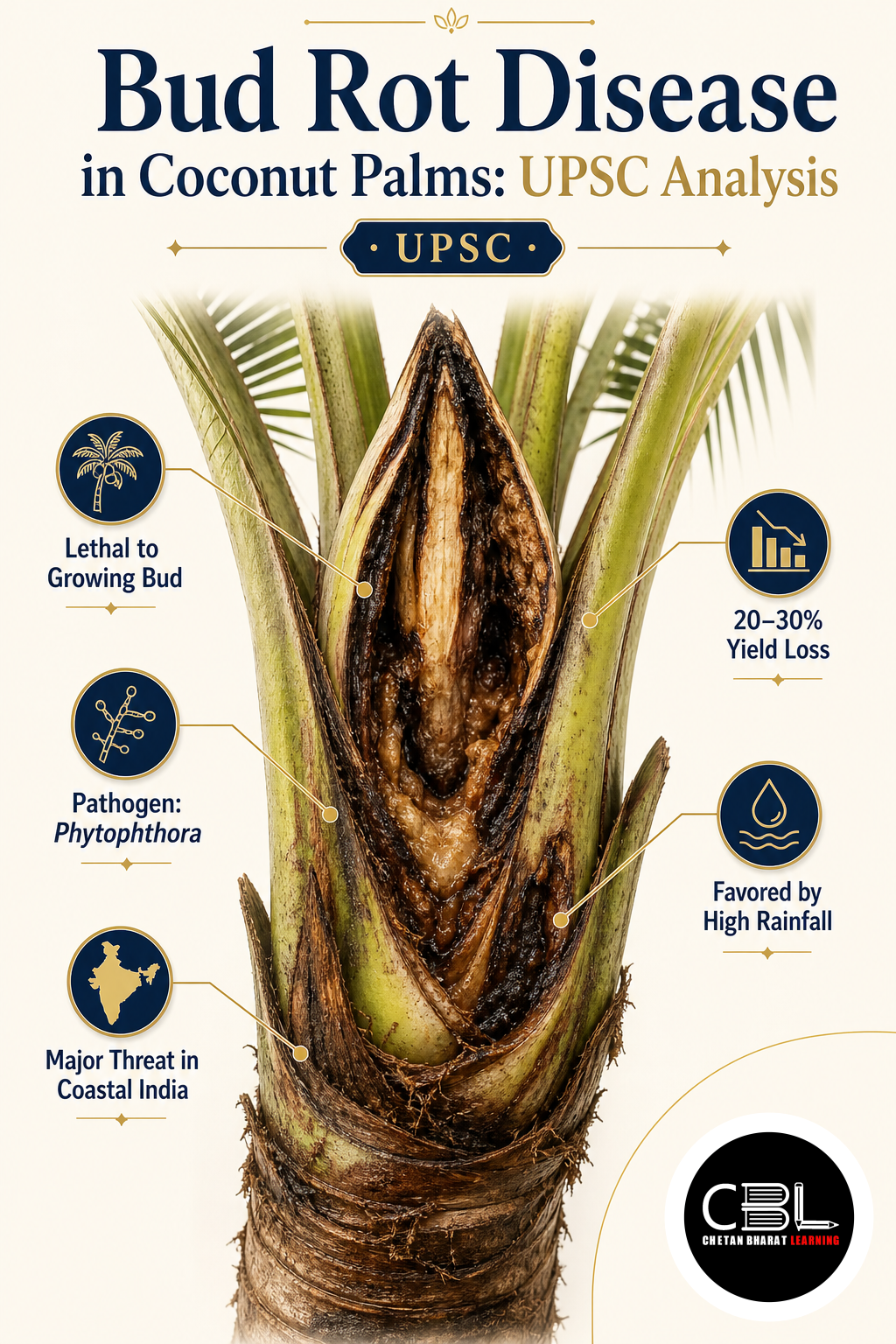
Bud rot is a serious disease of coconut palms that damages the terminal bud and surrounding tissues. This terminal bud contains the growing point responsible for producing new leaves and maintaining the palm’s upward growth.
The disease is associated with Phytophthora palmivora, a fungus-like organism belonging to the oomycetes. Although agricultural literature commonly describes it as a fungal disease, oomycetes are biologically distinct from true fungi.
When the pathogen attacks the central growing region, tissues begin to decay. If infection destroys the growing point, the coconut palm cannot produce new leaves and may eventually die.
Unlike many branching plants, coconut palms generally possess a single main growing point. Damage to this structure is therefore particularly dangerous and makes early disease recognition essential.
Why in News?
Coconut farmers in Tiptur taluk of Tumakuru district have expressed concern about increasing disease incidence and its potential impact on coconut production. The reported cases highlight the vulnerability of plantations to destructive plant pathogens.
The disease occurs more frequently under wet and humid environmental conditions, particularly during the monsoon. Flood-prone locations and plantations experiencing prolonged moisture can face heightened infection risks.
As bud rot may become fatal, farmers need to identify initial symptoms before the growing point suffers irreversible damage. The situation demonstrates the importance of timely agricultural extension services and effective plantation management.
Location and Key Features
- Host plant: Coconut palm, scientifically known as Cocos nucifera.
- Causal organism: Phytophthora palmivora belongs to the oomycetes.
- Infection site: The terminal growing point and neighbouring young tissues.
- Age susceptibility: Young palms show greater vulnerability, though all ages can be affected.
- Seasonal occurrence: High rainfall and humidity during monsoon months favour disease development.
- Dry-season behaviour: Activity may decline in dry weather, while the pathogen can persist in infected material.
- Severe outcomes: Progressive decay destroys the terminal bud, halting new leaf production and killing the palm.
Symptoms of Bud Rot in Coconut Palms
Early Symptoms in Seedlings
Yellowing of one or two younger leaves and rotting of basal leaf tissues, progressing towards the crown with an unpleasant odour.
Advanced Symptoms in Young Palms
The central leaf decays into a soft mass, leading to crown collapse and death if the growing point is destroyed.
Symptoms in Adult Palms
Discolouration of the spear leaf, which becomes pale then brown, with downward rot reaching the terminal bud and causing older leaves to droop.
Ecological and Agricultural Significance
Threat to Coconut Productivity
Coconut is a critical plantation crop. Loss of productive palms reduces output and imposes long-term financial burdens due to replacement delays.
Relationship Between Climate and Plant Diseases
Persistent rainfall and high humidity create favourable conditions for pathogens, highlighting the need for local weather monitoring and disease surveillance.
Importance of Agricultural Extension
Extension services aid early symptom recognition and management practice communication. Refer to the Coconut Development Board and ICAR for guidelines.
Threats and Challenges
- High moisture exposure: Monsoon rainfall and humidity favour disease development.
- Delayed detection: Internal decay may precede visible symptoms.
- Irreversible damage: Destruction of the terminal bud stops growth.
- Economic losses: Reduced production and replacement costs.
- Limited technical access: Small farmers struggle to get timely advice.
- Recurring risks: Infected material and environment hinder management.
Conservation and Disease Management Measures
Effective management relies on early detection, prompt action, and preventive protection.
- Remove infected tissue: Carefully clean decayed crown tissues in early cases.
- Protect treated areas: Apply approved fungicidal preparations (e.g., Bordeaux paste).
- Preventive treatment: Use Bordeaux mixture or recommended Phytophthora controls before and during wet periods.
- Improve drainage: Reduce water accumulation around palms.
- Maintain sanitation: Dispose of diseased material per guidelines.
- Seek expert diagnosis: Consult agricultural officers or pathologists for accurate recommendations.
Bordeaux mixture is a copper sulphate and lime-based fungicide used against Phytophthora, requiring proper concentration to avoid damage.
Integrated disease management combines observation, preventive measures, sanitation, and evidence-based treatment to minimise chemical overuse.
Way Forward
- Expand surveillance: Promote monitoring during high-risk weather.
- Improve awareness: Train farmers to recognise early signs.
- Strengthen extension: Provide timely expert guidance.
- Promote prevention: Enhance sanitation, drainage, and recommended practices.
- Support research: Investigate pathogen behaviour and control methods.
- Integrate weather advisories: Use rainfall and humidity data for preparedness.
Prelims Practice Corner
-
Which organism is associated with bud rot of coconut palms?
(a) Puccinia graminis (b) Phytophthora palmivora (c) Xanthomonas oryzae (d) Rhizobium leguminosarum
Answer: Phytophthora palmivora.
-
Phytophthora palmivora belongs to which group of organisms?
(a) Bacteria (b) Viruses (c) Oomycetes (d) Nematodes
Answer: Oomycetes.
-
Which environmental condition generally favours severe bud rot incidence in coconut palms?
(a) Prolonged low humidity (b) High humidity during monsoon (c) Freezing temperatures (d) Dry desert conditions
Answer: High humidity during monsoon.
-
Consider the following statements:
1. Bud rot affects the terminal growing point of coconut palms. 2. Young coconut palms are especially vulnerable. 3. Severe infection can stop the formation of new leaves.
Which statements are correct?
(a) 1 and 2 only (b) 2 and 3 only (c) 1 and 3 only (d) 1, 2 and 3
Answer: 1, 2 and 3.
-
Bordeaux mixture traditionally contains which combination?
(a) Copper sulphate and lime (b) Sodium chloride and urea (c) Potassium nitrate and gypsum (d) Ammonium sulphate and borax
Answer: Copper sulphate and lime.
Mains Practice Questions
-
Explain the causes, symptoms and management strategies of bud rot in coconut palms. (150 words, 10 marks)
Answer Structure:
- Intro: Identify the disease, its causal organism and the affected growing point.
- Body: Explain monsoon-related conditions, symptoms, crown damage, early detection and management measures.
- Conclusion: Highlight preventive surveillance and timely intervention.
-
Examine the relationship between climatic conditions and plant diseases in Indian agriculture. Discuss the role of integrated disease management in protecting farmers’ livelihoods. (250 words, 15 marks)
Answer Structure:
- Intro: Explain the relationship among host susceptibility, pathogens and environmental factors.
- Body: Discuss rainfall, humidity, pathogen development, losses, extension services, surveillance and management. Use coconut bud rot as a case study.
- Conclusion: Recommend climate-informed monitoring and scientific support.
Frequently Asked Questions
What causes bud rot in coconut palms?
The disease is caused by Phytophthora palmivora, a fungus-like oomycete that infects the terminal growing point and surrounding tissues.
Why is coconut bud rot more severe during the monsoon?
High rainfall and humidity favour infection and accelerate deterioration of crown tissues.
How can farmers manage coconut bud rot?
By early detection, removal of affected tissues, field sanitation, and preventive treatments like Bordeaux mixture under expert guidance. Severely damaged palms may not recover.
Related Current Affairs
Preparing for UPSC, PCS or HCS?
Talk to a mentor at Chetan Bharat Learning, Chandigarh. Free guidance on choosing the right exam and building a study plan.
Chat on WhatsAppCall 97793 53345UPSC / IAS / PCS coaching in Chandigarh · Trusted by aspirants across Punjab & Haryana
Leave a Reply
You must be logged in to post a comment.