
UPSC Mapping
| Prelims | Indian Polity, Statutory Bodies and Human Rights |
|---|---|
| Mains | GS Paper 2 – Constitution, Governance and Social Justice |
Quick Facts
| Established | 12 October 1993 |
|---|---|
| Legal Basis | Protection of Human Rights Act, 1993 |
| Nature | Statutory, autonomous and quasi-judicial |
| Chairperson in 2026 | Justice V. Ramasubramanian |
What is the NHRC?
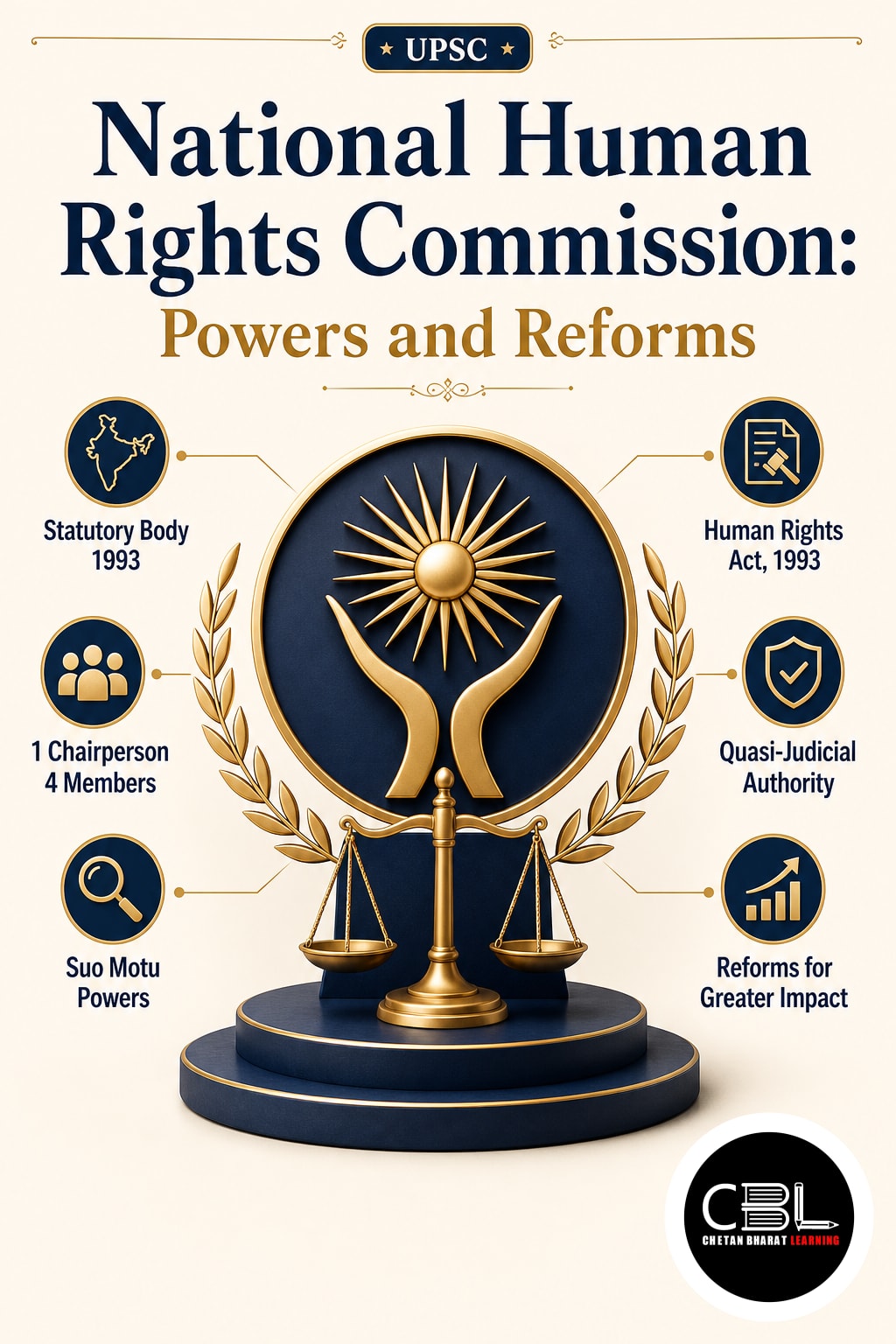
The NHRC is an independent statutory institution established to protect and promote human rights in India. It was constituted on 12 October 1993 under the Protection of Human Rights Act, 1993, subsequently amended in 2019.
Section 2(1)(d) of the Act defines human rights as rights relating to life, liberty, equality and dignity guaranteed by the Constitution or embodied in international covenants and enforceable by Indian courts.
The Commission investigates alleged violations, reviews institutional safeguards, recommends remedial action and promotes human rights awareness. It is quasi-judicial because it has inquiry powers like a civil court, but its recommendations are not directly enforceable.
Why in News?
The Commission commemorated its 33rd Foundation Day on 12 October 2026 at Vigyan Bhawan, New Delhi. Chief Justice of India Justice Surya Kant attended as the chief guest.
The national conference focused on water security, human dignity and the right to water. Speakers emphasised the importance of strengthening human rights institutions amid changing social, technological and environmental conditions.
According to the Commission’s announcement, it had registered more than 24 lakh cases, including about 3,100 suo motu cases, and recommended around ₹274 crore in relief during its 33-year journey.
Composition of the Commission
Section 3 of the Protection of Human Rights Act specifies the composition. The 2019 amendment expanded eligibility for the Chairperson and increased expert members.
| Position | Eligibility or Composition |
|---|---|
| Chairperson | Former Chief Justice of India or Judge of the Supreme Court |
| Judicial Member 1 | Serving or former Judge of the Supreme Court |
| Judicial Member 2 | Serving or former Chief Justice of a High Court |
| Expert Members | Three persons with human rights expertise; at least one must be a woman |
| Ex-officio Members | Heads of specified national commissions and the Chief Commissioner for Persons with Disabilities for Section 12 functions |
Ex-officio Members
- Chairperson, National Commission for Scheduled Castes
- Chairperson, National Commission for Scheduled Tribes
- Chairperson, National Commission for Minorities
- Chairperson, National Commission for Women
- Chairperson, National Commission for Backward Classes
- Chairperson, National Commission for Protection of Child Rights
- Chief Commissioner for Persons with Disabilities
Appointment and Tenure
The President appoints the Chairperson and members on the recommendation of a committee headed by the Prime Minister.
| Selection Committee Member | Position |
|---|---|
| Prime Minister | Chairperson |
| Speaker of Lok Sabha | Member |
| Union Home Minister | Member |
| Leader of Opposition in Lok Sabha | Member |
| Leader of Opposition in Rajya Sabha | Member |
| Deputy Chairman of Rajya Sabha | Member |
The Chairperson and members hold office for three years or until age 70, whichever is earlier. They may be reappointed under statutory conditions. Removal for proven misbehaviour or incapacity follows a Supreme Court-led inquiry.
Key Functions and Powers
Section 12 of the Act details the NHRC’s principal functions:
- Suo motu and petition inquiries: Investigate alleged human rights violations or negligence by public servants.
- Judicial intervention: Intervene in court proceedings with approval.
- Prison monitoring: Visit prisons and detention institutions.
- Review of safeguards: Examine and recommend improvements to legal protections.
- Research and awareness: Promote education, research and public programmes.
- International instruments: Study treaties and advise on implementation.
- Civil society cooperation: Engage organisations in rights promotion.
- Recommendations for relief: Suggest compensation, prosecution or disciplinary action.
Powers During Inquiries
Under Section 13, the NHRC has civil court powers: summoning witnesses, examining evidence and requiring documents. Section 18 allows recommending relief, approaching constitutional courts and seeking reports from authorities.
Constitutional and Legal Framework
| Article or Act | What It Provides |
|---|---|
| Article 14 | Equality before law and equal protection of laws |
| Article 19 | Fundamental freedoms subject to restrictions |
| Article 21 | Protection of life and personal liberty |
| Articles 32 and 226 | Remedies through Supreme Court and High Courts |
| Protection of Human Rights Act, 1993 | Establishment, composition, powers and functions |
| Protection of Human Rights (Amendment) Act, 2019 | Revised membership, eligibility and tenure |
The NHRC also aligns with the Universal Declaration of Human Rights and the Paris Principles governing national human rights institutions.
What are the Paris Principles?
The Paris Principles (1993) set international standards for national human rights institutions. They stress independence, pluralism, adequate resources and broad mandates. Compliance is assessed through the Global Alliance of National Human Rights Institutions.
Emerging Human Rights Challenges
- Digital surveillance and privacy: Legality and accountability of expanding data collection.
- Algorithmic discrimination: AI systems reproducing bias in public services.
- Climate-related inequality: Environmental degradation affecting vulnerable groups.
- Right to water: Unequal access impacting health and dignity.
- Custodial rights: Allegations of unlawful detention and prison conditions.
- Social exclusion: Discrimination against women, children, persons with disabilities and marginalised communities.
Limitations and Institutional Concerns
- Non-binding recommendations: No direct enforcement like court orders.
- One-year limitation: Section 36(2) bars inquiries after one year of violation.
- Armed forces jurisdiction: Restricted procedure under Section 19.
- Resource constraints: Vacancies and deputation affect capacity.
- Delayed compliance: Slow implementation of recommendations.
- Independence concerns: Appointment processes and autonomy require strengthening.
Way Forward
- Improve appointment transparency: Ensure timely, merit-based selections.
- Strengthen investigation capacity: Provide professional staff and expertise.
- Enhance compliance monitoring: Publish follow-up reports and track implementation.
- Address emerging issues: Build expertise in AI, privacy, climate justice and digital governance.
- Strengthen state bodies: Coordinate with State Human Rights Commissions.
- Promote accessible complaints: Expand language and digital facilities for vulnerable groups.
Prelims Practice Corner
Q1. Under which legislation was the National Human Rights Commission established?
- (a) Protection of Civil Rights Act, 1955
- (b) Protection of Human Rights Act, 1993
- (c) Human Rights Protection Act, 2005
- (d) National Human Rights Act, 2019
Answer: (b) Protection of Human Rights Act, 1993.
Q2. Consider the following statements about the NHRC:
1. Its Chairperson must necessarily be a former Chief Justice of India.
2. At least one of its three expert members must be a woman.
3. Its recommendations are advisory rather than enforceable.
Which are correct?
- (a) 1 and 2 only
- (b) 1 and 3 only
- (c) 2 and 3 only
- (d) 1, 2 and 3
Answer: (c) 2 and 3 only.
Q3. Who chairs the committee recommending NHRC appointments?
- (a) Prime Minister
- (b) Chief Justice of India
- (c) President of India
- (d) Union Law Minister
Answer: (a) Prime Minister.
Q4. Which is a key requirement of the Paris Principles?
- (a) Direct political control
- (b) Exclusive judicial membership
- (c) Mandatory prosecution powers
- (d) Independence, pluralism and adequate resources
Answer: (d) Independence, pluralism and adequate resources.
Q5. Which statement about the NHRC is correct?
- (a) Constitutional body under Article 324
- (b) Chairperson’s term is six years without age limit
- (c) Section 36(2) restricts inquiries older than one year
- (d) Unrestricted jurisdiction over armed forces
Answer: (c) Section 36(2) provides a one-year limitation.
Mains Practice Questions
Q1.
Despite having a broad statutory mandate, the NHRC faces significant institutional and operational limitations. Critically examine its role in protecting human rights in India and suggest reforms. (15 marks)
Answer Structure:
- Intro: Introduce the Commission under the Protection of Human Rights Act, 1993.
- Body: Discuss inquiry powers, suo motu action, custodial rights, non-binding recommendations and independence issues.
- Conclusion: Recommend stronger investigation capacity, transparent appointments and compliance monitoring.
Q2.
Emerging challenges such as digital surveillance, algorithmic discrimination and climate change require human rights institutions to adapt beyond conventional civil liberties. Discuss. (10 marks)
Answer Structure:
- Intro: Explain the link between technology, environment and human dignity.
- Body: Cover privacy, AI bias, environmental justice, the right to water and governance challenges.
- Conclusion: Emphasise multidisciplinary expertise, stronger institutions and rights-centred policy.
Frequently Asked Questions
When was the National Human Rights Commission established?
The NHRC was established on 12 October 1993 under the Protection of Human Rights Act, 1993. It celebrated its 33rd Foundation Day on 12 October 2026.
Is the NHRC a constitutional or statutory body?
The NHRC is a statutory, autonomous and quasi-judicial body established by parliamentary legislation. It is not a constitutional body like the Election Commission or the CAG.
Are recommendations of the NHRC binding?
The Commission’s recommendations are generally not directly enforceable like court judgments. However, authorities must respond, and the NHRC can approach the Supreme Court or High Courts for directions.
Related Current Affairs
Preparing for UPSC, PCS or HCS?
Talk to a mentor at Chetan Bharat Learning, Chandigarh. Free guidance on choosing the right exam and building a study plan.
Chat on WhatsAppCall 97793 53345UPSC / IAS / PCS coaching in Chandigarh · Trusted by aspirants across Punjab & Haryana
Leave a Reply
You must be logged in to post a comment.