
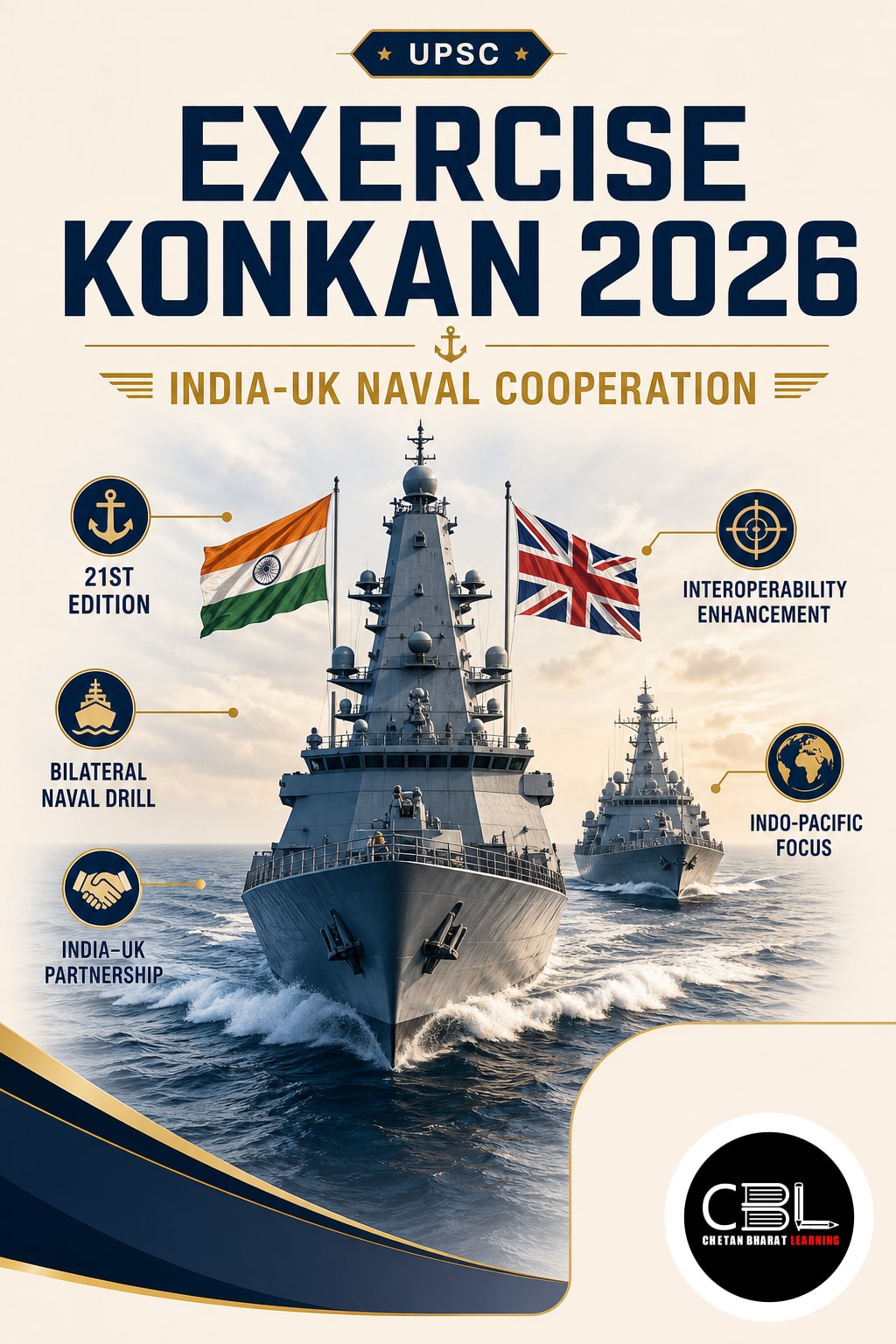

UPSC Mapping
- Prelims: Defence Exercises and International Relations
- Mains: GS Paper 2 – International Relations; GS Paper 3 – Security
What is Exercise Konkan 2026?
Exercise Konkan is a bilateral maritime exercise conducted between the Indian Navy and the British Royal Navy. Institutionalised in 2004, the exercise strengthens tactical interoperability, professional understanding and cooperation between the two naval forces.
Its training activities involve different aspects of naval warfare, including surface operations, air defence and anti-submarine warfare. The exercise also promotes the exchange of operational practices and experience.
The 2026 edition is being hosted by the United Kingdom near Plymouth. The deployment provides an opportunity for the participating navies to undertake coordinated operations in European maritime waters.
Why in News?
The Indian Navy’s guided-missile stealth frigate INS Trishul arrived at Plymouth to participate in Exercise Konkan 2026 with the Royal Navy.
The exercise forms part of INS Trishul’s wider European deployment. The ship previously participated in Exercise VARUNA-24 with the French Navy near Toulon and subsequently visited Valencia, Spain.
The engagement reflects continued efforts to strengthen India-UK naval cooperation, particularly in tactical training, maritime security and protection of important sea routes.
Key Features of Exercise Konkan 2026
- Two-phase structure: Harbour Phase at Plymouth followed by an operational Sea Phase off the southern coast of the United Kingdom.
- Harbour Phase: Operational briefings, professional exchanges, cross-deck visits, technical discussions and personnel interactions.
- Sea Phase: Coordinated maritime manoeuvres and tactical training under simulated operational conditions.
- Tri-domain operations: Air, surface and subsurface warfare drills.
- Advanced aviation operations: Helicopter landing practices, flight-deck coordination and maritime aviation procedures.
- Air-defence exercises: Coordinated responses to simulated aerial threats.
- Anti-submarine warfare: Submarine detection, tracking and coordinated defensive responses.
- Surface firing and tactical manoeuvres: Tactical communication, navigation and operational coordination.
- Professional knowledge exchange: Sharing of operational practices to improve mutual understanding.
Harbour Phase vs Sea Phase
| Harbour Phase | Sea Phase |
|---|---|
| Conducted while ships are in port | Conducted during operational deployment at sea |
| Operational planning and briefings | Tactical manoeuvres and simulated combat operations |
| Professional discussions and training exchanges | Air defence and anti-submarine warfare drills |
| Cross-deck visits and familiarisation | Coordinated aviation and surface operations |
About INS Trishul
INS Trishul (F43) is a Talwar-class guided-missile stealth frigate of the Indian Navy. Commissioned in 2003, the vessel is designed for multiple operational roles, including surface warfare, air defence and anti-submarine operations.
The warship is equipped with guided-missile systems, sensors and onboard aviation facilities. Its deployments contribute to maritime security, international naval cooperation and India’s long-range operational capability.
| Feature | Details |
|---|---|
| Ship | INS Trishul |
| Pennant Number | F43 |
| Class | Talwar-class |
| Type | Guided-missile stealth frigate |
| Commissioned | 2003 |
| Operator | Indian Navy |
INS Trishul’s participation illustrates the importance of maintaining naval readiness during extended overseas deployments. For further information, visit the Indian Navy’s official website.
Significance for India
1. Strengthening India-UK Defence Cooperation
The exercise reinforces defence cooperation under the India-UK Comprehensive Strategic Partnership. Maritime training helps both countries strengthen professional relationships and operational coordination.
It also complements the broader India-UK Vision 2035, which identifies defence and security cooperation as important components of bilateral engagement.
2. Improving Naval Interoperability
Interoperability refers to the ability of different military forces to operate effectively together. It requires compatible communication procedures, common tactical understanding and coordinated planning.
Joint naval training prepares both forces for cooperation during maritime emergencies, humanitarian missions and other lawful operations.
3. Enhancing Blue-Water Capabilities
A blue-water navy can undertake sustained operations far from its home coastline. Overseas deployments help test logistical endurance, operational readiness and maritime coordination.
Participation in exercises near European waters demonstrates the Indian Navy’s capacity to maintain international maritime engagement over considerable distances.
4. Protecting Sea Lines of Communication
Sea Lines of Communication (SLOCs) are maritime routes used for transporting goods, energy resources and other strategic supplies. Their security is essential for international trade and economic stability.
Cooperation between maritime powers can improve awareness of threats affecting commercial shipping and reinforce the importance of international maritime law.
5. Expanding Defence Diplomacy
Naval deployments provide opportunities for professional interaction, port visits and strategic dialogue with foreign partners.
India’s engagement with the Royal Navy also strengthens cooperation with an important European maritime power and NATO member, without implying that India is part of NATO.
Challenges in Maritime Cooperation
- Operational compatibility: Different naval platforms and communication procedures can create coordination challenges during multinational exercises.
- Complex maritime threats: Submarines, unmanned systems and cyber vulnerabilities demand regular tactical adaptation.
- Logistical requirements: Extended deployments require sustained maintenance, fuel, supplies and technical support.
- Resource allocation: Overseas naval engagement must be balanced with domestic maritime security and coastal defence responsibilities.
- Information security: Sharing operational information requires appropriate safeguards and mutual trust.
Way Forward
- Deepen joint maritime training: Continue regular exercises covering surface, air and subsurface warfare.
- Strengthen information exchange: Develop secure procedures for sharing maritime situational awareness and operational knowledge.
- Expand specialised cooperation: Encourage exchanges in submarine detection, maritime aviation, cyber defence and naval logistics.
- Promote humanitarian coordination: Include disaster response and search-and-rescue cooperation in future engagements.
- Support rules-based maritime security: Reinforce respect for international maritime law and lawful freedom of navigation.
Exercise Konkan 2026 highlights the strategic value of regular naval cooperation between India and the United Kingdom. Its contribution extends beyond tactical drills to defence diplomacy, maritime stability and long-term operational preparedness.
For more defence and international relations topics, explore the current affairs analysis portal. Official defence updates can also be accessed through the Press Information Bureau.
Prelims Practice Corner
Q1. Exercise Konkan is a bilateral naval exercise between which countries?
- (a) India and France
- (b) India and Australia
- (c) India and Japan
- (d) India and United Kingdom
Show answer
Answer: (d) Exercise Konkan is conducted between the Indian Navy and the United Kingdom’s Royal Navy.
Q2. Consider the following statements about Exercise Konkan 2026:
1. The exercise involved INS Trishul.
2. It was hosted by the United Kingdom near Plymouth.
3. It was conducted under the IBSA Dialogue Forum.
Which statements are correct?
- (a) 1 and 2 only
- (b) 2 and 3 only
- (c) 1 and 3 only
- (d) 1, 2 and 3
Show answer
Answer: (a) Statements 1 and 2 are correct. Konkan is an India-UK bilateral exercise, while IBSAMAR is conducted among IBSA countries.
Q3. INS Trishul belongs to which class of warships?
- (a) Kolkata-class destroyer
- (b) Arihant-class submarine
- (c) Talwar-class frigate
- (d) Shivalik-class frigate
Show answer
Answer: (c) INS Trishul is a Talwar-class guided-missile stealth frigate.
Q4. Which of the following best describes anti-submarine warfare?
- (a) Protection of ports exclusively against cyberattacks
- (b) Detection, tracking and response against underwater submarine threats
- (c) Conducting only surface missile firing exercises
- (d) Monitoring civilian air traffic near naval bases
Show answer
Answer: (b) Anti-submarine warfare involves detecting, tracking and countering submarine threats using appropriate naval assets.
Q5. Which of the following pairs is correctly matched?
- (a) VARUNA – India and United Kingdom
- (b) IBSAMAR – India and Japan
- (c) KONKAN – India and Russia
- (d) VARUNA – India and France
Show answer
Answer: (d) VARUNA is the bilateral naval exercise between India and France. KONKAN involves India and the United Kingdom.
Mains Practice Questions
Q1. Bilateral maritime exercises play an important role in strengthening India’s defence diplomacy and operational capabilities. Discuss with reference to Exercise Konkan and India-UK strategic cooperation. (15 marks)
Answer Structure
- Intro: Introduce Exercise Konkan as an India-UK bilateral naval engagement.
- Body: Discuss interoperability, joint tactical training, anti-submarine warfare, maritime security, long-range deployments and strategic partnerships.
- Conclusion: Emphasise institutionalised defence cooperation, naval readiness and maritime stability.
Q2. Examine the strategic importance of blue-water naval capabilities and the protection of Sea Lines of Communication for India’s national security and economic interests. (10 marks)
Answer Structure
- Intro: Define blue-water naval capability and Sea Lines of Communication.
- Body: Explain overseas deployments, maritime trade, energy security, anti-piracy operations, logistics and international naval partnerships.
- Conclusion: Highlight sustained naval modernisation and cooperative maritime security.
Frequently Asked Questions
What is Exercise Konkan 2026?
Exercise Konkan 2026 is a bilateral maritime exercise involving the Indian Navy and the United Kingdom’s Royal Navy. The 2026 edition is being hosted near Plymouth, England, and focuses on tactical interoperability and maritime security.
Which Indian Navy warship participated in Exercise Konkan 2026?
INS Trishul, a Talwar-class guided-missile stealth frigate, participated in the exercise. The warship was commissioned in 2003 and undertakes multiple maritime operational roles.
Why is Exercise Konkan important for India?
The exercise strengthens India-UK defence cooperation and improves operational coordination between their navies. It also supports India’s maritime security interests, overseas naval readiness and engagement with important international partners.
Related Current Affairs
Preparing for UPSC, PCS or HCS?
Talk to a mentor at Chetan Bharat Learning, Chandigarh. Free guidance on choosing the right exam and building a study plan.
Chat on WhatsAppCall 97793 53345UPSC / IAS / PCS coaching in Chandigarh · Trusted by aspirants across Punjab & Haryana
Leave a Reply
You must be logged in to post a comment.