

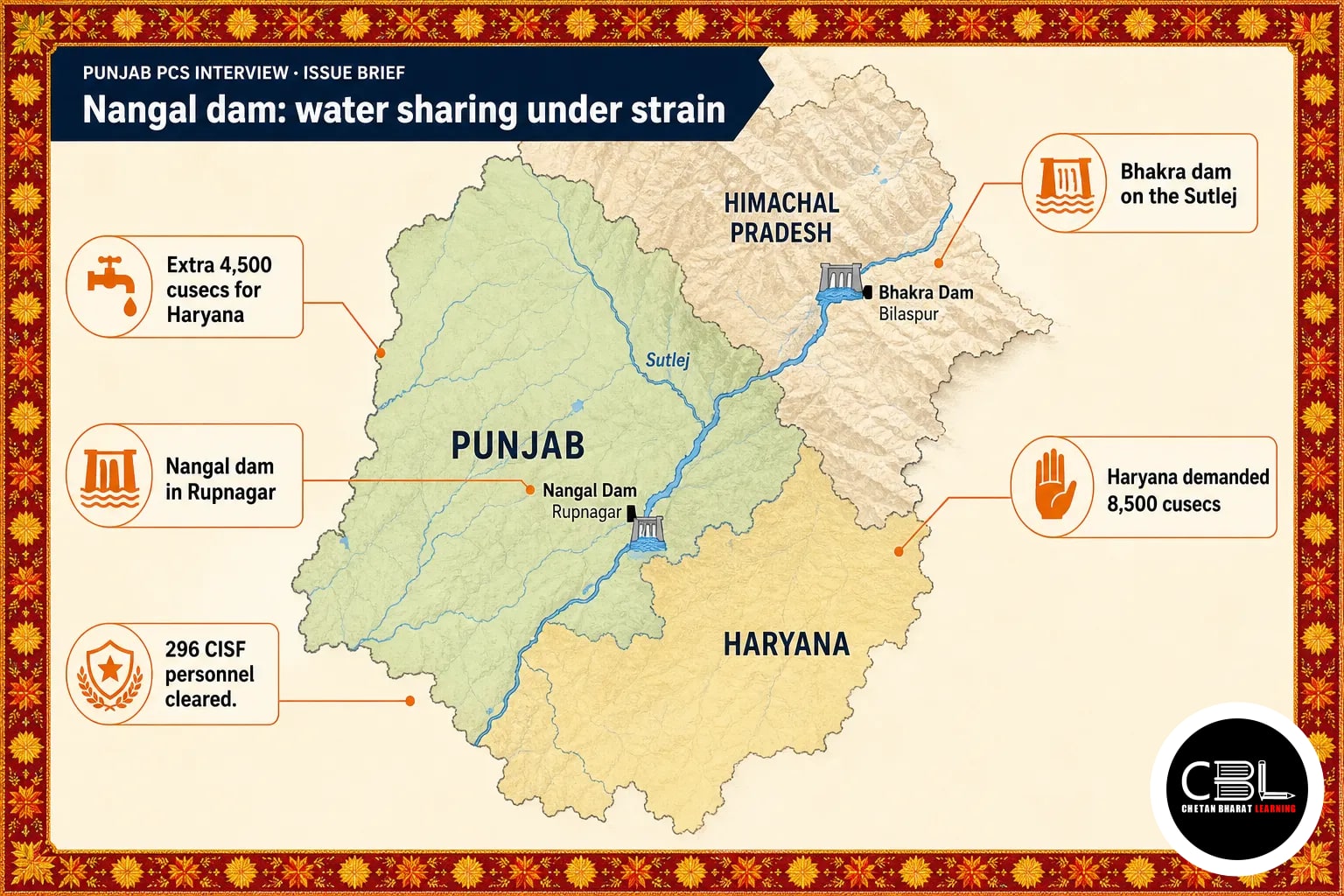
On 30 April 2025, the Bhakra Beas Management Board (BBMB) decided on an extra 4,500 cusecs (cubic feet per second) for Haryana, which cited drinking-water needs. Punjab said Haryana had exhausted its annual share and resisted extra releases at Nangal dam in Rupnagar. The High Court directed police withdrawal from operational duties. The dispute later extended to central security deployment: Punjab’s Assembly opposed it, and the state withdrew consent. Water sharing and infrastructure control remain central issues.
Timeline: from board to stand-off
- 1966ReorganisationBoard born
The Bhakra Management Board was set up under the Punjab Reorganisation Act, 1966.
- 1976Beas projectsRenamed
The board became BBMB when Beas projects were added in 1976.
- 30 Apr2025Extra release
BBMB decided on an additional 4,500 cusecs for Haryana; Punjab opposed the decision.
- 6–7 May2025Court steps in
The High Court directed withdrawal of Punjab police from operational duties at the dam and Lohand control room.
- July2025Security dispute
The Punjab Assembly unanimously opposed central security deployment; Punjab later withdrew its consent.
What is BBMB?
BBMB is a statutory board working under the Union Ministry of Power. It manages the Bhakra and Nangal dams, the Beas-Sutlej Link and Pong dam. Its partner states and territories include Punjab, Haryana, Rajasthan, Himachal Pradesh, Delhi and Chandigarh.
Bhakra dam is on the Sutlej in Bilaspur, Himachal Pradesh. Nangal dam is downstream in Punjab’s Rupnagar district. The board’s management of shared projects connects water releases with inter-state coordination.
The two sides
Punjab’s position
- Haryana had already used its annual water share, according to Punjab.
- Punjab opposed the additional release and refused to open extra gates at Nangal.
- It objected to central security deployment at BBMB projects and later withdrew consent.
Haryana and other supporters
- Haryana sought extra water, citing acute drinking-water needs.
- Haryana, Rajasthan and Delhi voted for the additional release at the BBMB meeting.
- Haryana and Rajasthan supported deployment of the Central Industrial Security Force (CISF).
Key data
| Point | Details |
|---|---|
| Haryana’s demand | 8,500 cusecs in total, including 4,500 above its then allocation. |
| Union advice | The Union Home Secretary advised implementing the extra release for eight days. |
| Security deployment | The Centre cleared 296 CISF personnel at BBMB projects and asked the board to bear the cost. |
| Punjab groundwater | Extraction was assessed at 152.22% of annual recharge in 2025–26. |
| Constitution | State List Entry 17 concerns water; Union List Entry 56 concerns regulation of inter-state rivers. |
| Dispute resolution | Article 262 and the Inter-State River Water Disputes Act, 1956, concern adjudication of inter-state water disputes. |
Way forward
- Shared data: Publish agreed figures on storage, releases and each partner’s use.
- Drinking-water planning: Develop a jointly agreed protocol for urgent needs without overlooking established shares.
- Institutional dialogue: Use BBMB meetings and inter-governmental consultations to address objections early.
- Operational security: Agree on security arrangements that protect infrastructure and respect lawful operational roles.
- Water conservation: Reduce groundwater pressure through efficient irrigation and crop diversification with farmer participation.
Likely interview questions
What is BBMB and what does it manage?
Answer pointers:
- A statutory board under the Union Ministry of Power.
- Manages Bhakra, Nangal and specified Beas projects for partner states and territories.
- Emphasise coordinated operation of shared infrastructure.
Do you think the extra release to Haryana was justified?
Answer pointers:
- Recognise Haryana’s stated drinking-water needs.
- Consider Punjab’s claim that Haryana had used its annual share.
- Recommend a transparent, jointly agreed emergency-release protocol.
Do you think central security deployment at BBMB projects is desirable?
Answer pointers:
- Critical infrastructure requires reliable protection.
- Punjab objected to deployment; Haryana and Rajasthan supported it.
- Seek consultations and clearly defined operational responsibilities.
As Deputy Commissioner of Rupnagar, how would you handle a stand-off at Nangal dam?
Answer pointers:
- Maintain public order and protect people and infrastructure.
- Coordinate with BBMB, police and state authorities; comply with court directions.
- Facilitate dialogue and communicate verified information calmly.
How is this dispute linked to the Sutlej-Yamuna Link canal issue and federalism?
Answer pointers:
- Both involve Punjab–Haryana water-sharing concerns, but concern different questions.
- The Sutlej-Yamuna Link (SYL) issue concerns Haryana’s share of Ravi-Beas water.
- Use constitutional mechanisms and cooperative dialogue rather than treating disputes as identical.
Recognise drinking-water needs alongside concerns about agreed shares and state consent. Avoid assigning motives; distinguish the release decision from the later security dispute.
Prelims Practice Corner
Q1. Under which Act was the Bhakra Management Board set up?
(a) Punjab Reorganisation Act, 1966 (b) Water Act, 1974 (c) Environment Protection Act, 1986 (d) Forest Conservation Act, 1980
Show answer
Answer: (a) because the Punjab Reorganisation Act, 1966 established the board.
Q2. How much additional water did BBMB decide to release for Haryana on 30 April 2025?
(a) 296 cusecs (b) 4,500 cusecs (c) 8,500 cusecs (d) 152 cusecs
Show answer
Answer: (b) because 4,500 cusecs was the additional amount, while 8,500 cusecs was Haryana’s total demand.
Q3. Which constitutional article concerns adjudication of inter-state water disputes?
(a) Article 14 (b) Article 21 (c) Article 262 (d) Article 356
Show answer
Answer: (c) because Article 262 addresses adjudication of inter-state water disputes.
Frequently Asked Questions
Why did Punjab oppose the 2025 BBMB water decision?
Punjab said Haryana had already used its annual share. It opposed the additional release and refused to open extra gates at Nangal dam.
Where are Bhakra and Nangal dams?
Bhakra dam is on the Sutlej in Bilaspur, Himachal Pradesh, while Nangal dam is in Punjab’s Rupnagar district. Nangal is downstream of Bhakra.
What did the High Court direct during the Nangal stand-off?
It directed Punjab to withdraw police personnel from operational duties at Bhakra Nangal dam and the Lohand control room. The directions came on 6–7 May 2025.
Sources: Tribune explainer, Drishti IAS, The Week, Tribune: CISF resolution
Related Current Affairs
More Punjab interview issues
Preparing for UPSC, PCS or HCS?
Talk to a mentor at Chetan Bharat Learning, Chandigarh. Free guidance on choosing the right exam and building a study plan.
Chat on WhatsAppCall 97793 53345UPSC / IAS / PCS coaching in Chandigarh · Trusted by aspirants across Punjab & Haryana


Leave a Reply
You must be logged in to post a comment.