
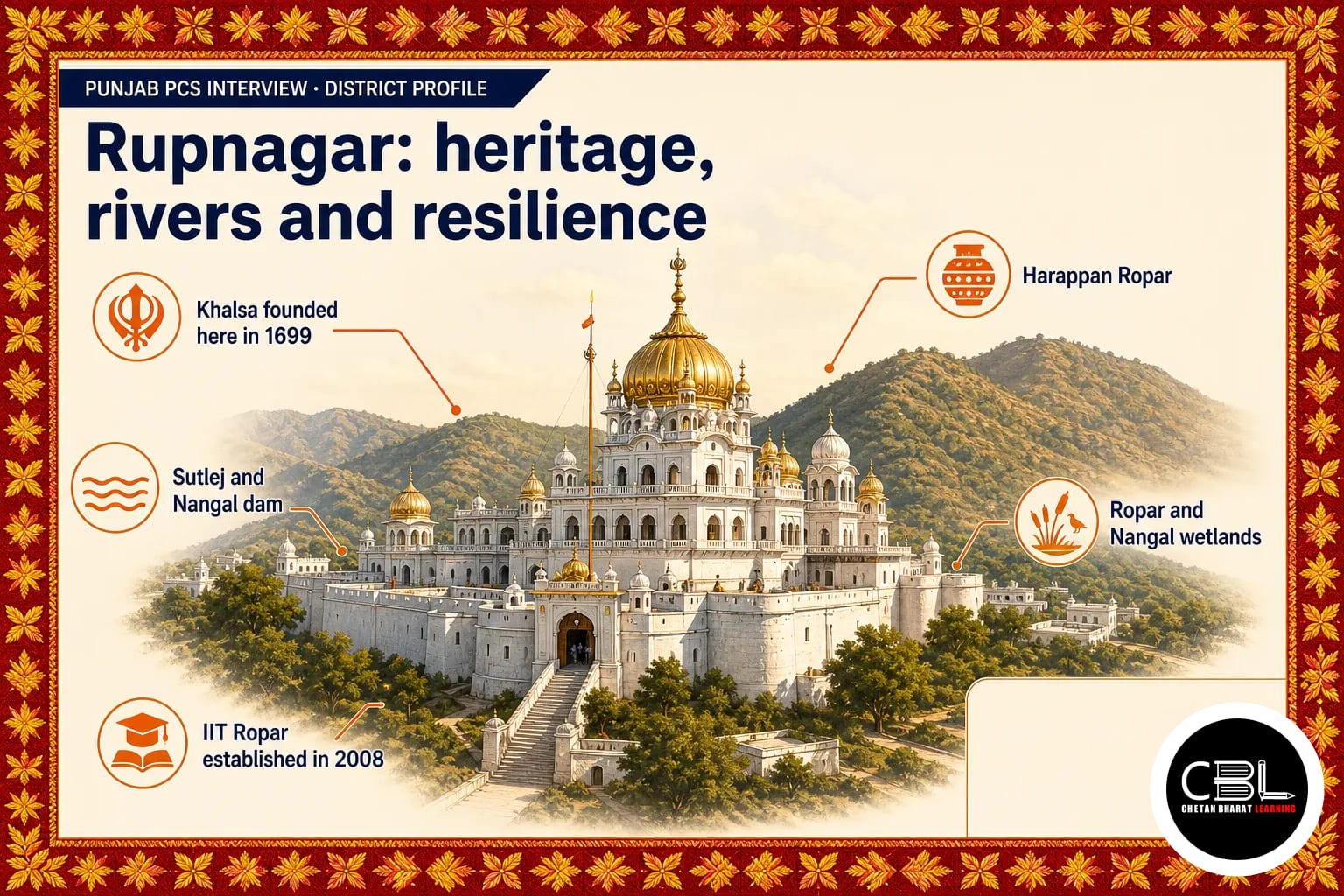
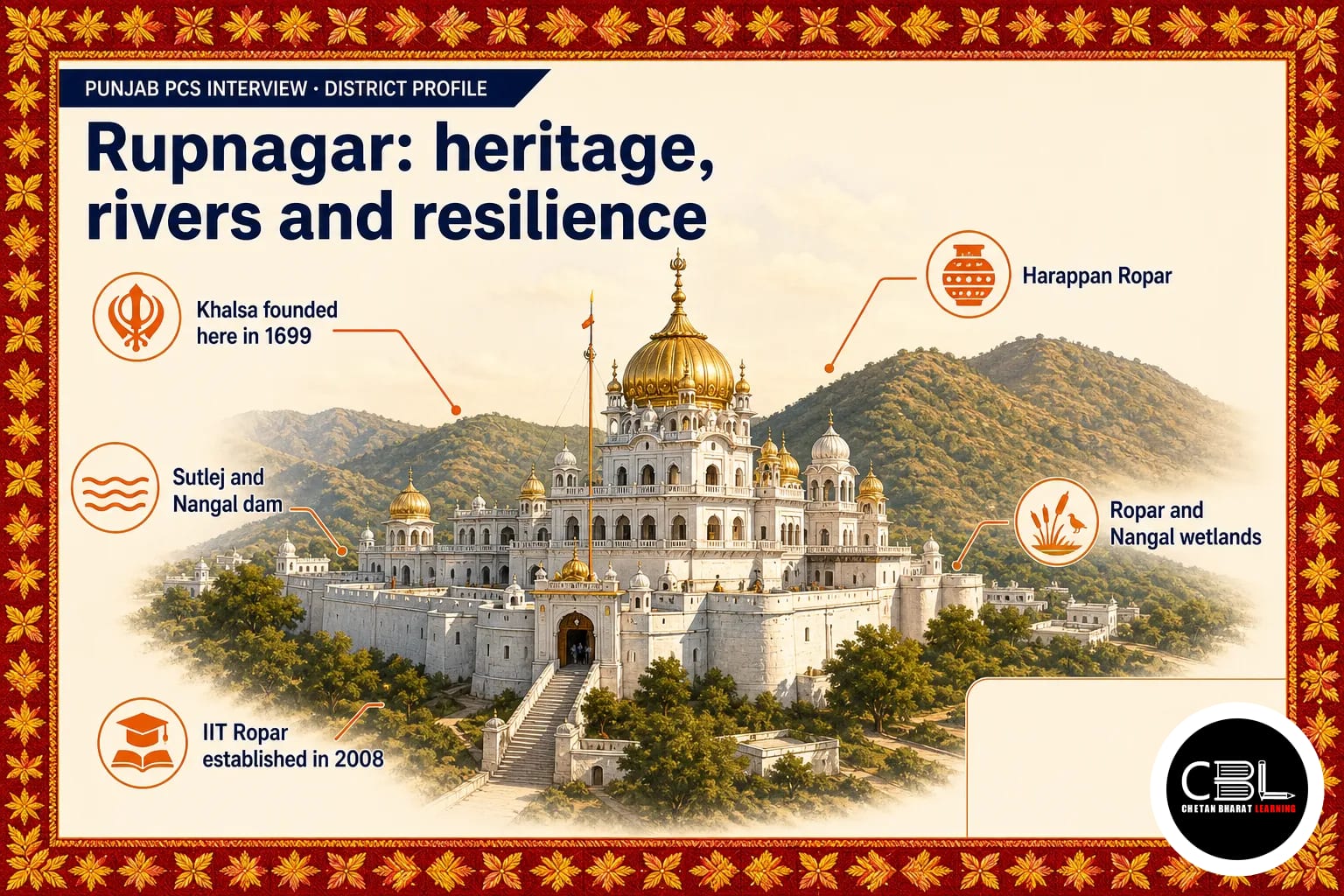
Rupnagar, also called Ropar, lies in Punjab’s Puadh area of Malwa, bordering Himachal Pradesh. The Sutlej emerges from the hills here. The district is known for its Harappan site, Sikh heritage and wetlands. Balancing water demands with ecological protection is a major administrative challenge. In November 2025, a special Punjab Vidhan Sabha session at Sri Anandpur Sahib marked Guru Tegh Bahadur’s martyrdom anniversary.
Timeline: Rupnagar (Ropar) in 6 stops
- 1699Khalsa foundedFounding
Guru Gobind Singh created the Khalsa at Sri Anandpur Sahib on Baisakhi.
- 1704Chamkaur battleMartyrdom
The elder Sahibzadas were martyred during the Battle of Chamkaur.
- 1953Archaeological excavationExcavation
Ropar became the first Harappan site excavated in independent India.
- 2008Higher educationEstablished
Indian Institute of Technology Ropar was established.
- Nov 2025Assembly sessionCommemoration
A special Punjab Vidhan Sabha session marked Guru Tegh Bahadur’s martyrdom anniversary.
- May 2026Holy cityNotified
Sri Anandpur Sahib was notified as a holy city.
Know your district
| Point | Details |
|---|---|
| Headquarters | Rupnagar, also known as Ropar. |
| Region | Malwa, in the Puadh area. |
| Rivers and terrain | The Sutlej leaves the hills near Rupnagar; Ropar headworks are on the river. |
| Borders | Himachal Pradesh. |
| Known for | Harappan archaeology, Sikh heritage, the Sutlej and wetlands. |
| Famous personalities | Guru Gobind Singh and Guru Tegh Bahadur are closely associated with Sri Anandpur Sahib. |
| Economy | Agriculture, services, industry and visitor activity linked to religious heritage. |
| Key institutions | Indian Institute of Technology (IIT) Ropar and the Bhakra Beas Management Board (BBMB). |
Places and people the board may ask about
- Ropar archaeological site: It was the first Harappan site excavated in independent India.
- Sri Anandpur Sahib: Guru Gobind Singh created the Khalsa here on Baisakhi in 1699.
- Takht Sri Kesgarh Sahib: This important Sikh seat of authority is at Sri Anandpur Sahib.
- Chamkaur Sahib: It is associated with the battle and the martyrdom of the elder Sahibzadas.
- Kiratpur Sahib: This historic Sikh town is an important place of pilgrimage.
- Nangal: The dam and township stand on the Sutlej; Bhakra dam is across the border in Himachal Pradesh.
- Ropar and Nangal wetlands: Both are Ramsar sites, designated under the international Ramsar Convention on wetlands.
Strengths and challenges
Strengths
- Harappan and Sikh heritage support learning and responsible tourism.
- The Sutlej, headworks and wetlands are important water and ecological assets.
- IIT Ropar offers opportunities for research and local collaboration.
Challenges
- Balancing competing water demands with wetland and river health.
- Managing visitor pressure while protecting heritage and local amenities.
- Addressing access to services and public concerns during proposed administrative changes.
What happened in 2025-26
- 2025: A Punjab-Haryana water-release dispute centred on Nangal dam and the BBMB. Read the BBMB water dispute brief.
- November 2025: A special Punjab Vidhan Sabha session at Sri Anandpur Sahib marked the 350th martyrdom anniversary of Guru Tegh Bahadur. Read the Anandpur Sahib session brief.
- 2025–mid-2026: A proposal sought to make Anandpur Sahib Punjab’s 24th district using parts of Rupnagar and Hoshiarpur’s Garhshankar area. The Rupnagar bar association went on strike; it remained a proposal as of mid-2026.
- May 2026: Sri Anandpur Sahib was notified as a holy city.
If you were DC of Rupnagar (Ropar)
- Water coordination: As Deputy Commissioner (DC), coordinate with the BBMB and relevant departments on water information and local preparedness.
- Wetland protection: Work with the forest and pollution-control authorities to monitor wetland health and address identified threats.
- Heritage and visitors: Coordinate sanitation, traffic and emergency services around major festivals with local institutions and communities.
- Accessible services: Consult residents and the bar association on service-access concerns arising from any district reorganisation proposal.
- Local partnerships: Engage IIT Ropar and district departments on practical water, waste and public-service solutions.
Likely interview questions
Tell us about your district and what it is famous for.
Answer pointers:
- Locate Rupnagar in the Puadh area of Malwa, along the Sutlej.
- Mention Harappan Ropar and the founding of the Khalsa at Sri Anandpur Sahib.
- Close with its wetlands, institutions and need for sustainable development.
How would you balance water use and wetland protection in Rupnagar?
Answer pointers:
- Recognise water needs for livelihoods and public use.
- Explain the ecological importance of Ropar and Nangal wetlands.
- Support coordinated monitoring and decisions based on reliable information.
As DC, how would you respond to public concerns about a proposed new district?
Answer pointers:
- Explain the proposal accurately without treating it as an accomplished decision.
- Hear residents, legal professionals and affected departments on access to services.
- Send evidence-based feedback to the government and maintain continuity of services.
Why is Sri Anandpur Sahib important in Sikh history?
Answer pointers:
- Guru Gobind Singh created the Khalsa there on Baisakhi in 1699.
- Takht Sri Kesgarh Sahib and Hola Mohalla are associated with the town.
- Connect its heritage with respectful visitor management and conservation.
What does the Nangal water dispute teach us about inter-state cooperation?
Answer pointers:
- Water management involves the interests of multiple states and institutions.
- The BBMB has a role in managing the relevant infrastructure.
- Emphasise dialogue, reliable data and decisions within the applicable legal framework.
Speak with pride about Rupnagar’s heritage without exaggeration. Acknowledge water and service-delivery challenges, and offer one practical, cooperative solution.
Prelims Practice Corner
Q1. Where was the Khalsa created in 1699?
(a) Nangal (b) Sri Anandpur Sahib (c) Ropar headworks (d) Kiratpur Sahib
Show answer
Answer: (b) because Guru Gobind Singh created the Khalsa at Sri Anandpur Sahib.
Q2. Which Harappan site was the first excavated in independent India?
(a) Ropar (b) Harappa (c) Mohenjo-daro (d) Lothal
Show answer
Answer: (a) because Ropar was the first Harappan site excavated after independence.
Q3. Which river flows past Nangal dam?
(a) Ravi (b) Beas (c) Sutlej (d) Chenab
Show answer
Answer: (c) because Nangal dam is on the Sutlej.
Frequently Asked Questions
What is Rupnagar district famous for?
Rupnagar is famous for its Harappan site and Sikh heritage. Sri Anandpur Sahib, where the Khalsa was created, is in the district.
Which region of Punjab is Rupnagar in?
Rupnagar is in the Puadh area of Malwa. It borders Himachal Pradesh.
Are there Ramsar sites in Rupnagar district?
Yes. Ropar wetland and Nangal wetland are Ramsar sites.
Sources: The Tribune, PTC News, The Tribune
Related Current Affairs
More Punjab district profiles
Preparing for UPSC, PCS or HCS?
Talk to a mentor at Chetan Bharat Learning, Chandigarh. Free guidance on choosing the right exam and building a study plan.
Chat on WhatsAppCall 97793 53345UPSC / IAS / PCS coaching in Chandigarh · Trusted by aspirants across Punjab & Haryana


Leave a Reply
You must be logged in to post a comment.