
UPSC Syllabus Mapping
| GS Paper | GS-III |
|---|---|
| Subject | Indian Economy, External Sector and Banking |
What is Liberalised Remittance Scheme?
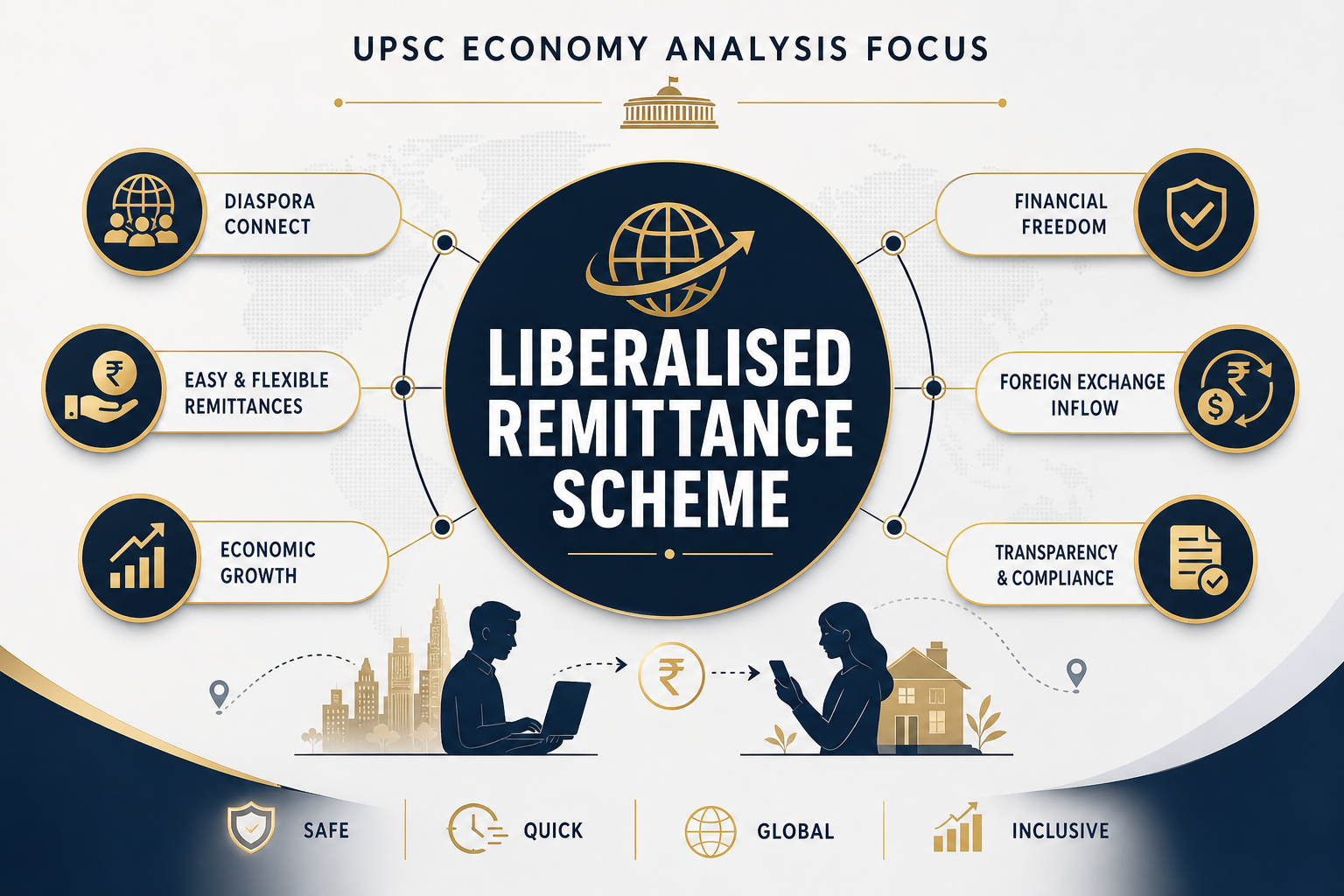
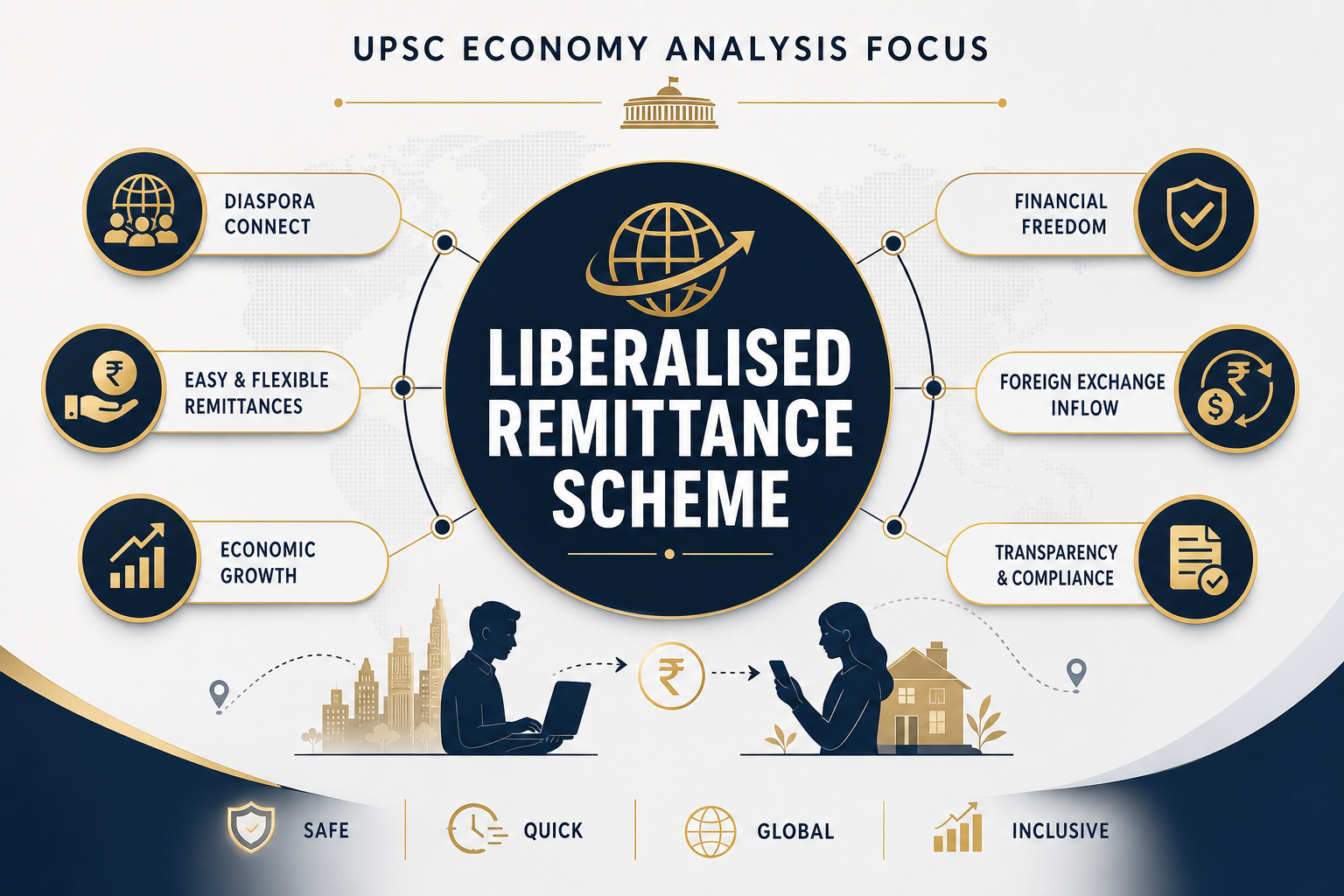
The Liberalised Remittance Scheme (LRS) is a facility introduced by the Reserve Bank of India that permits resident individuals to remit money abroad for permitted current account and capital account transactions without obtaining prior approval from the RBI, subject to the prescribed annual limit.
Permissible purposes include overseas education, travel, medical treatment, gifts, maintenance of relatives, foreign investments, purchase of assets abroad and deposits in overseas accounts. The scheme facilitates legitimate cross-border financial transactions while remaining subject to regulatory safeguards.
Why is Liberalised Remittance Scheme in News?
According to the passage report, outward remittances under the Liberalised Remittance Scheme increased from about US$2.286 billion in April to nearly US$2.396 billion in May. Higher equity and debt investments abroad, increased overseas travel and larger overseas deposit-related remittances contributed to the rise.
The increase indicates stronger financial integration and improved overseas spending by Indian residents. At the same time, the RBI continues to monitor foreign exchange liquidity and exchange rate stability. Official details are available at Reserve Bank of India.
Key Features of Liberalised Remittance Scheme
- Applicable to resident individuals, including minors through guardians.
- Permits remittances for approved current and capital account transactions.
- Covers education, travel, medical treatment, gifts and maintenance of relatives.
- Allows overseas investments in shares, bonds, mutual funds and immovable property, subject to regulations.
- Facilitates global financial integration while ensuring compliance with foreign exchange regulations.
- Administered under the Foreign Exchange Management Act (FEMA).
Challenges Related to Liberalised Remittance Scheme
Rapid growth in outward remittances can increase demand for foreign currency and exert pressure on the rupee during periods of global uncertainty. Persistent capital outflows may also affect domestic liquidity if not balanced by adequate capital inflows and export earnings.
The scheme also requires strong anti-money laundering safeguards, tax compliance and effective monitoring to prevent misuse. For related economy topics, visit the UPSC current affairs library.
Way Forward for Liberalised Remittance Scheme
India should continue strengthening macroeconomic fundamentals, maintain adequate foreign exchange reserves and improve financial literacy regarding overseas investments. Balanced capital flows, transparent regulations and robust compliance mechanisms will help sustain external sector stability.
Further policy information can be accessed through PIB Official Release.
Prelims Practice Corner
- Which institution administers the Liberalised Remittance Scheme?
- The Liberalised Remittance Scheme operates under which legislation?
- Which of the following is a capital account transaction under LRS?
- (a) Purchase of overseas property
- (b) Tourism
- (c) Medical treatment
- (d) Gifts
- Outward remittances primarily affect which component of the Balance of Payments?
- Which GS Paper covers India’s external sector and banking?
Answers
- Reserve Bank of India (RBI)
- Foreign Exchange Management Act (FEMA)
- (a) Purchase of overseas property
- Current and Capital Account transactions
- GS-III
Mains Practice Questions
Q1. Discuss the significance of the Liberalised Remittance Scheme in promoting India’s financial integration with the global economy.
Answer Outline: Objectives, benefits, capital flows, external sector, regulatory safeguards.
Q2. Examine the opportunities and challenges arising from rising outward remittances under the Liberalised Remittance Scheme.
Answer Outline: Investments, forex management, exchange rate, compliance, macroeconomic stability.
FAQs on Liberalised Remittance Scheme
What is the Liberalised Remittance Scheme?
It is an RBI facility that allows resident individuals to remit money abroad for approved purposes within the prescribed limit.
Why has the Liberalised Remittance Scheme become important?
It supports overseas education, travel, investments and global financial integration while facilitating legitimate foreign exchange transactions.
Why is the topic important for UPSC?
It connects foreign exchange management, the balance of payments, RBI regulations and India’s external sector under GS-III Economy.
Related Current Affairs
Preparing for UPSC, PCS or HCS?
Talk to a mentor at Chetan Bharat Learning, Chandigarh. Free guidance on choosing the right exam and building a study plan.
Chat on WhatsAppCall 97793 53345UPSC / IAS / PCS coaching in Chandigarh · Trusted by aspirants across Punjab & Haryana
Leave a Reply
You must be logged in to post a comment.