
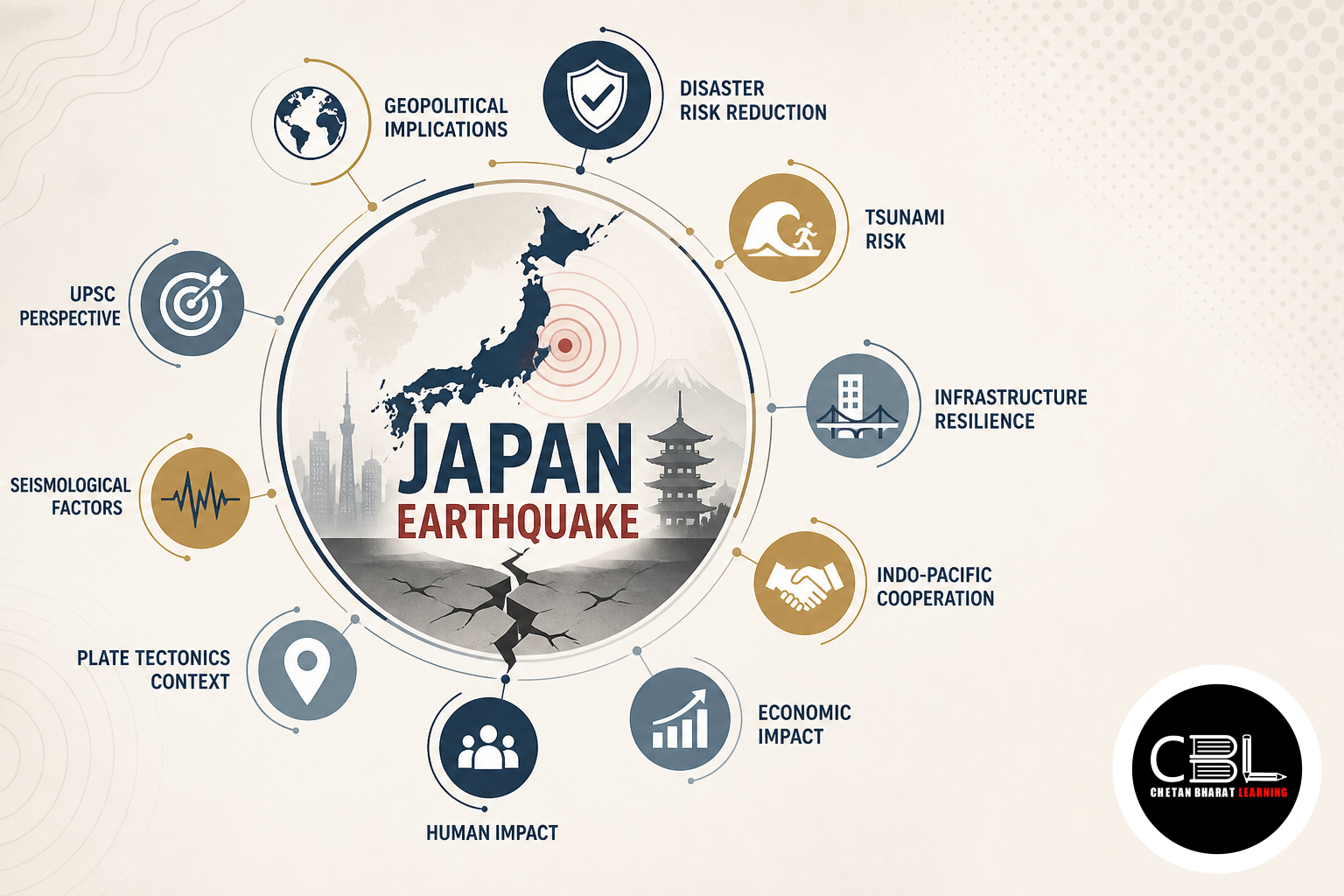

UPSC Mapping
Prelims
- Earthquakes
- Plate Tectonics
- Ring of Fire
Mains
- GS Paper I (Geography) & GS Paper III (Disaster Management)
Quick Facts
| Location | Kumamoto Prefecture, Japan |
|---|---|
| Magnitude | 7.1 |
| Region | Pacific Ring of Fire |
What is Japan earthquake?
The Japan earthquake refers to the recent powerful seismic event that struck southern Japan. Earthquakes occur when accumulated stress along tectonic plate boundaries is released suddenly as seismic waves.
Japan lies where multiple tectonic plates interact, making it one of the world’s most earthquake-prone countries.
Why is Japan earthquake in News?
The reported magnitude 7.1 earthquake damaged infrastructure, disrupted transport and triggered a tsunami advisory before authorities assessed the risk.
Japan activated emergency response systems and continued monitoring aftershocks. Official updates can be followed through Japan Meteorological Agency.
Key Features
The event illustrates important geographical concepts.
- Plate boundary: Japan lies along converging tectonic plates.
- Ring of Fire: Frequent earthquakes and volcanoes characterize this zone.
- Epicentre and focus: UPSC frequently asks these concepts.
- Tsunami risk: Large undersea earthquakes may generate destructive waves.
- Preparedness: Strict building codes reduce casualties.
Challenges
Despite advanced preparedness, significant risks remain.
- Dense population increases exposure.
- Infrastructure damage disrupts transport and communication.
- Aftershocks complicate rescue operations.
- Tsunami threat requires rapid evacuation.
- Economic losses can be substantial.
Way Forward
Countries should continue investing in resilient infrastructure, earthquake-resistant construction and public awareness. Scientific monitoring and early warning systems reduce disaster risk.
India can strengthen preparedness through improved urban planning and community drills. Refer to the National Disaster Management Authority for disaster management guidelines.
Prelims Practice Corner
Q1. Japan mainly lies on which tectonic zone?
(a) Mid-Atlantic Ridge (b) Pacific Ring of Fire (c) Alps (d) Andes
Answer
Answer: (b) It is located on the Pacific Ring of Fire.
Q2. The point directly above the focus is called?
(a) Fault (b) Epicentre (c) Rift (d) Crust
Answer
Answer: (b).
Q3. Seismic waves are generated due to?
(a) Wind (b) Stress release (c) Rain (d) Ocean currents
Answer
Answer: (b).
Q4. Tsunamis are commonly associated with?
(a) Desert storms (b) Undersea earthquakes (c) Tornadoes (d) Avalanches
Answer
Answer: (b).
Q5. Which GS Paper covers Disaster Management?
(a) GS I only (b) GS II (c) GS III (d) GS IV
Answer
Answer: (c).
Mains Practice Questions
Q1. Explain why Japan experiences frequent earthquakes. (10 marks)
Answer Structure:
- Intro: Plate tectonic setting.
- Body: Plate boundaries, Ring of Fire, subduction, preparedness.
- Conclusion: Importance of resilience.
Q2. Discuss lessons for India’s disaster management from Japan. (15 marks)
Answer Structure:
- Intro: Disaster risk context.
- Body: Early warning, infrastructure, awareness, governance.
- Conclusion: Build resilient communities.
FAQs
Why is Japan prone to earthquakes?
Japan lies at the meeting point of several tectonic plates within the Pacific Ring of Fire.
What is the difference between magnitude and intensity?
Magnitude measures energy released, while intensity measures observed effects at a location.
Why are earthquakes important for UPSC?
They are relevant for Geography, Environment and Disaster Management in both Prelims and Mains.
Related Current Affairs
Preparing for UPSC, PCS or HCS?
Talk to a mentor at Chetan Bharat Learning, Chandigarh. Free guidance on choosing the right exam and building a study plan.
Chat on WhatsAppCall 97793 53345UPSC / IAS / PCS coaching in Chandigarh · Trusted by aspirants across Punjab & Haryana
Leave a Reply
You must be logged in to post a comment.