
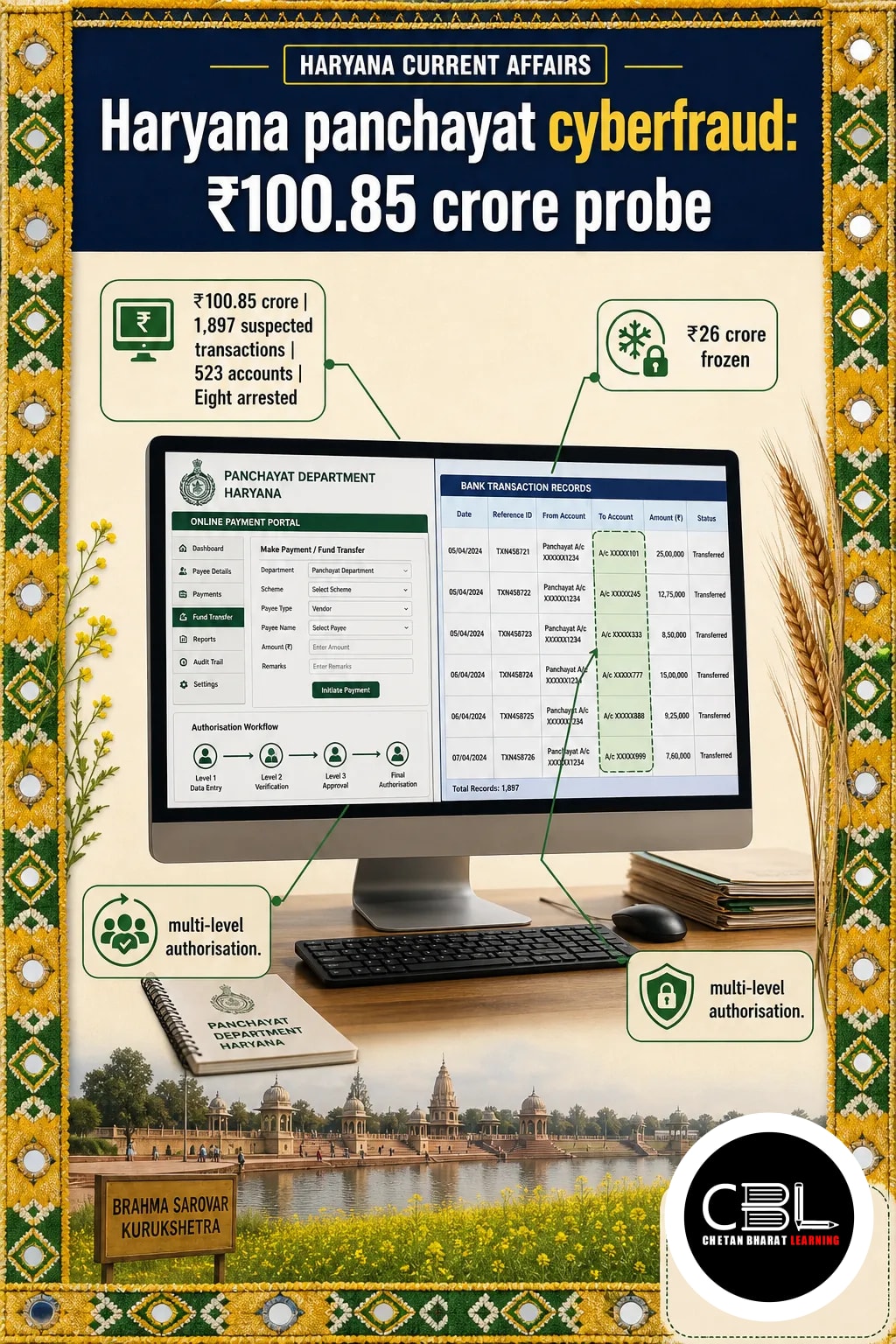

The Haryana panchayat cyberfraud probe concerns suspected transfers of ₹100.85 crore from government funds. Police are examining bank accounts, payment controls and possible security lapses. Follow Haryana current affairs for related exam updates.
Quick answer: In the Haryana panchayat cyberfraud case, police found 1,897 suspected transactions involving ₹100.85 crore between 9 and 14 November. The funds belonged to Haryana’s Development and Panchayats Department. Investigators traced the transactions through 523 accounts; eight people had been arrested, according to the report.
Key facts about the Haryana panchayat cyberfraud
The investigation covers six days of suspected transactions involving panchayat department funds.
| Point | Details |
|---|---|
| Suspected transfers | ₹100.85 crore |
| Transactions and accounts | 1,897 transactions through 523 accounts |
| Transaction dates | 9–14 November |
| Department’s bank | Punjab National Bank |
| Police action | Eight arrested; ₹26 crore frozen |
How did the suspected fraud work?
Police say the money was allegedly sent to private entities and then routed through suspected mule accounts. A mule account is used to move money on behalf of others, making the trail harder to follow.
Investigators say some account holders allegedly sold or rented their accounts for ₹10,000–15,000. They also handed over subscriber identity module (SIM) cards and automated teller machine (ATM) cards, according to an officer.
Police suspect the department’s central account at the state headquarters may have been targeted. However, they have not established that individual gram panchayat accounts were compromised.
Which payment controls are under scrutiny?
Investigators are examining whether required payment authorisation safeguards were bypassed. These include digital signature certificates and multi-level authorisation.
Police said one-time passwords (OTPs) were not sent to sarpanches when money was deducted. As a result, account holders lacked those transaction alerts, according to an officer.
Meanwhile, the inquiry covers Punjab National Bank (PNB), the department’s payment portal and the software connecting them. Investigators are also examining possible internal assistance, compromised credentials or negligence. The source has not established where the breach began.
What action have police and banks taken?
Police have frozen ₹26 crore and arrested eight people, according to the report. Ten police teams are conducting raids, while nearly 70 personnel are working on the case.
Separately, some banks returned around ₹40 crore to PNB after detecting suspected irregularities in beneficiary accounts. These figures should not be treated as a final recovery total.
Investigators are also examining a possible international cybercrime link. However, the involvement of the group named in the report remains unconfirmed. For earlier coverage, see the Haryana panchayat cyber fraud report.
- State formation: Haryana was formed on 1 November 1966.
- Constitution: Part IX of the Constitution deals with panchayats.
- Headquarters: Panchkula is the headquarters of Panchkula district.
Source: Indian Express Chandigarh, 28 November 2026
Prelims Practice Corner
Frequently Asked Questions
How much was involved in the Haryana panchayat cyberfraud?
Police identified suspected transactions involving ₹100.85 crore. The transactions took place across six days.
How many people were arrested in the panchayat cyberfraud case?
Eight people had been arrested, according to the report. Police were also conducting raids in different parts of the country.
What is a mule account in a cyberfraud case?
A mule account is used to move money on behalf of others. In this case, police say suspected mule accounts helped conceal the money trail.
Related Current Affairs
Preparing for UPSC, PCS or HCS?
Talk to a mentor at Chetan Bharat Learning, Chandigarh. Free guidance on choosing the right exam and building a study plan.
Chat on WhatsAppCall 97793 53345UPSC / IAS / PCS coaching in Chandigarh · Trusted by aspirants across Punjab & Haryana



Leave a Reply
You must be logged in to post a comment.